Table of Contents
- Aircraft Maintenance Shop vs Factory Service: Key Differences
- Independent MRO vs OEM Aircraft Maintenance: Operational Differences
- Aircraft Maintenance Cost Comparison: What You'll Actually Pay
- FAA Part 145 Repair Station Benefits and Independent Shop Compliance
- OEM Aircraft Parts vs PMA Parts: Quality, Warranty, and Liability
- How to Evaluate a Maintenance Shop vs Factory Service for Your Aircraft
- When to Choose Independent Shop vs Factory Service: Decision Framework
- Conclusion: Making the Right Choice for Your Aircraft
Aircraft Maintenance Shop vs Factory Service: 2026 Guide
Last Updated: July 18, 2026
When your aircraft needs maintenance, the decision between an independent maintenance shop and factory service carries real consequences for downtime, costs, warranty coverage, and regulatory compliance. Understanding the trade-offs between convenience and specialization, cost and warranty protection, and local responsiveness versus OEM expertise is essential. This guide breaks down the regulatory framework, operational differences, cost structures, and decision criteria that separate these two paths.
What Defines Each Option
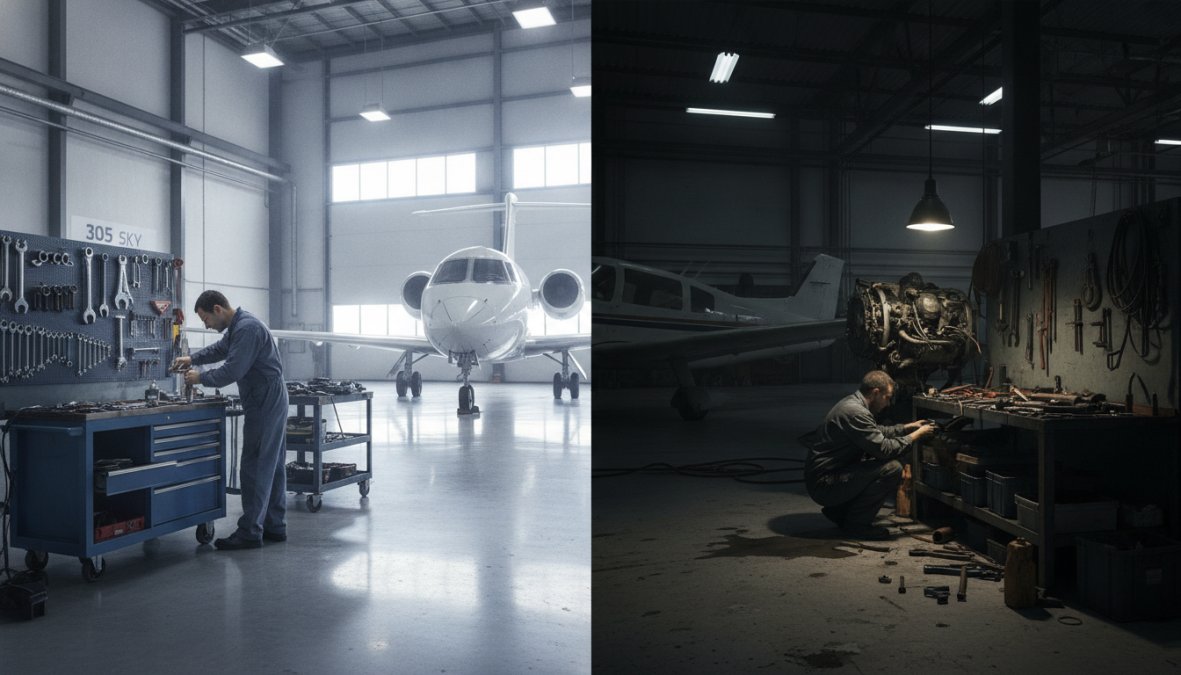
An independent maintenance shop is typically a FAA Part 145 certified repair station operated by private companies or partnerships. These facilities employ A&P mechanics and may specialize in certain aircraft types or maintenance disciplines. They source parts independently, manage their own work schedules, and bill on time-and-materials or flat-rate models.
Factory service operates directly under the aircraft manufacturer's authority. Boeing, Airbus, Bombardier, and other OEMs run their own service centers or authorize exclusive dealer networks to perform factory-level maintenance. These facilities have direct access to original equipment manufacturer (OEM) technical data, service bulletins, and engineering support. They use only OEM parts unless explicitly approved alternatives exist.
The practical difference emerges in how each handles a routine annual inspection. An independent shop schedules your aircraft based on available hangar slots and performs work using approved parts from their vendor network. A factory service center coordinates scheduling through the OEM network, accesses real-time engineering updates, and uses genuine manufacturer parts with full OEM traceability.
Regulatory Framework and Certifications
The FAA governs both pathways through Part 145 (repair stations) and Part 121/135 (air carriers).
An independent maintenance shop operating as a FAA Part 145 repair station must maintain specific certifications tied to aircraft type and maintenance discipline. Part 145 certification requires documented procedures, qualified personnel, quality control systems, and regular FAA audits. The certificate holder must employ at least one A&P mechanic with airframe and powerplant ratings and maintain a quality assurance program.
Factory service centers operate under different regulatory umbrellas. Boeing and Airbus service centers hold FAA approvals that supersede traditional Part 145 requirements because the manufacturer's engineering data becomes the source of authority. They're approved to perform work beyond what independent shops can legally undertake, including modifications and engineering changes that require OEM engineering justification.
This regulatory distinction matters practically: if your aircraft needs a structural repair that exceeds standard maintenance scope, an independent shop must either refer you to factory service or obtain special FAA authorization. Factory service performs this work routinely as part of normal operations.
Independent MRO vs OEM Aircraft Maintenance: Operational Differences
An independent MRO operates on commercial scheduling principles, managing multiple aircraft types and optimizing technician use. This creates flexibility: if your aircraft needs urgent AOG (aircraft on ground) support, an independent shop with mobile maintenance capability can respond faster than coordinating with a distant factory service center. However, they work within the limits of their technical library sourced from publicly available documentation.
OEM aircraft maintenance centers operate as extensions of the manufacturer's engineering infrastructure. They receive real-time updates on service bulletins before public release and access engineering change proposals and fleet-wide performance data. When complex issues arise, factory service can consult with manufacturer engineers in real time.
Line Maintenance vs Hangar Maintenance Capabilities
Line maintenance covers pre-flight checks, fluid servicing, tire/brake maintenance, and minor repairs performed at the aircraft's base while remaining available for operations. Most independent shops excel at line maintenance because it requires minimal infrastructure and rapid turnaround.
Hangar maintenance requires extended groundings for C-checks, D-checks, major inspections, and component overhauls. Factory service centers maintain dedicated hangar space designed to OEM specifications with specialized equipment for heavy structural work and engine removal/installation. Independent shops range from well-equipped facilities to smaller operations focused on routine work.
Technical Data Access and Service Bulletins
Service bulletins represent the critical difference in technical capability. These are manufacturer-issued instructions for modifications, inspections, or corrective actions beyond routine maintenance.
An independent shop receives service bulletins through official FAA channels on the same schedule as the general aviation community. Factory service receives bulletins in draft form, participates in their development, and often implements them before public release. For emerging issues, factory service addresses them proactively while independent shops wait for official publication.
Aircraft Maintenance Cost Comparison: What You'll Actually Pay
Time and Materials Billing Models
Independent shops typically bill on time and materials or flat-rate packages. Time and materials charges labor at an hourly rate (typically $85-$150 per A&P hour) plus parts at cost-plus markup. Flat-rate packages bundle labor and parts into a fixed price for defined maintenance events.
Factory service uses a service package model aligned to manufacturer-defined maintenance intervals. You know the cost upfront, but you pay premium pricing for the OEM's engineering and parts traceability.
A routine annual inspection might cost $3,500-$5,000 at an independent shop versus $6,000-$8,500 at factory service. Over a decade of aircraft ownership, this compounds significantly. However, if that inspection at an independent shop misses a developing issue later requiring emergency repair, the cost calculus shifts.
Hidden Costs and Transparency
Independent shops vary widely in transparency. The best shops provide detailed work orders and itemized parts lists before starting work. Factory service pricing is transparent because it's standardized, but factory service often identifies additional work during inspections that wasn't in the original scope.
Both channels may charge for travel time, equipment rentals, or expedited parts sourcing. Ask explicitly about these potential add-ons when comparing quotes.
FAA Part 145 Repair Station Benefits and Independent Shop Compliance
A FAA Part 145 repair station certificate means the facility has undergone FAA inspection and demonstrated compliance with federal maintenance standards. The shop must maintain a quality assurance program with documented procedures, personnel with appropriate certifications, technical manuals for each aircraft type, and maintenance records retention for seven years.
An A&P mechanic holds an Airframe and Powerplant rating from the FAA, demonstrating knowledge of aircraft systems, maintenance procedures, and regulatory compliance. Critical work (inspections, major repairs) requires A&P sign-off.
Quality control at independent shops varies. The best shops employ inspection authorization (IA) mechanics who independently verify work performed by other technicians. Factory service integrates quality control into their organizational structure with multiple checkpoints at each stage.
OEM Aircraft Parts vs PMA Parts: Quality, Warranty, and Liability
OEM parts are manufactured by the aircraft or component manufacturer to original specifications and come with full traceability, engineering certification, and manufacturer warranty. Factory service uses exclusively OEM parts.
PMA parts (Parts Manufacturer Approval) are produced by FAA-approved third-party manufacturers to equivalent specifications and typically cost 20-40% less than OEM equivalents. If a PMA part fails, you're responsible for proving the part was defective, a more complex process.
Warranty Coverage Differences
Factory service warranty typically covers parts and labor for 12 months or until the next scheduled maintenance event. Independent shops offering warranty coverage often limit it to 30-90 days. For critical components (engines, transmissions, avionics), longer warranty periods justify premium pricing.
How to Evaluate a Maintenance Shop vs Factory Service for Your Aircraft
Evaluating Certifications and Track Record
Verify the shop's FAA Part 145 certificate through the FAA's online database and confirm it covers your specific aircraft type. Request documentation of personnel qualifications and ask for references from aircraft owners with similar aircraft.
Review their maintenance records by requesting a sample work order. Well-documented work orders show professionalism and create accountability.
Assessing AOG Response Capability and Turnaround Times
Ask each shop: What's their AOG response protocol? Do they maintain mobile maintenance capability? What's their average response time for emergency calls?
Turnaround time for routine work also matters. Independent shops often deliver faster turnaround (5-7 days) than factory service (10-14 days) due to lighter scheduling constraints.
Checking References and Regulatory Compliance
Verify regulatory compliance through the FAA by checking whether the shop has had any enforcement actions, citations, or certificate suspensions. Ask the shop about their FAA audit history and findings.
When to Choose Independent Shop vs Factory Service: Decision Framework
Choose an independent shop when:
Your aircraft needs routine line maintenance, annual inspections, or preventive maintenance that doesn't require OEM engineering involvement. Independent shops excel at these tasks, deliver faster turnaround, and cost less. You operate a smaller aircraft (Cessna, Piper, Cirrus) where factory service may not exist or requires travel to distant dealers. Your aircraft is out of warranty.
Choose factory service when:
Your aircraft is under warranty and you want to preserve warranty coverage. You need complex hangar maintenance, major overhauls, or structural repairs requiring OEM engineering authority. Your aircraft is relatively new or you plan to keep it for resale. You need comprehensive support across multiple maintenance disciplines.
| Maintenance Need | Independent Shop | Factory Service | Better Choice |
|---|---|---|---|
| Annual inspection | $3,500-$5,000 | $6,000-$8,500 | Independent |
| AOG emergency response | 1-2 hours | 4-6 hours | Independent |
| Engine overhaul | $15,000-$25,000 | $20,000-$30,000 | Independent |
| Warranty preservation | May void | Maintains | Factory |
| Structural repair | Limited capability | Full capability | Factory |
| Turnaround time | 5-7 days | 10-14 days | Independent |
Best Use Cases for Each Option
Independent shop best for:
- Frequent line maintenance and inspections
- General aviation aircraft (Cessna 172, Piper Cherokee, Cirrus SR22)
- Out-of-warranty aircraft
- Cost-conscious owners prioritizing budget
- AOG emergency response needs
Factory service best for:
- Warranty preservation during coverage period
- Complex powerplant and structural work
- Business jets and turboprops requiring integrated support
- Aircraft requiring engineering modifications
- Pre-purchase inspections on high-value aircraft
FBO vs Independent Shop: Additional Considerations
An FBO (Fixed Base Operator) is a service provider at an airport offering fuel, parking, and often maintenance services. FBOs vary widely in maintenance capability; some operate as independent Part 145 shops, others coordinate with external repair stations.
When evaluating an FBO, distinguish between work they perform directly (staffed with A&P mechanics) and work they coordinate through partners. Direct FBO work offers accountability; coordinated work adds layers of communication and potential delays.
Choosing between aircraft maintenance shop vs factory service ultimately reflects your priorities: cost and speed versus warranty and engineering support. Most aircraft owners benefit from a hybrid approach, using independent shops for routine maintenance and line support, and factory service for warranty-critical work and complex repairs.
Frequently Asked Questions
What are the main differences between an independent aircraft maintenance shop and factory service?
Independent maintenance shops are typically FAA Part 145-certified repair stations staffed with A&P mechanics who handle routine maintenance, repairs, and component overhauls. Factory service centers (OEM facilities) offer manufacturer-specific expertise, direct access to service bulletins and airworthiness directives, and often provide warranty support. Independent shops often excel at line maintenance and quick turnarounds, while factory centers handle complex engine maintenance and provide OEM-backed quality assurance. Both must maintain regulatory compliance and aircraft logbook documentation.
How do costs differ between independent MRO and OEM aircraft maintenance?
Independent MRO pricing typically uses time and materials billing models with competitive labor rates. Factory service centers often charge premium rates justified by OEM expertise and warranty backing. Independent shops may offer cost savings on routine maintenance and preventive maintenance tasks, while factory centers justify higher costs through access to proprietary technical data, OEM parts, and manufacturer-backed quality control. Actual costs depend on your aircraft type, maintenance needs, and facility location.
What certifications should I verify when evaluating a maintenance shop?
Verify that the shop holds an FAA-issued repair station certificate and that all mechanics carry current Airframe and Powerplant (A&P) certifications. Check their maintenance facility rating, review their aircraft maintenance manual compliance, and confirm they maintain current airworthiness directive tracking systems. Ask for references from similar aircraft owners and verify their maintenance tracking software meets regulatory requirements. Request documentation of their quality control procedures and inspection protocols for return to service.
Do independent shops have access to the same OEM parts and technical data as factory service centers?
Independent shops can access OEM parts through authorized distributors, but factory centers have direct OEM supply chains and priority allocation. For technical data, independent shops rely on publicly available service bulletins and aircraft maintenance manuals, while factory centers have proprietary engineering data and direct manufacturer support. Many independent shops use PMA (Parts Manufacturer Approved) alternatives that meet FAA standards. However, some complex repairs or engine maintenance may require factory-level technical resources and OEM component overhaul capabilities.
What warranty and liability differences exist between independent shops and factory service?
Factory service centers typically provide OEM-backed warranty coverage on parts and labor, protecting you if issues arise post-repair. Independent shops offer their own workmanship warranties but lack manufacturer backing. Liability and insurance coverage differ significantly, factory centers carry OEM liability insurance, while independent shops maintain their own professional liability coverage. Always verify insurance limits and ask about warranty duration. Document all maintenance in your aircraft logbooks to maintain warranty validity and ensure proper return to service compliance.
This article was written using GrandRanker