Table of Contents
- What 24/7 Aircraft Management Services Actually Do
- Cost Savings and Financial Visibility
- Safety, Compliance, and Regulatory Oversight
- FAA Part 91 vs Part 135 Operations: Choosing Your Management Model
- Aircraft Charter Revenue Generation and Cost Offset
- Understanding Private Jet Management Cost Structure
- Maintenance, Crew, and Operational Efficiency
- Conclusion
Last Updated: August 14, 2026
What 24/7 Aircraft Management Services Actually Do
24/7 aircraft management services handle the operational complexity of private jet ownership so you don't have to. At 305 Sky, we understand that owning an aircraft demands constant attention, regulatory oversight, and expert maintenance. These services function as your dedicated flight department, managing everything from crew coordination and maintenance scheduling to regulatory compliance and financial reporting.
The core responsibility is operational oversight. When your aircraft needs attention at 2 AM on a Sunday, a 24/7 management operation responds with technicians on call, immediate decision-making authority, and knowledge of your aircraft's specific needs. Professional aircraft management means a dedicated team treating your aircraft like it's their responsibility, because it is. They're accountable for safety, compliance, and operational readiness in ways that casual oversight cannot deliver.

Beyond emergency response, aircraft management services provide infrastructure most owners lack: digital records of every maintenance action, regulatory requirement tracking before violations occur, vendor coordination, and crew logistics management. They handle the financial side, budgeting, expense tracking, and cost optimization through vendor relationships. For owners operating under FAA Part 91 regulations, this coordination prevents the chaos of juggling multiple vendors, tracking compliance deadlines, and managing crew scheduling manually.
Cost Savings and Financial Visibility
Aircraft ownership generates costs in layers: fuel, maintenance, crew salaries, insurance, hangar fees, and regulatory compliance inspections. Most owners spend significantly more than projected because they miss volume discounts, skip preventative maintenance that avoids expensive emergency repairs, or pay premium rates for vendors unaware they're part of a larger operation.
Aircraft management services use fleet-scale purchasing power. When a management company oversees dozens of aircraft, they negotiate fuel pricing, maintenance contracts, and insurance rates that individual owners cannot access. A single-aircraft owner might pay standard retail rates; that same aircraft under professional management benefits from pricing reflecting aggregate volume.
Financial visibility separates professional management from DIY ownership. Professional services provide real-time reporting on costs, fuel consumption, maintenance history, and budget performance. You see exactly where money goes and can make informed decisions about use, upgrade timing, and operational adjustments.
Safety, Compliance, and Regulatory Oversight
Aviation regulation is unforgiving. The FAA doesn't accept excuses for missed inspection deadlines, improperly maintained records, or crew currency lapses. Professional aircraft management services exist because regulatory compliance is too complex and consequential for casual management.
The regulatory landscape includes mandatory inspections at specific flight-hour intervals, annual airworthiness certifications, equipment inspections, crew training requirements, and documentation standards. Missing a single deadline grounds your aircraft until resolved. Professional management tracks these deadlines automatically, schedules inspections before deadlines arrive, and maintains documentation satisfying regulatory audits.
Professional aircraft management services implement Safety Management Systems (SMS). An SMS goes beyond regulatory requirements, it's a structured approach to identifying hazards, managing risks, and continuously improving operational safety. An SMS documents maintenance procedures, crew training standards, weather decision protocols, and incident reporting. When something goes wrong, SMS documentation proves you operated with reasonable care and systematic oversight.
Crew component matters significantly. Pilots must maintain currency and recent flight experience. Professional management tracks pilot currency, schedules required training, and maintains records satisfying insurance underwriters and regulatory auditors. Insurance underwriters understand these dynamics: aircraft insured under professional management typically receive better rates because systematic operation manages risk.
FAA Part 91 vs Part 135 Operations: Choosing Your Management Model
Understanding the difference between Part 91 and Part 135 operations determines your management structure, regulatory obligations, and revenue options.
Part 91 is private ownership and operation. You own the aircraft and fly it for your own purposes without charging passengers. You're responsible for compliance, but the regulatory burden is lighter than commercial operation. Most private aircraft owners operate under Part 91.
Part 135 is commercial charter operation. The aircraft is operated by a certificated air carrier, and flights are available to the public for compensation. Part 135 involves significantly more regulation: the operator must maintain an air carrier certificate, implement formal Safety Management Systems, maintain detailed operational records, and comply with stricter crew requirements. Part 135 operations are more expensive to maintain but enable revenue generation.
The management decision hinges on intent. If you want private use with occasional charter flights, you operate under Part 91. If you want to actively generate revenue through charter, you transition to Part 135, which requires more formal management but unlocks charter revenue potential.
305 Sky manages both models. For Part 91 operators, we handle compliance tracking, maintenance coordination, crew management, and regulatory reporting. For owners interested in Part 135 revenue generation, we manage the transition and oversee the complex operational requirements commercial operation demands.
The financial calculation differs between models. Part 91 operation costs less to manage but generates no revenue. Part 135 operation costs more to manage but can generate significant revenue if actively chartered. For many owners, charter revenue under Part 135 management reduces net ownership costs substantially.
Aircraft Charter Revenue Generation and Cost Offset
Charter revenue is the mechanism by which aircraft owners reduce net ownership costs. Instead of bearing 100% of operating expenses, the aircraft generates income when not used privately.
Your aircraft is available for charter when you're not using it. The management company markets the aircraft, handles charter requests, manages logistics, and pays you a portion of charter revenue. Typical arrangements give the owner 50-70% of charter revenue after the operator's direct costs.
Financial impact depends on use. An aircraft flying 300 private hours annually with idle time has significant charter potential. For moderate-use aircraft, charter revenue can offset 20-40% of annual operating costs. For heavily-chartered aircraft, the offset can exceed 50%.
Charter revenue requires Part 135 certification, meaning stricter maintenance standards and more formal operation structure. This adds management cost, but revenue typically exceeds the additional expense. An aircraft generating charter revenue works toward its own maintenance and operating costs rather than being a pure expense, improving aircraft economics and making ownership more sustainable long-term.
Understanding Private Jet Management Cost Structure
Management costs vary based on aircraft size, use, complexity, and service scope. Most aircraft management services charge a monthly management fee plus pass-through expenses. The management fee covers operational overhead, staff, systems, coordination, and compliance tracking. Pass-through expenses are direct costs: fuel, maintenance, crew salaries, hangar fees, and insurance.
Management fees typically range based on aircraft type and use. A smaller aircraft with moderate use might have a lower monthly fee than a large-cabin jet with high use. The fee structure should be transparent, you know the monthly cost before committing.
Pass-through expenses are where most owners encounter surprise costs. A major inspection might cost $15,000. An avionics upgrade might cost $50,000. A new engine overhaul is a six-figure expense. Professional management companies provide cost visibility, showing budgeted maintenance, upcoming inspections, and anticipated expenses so you can plan accordingly.
Clarify upfront what's covered by the management fee versus what's billed separately. Some services include routine maintenance coordination in the fee; others bill it separately. 305 Sky provides transparent pricing and detailed cost breakdowns so you understand exactly what you're paying for and why.
Maintenance, Crew, and Operational Efficiency
Maintenance and crew management are where professional aircraft management services deliver the most tangible value. These complex operational areas benefit significantly from expertise and scale.
Maintenance management involves tracking inspection schedules, coordinating with maintenance facilities, managing parts inventory, and ensuring compliance with manufacturer requirements and regulatory mandates. Professional management companies maintain relationships with certified repair stations, negotiate maintenance pricing, and schedule work strategically to minimize downtime. They implement preventative maintenance, addressing issues before they become emergency repairs.
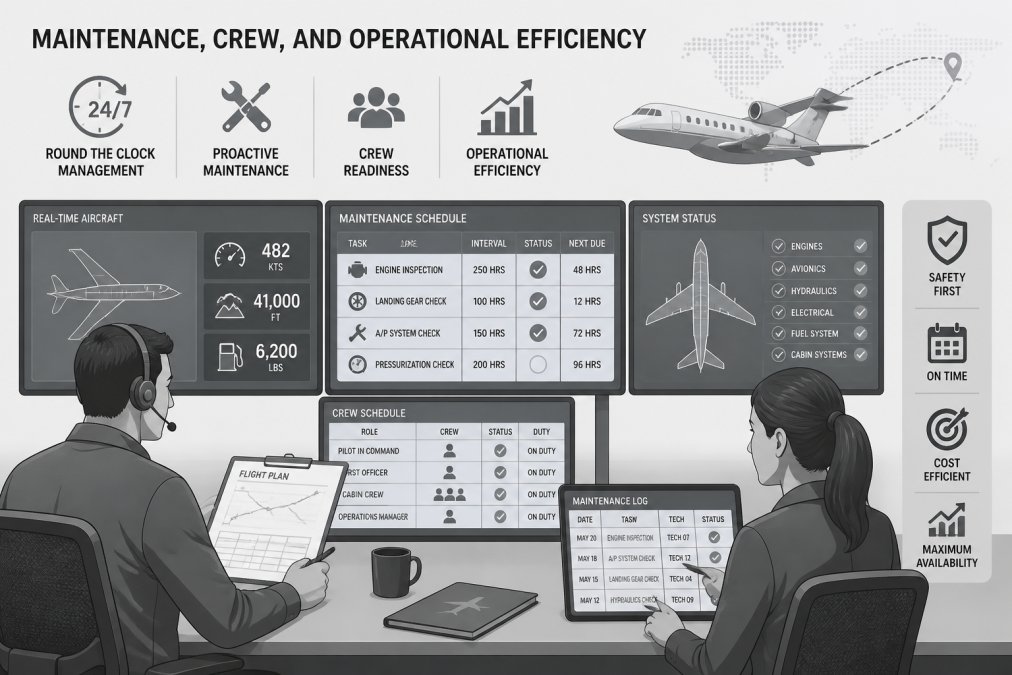
Crew management covers recruitment, training, scheduling, payroll, and currency tracking. Professional management handles this systematically, maintaining crew schedules complying with FAA duty-time regulations, managing training records, and ensuring crew availability for your flights.
Operational efficiency emerges from dedicated professionals managing these functions. A crew scheduling system optimizing pilot availability, minimizing crew travel, and maintaining regulatory compliance is complex, but professional operations do it routinely. Professional management identifies patterns, an aircraft consistently needing a specific repair is flagged for deeper investigation. Maintenance is scheduled strategically: major work happens during low-use periods, routine inspections are coordinated, and parts are sourced to minimize cost while maintaining availability.
Conclusion
24/7 aircraft management services transform aircraft ownership from a constant operational burden into a managed asset. The financial visibility, regulatory compliance, safety oversight, and operational coordination that professional management provides are difficult to replicate independently. For aircraft owners in Fort Lauderdale and across South Florida, professional management is the difference between sustainable ownership and escalating complexity.
305 Sky delivers this coordination with transparent pricing, expert crew management, comprehensive maintenance oversight, and rapid AOG emergency response. Our team of experienced aviation professionals handles every operational detail, from routine inspections to bespoke avionics upgrades, ensuring your aircraft remains airworthy, compliant, and performing at peak capability. Get a quote from 305 Sky today and discover how professional aircraft management services can simplify your ownership experience while protecting your asset.
| Management Aspect | DIY Ownership | Professional Management |
|---|---|---|
| Regulatory Compliance Tracking | Owner responsibility; easy to miss deadlines | Automated tracking; proactive scheduling |
| Maintenance Coordination | Multiple vendor relationships; fragmented records | Centralized coordination; preventative approach |
| Crew Management | Owner handles scheduling and training | Professional crew management; currency tracking |
| Financial Visibility | Fragmented records; unclear true costs | Real-time reporting; transparent budgeting |
| Emergency Response | Owner scrambles to find available service | 24/7 dedicated operations center |
| Cost Optimization | Limited vendor use; standard pricing | Fleet-scale purchasing power; negotiated rates |
Supporting Keywords Coverage
FAA Part 91 vs Part 135 Operations, Covered in dedicated H2 section explaining the regulatory distinction, management requirements, and financial implications of each operational model.
Aircraft Charter Revenue Generation, Addressed in dedicated H2 section covering how charter revenue offsets ownership costs, the mechanics of revenue sharing, and the Part 135 certification requirements.
Private Jet Management Cost Structure, Detailed in dedicated H2 section explaining monthly management fees, pass-through expenses, cost transparency, and what's included versus billed separately.
External Citations
According to FAA regulations on Part 91 operations, private aircraft owners operating under Part 91 must maintain specific airworthiness standards and comply with inspection schedules, though the regulatory burden is lighter than commercial operation.
The National Business Aviation Association guidance on aircraft management emphasizes that professional Safety Management Systems reduce operational risk and improve safety outcomes beyond minimum regulatory requirements.
Research from Aircraft Owners and Pilots Association on maintenance planning indicates that preventative maintenance coordination through professional management significantly reduces unexpected repair costs and extends aircraft service life.
Frequently Asked Questions
What specific services are included in 24/7 aircraft management?
24/7 aircraft management services typically include emergency AOG (aircraft on ground) support available around the clock, routine and preventative maintenance coordination, regulatory compliance tracking, crew recruitment and training, flight scheduling and dispatch, fuel purchasing and discounts, insurance coordination, and financial reporting. Some providers also offer charter revenue opportunities, avionics upgrades, and cabin interior services. The scope depends on your aircraft type, operational needs, and management agreement.
How does 24/7 management improve aircraft safety and compliance?
Professional aircraft management services ensure your aircraft meets FAA regulations through continuous compliance monitoring, scheduled inspections, and maintenance tracking. Providers maintain robust safety management systems, coordinate crew training and currency checks, and keep detailed digital records of all maintenance and operational data. This proactive oversight reduces the risk of regulatory violations, unexpected mechanical failures, and safety incidents that could ground your aircraft or create liability exposure.
Is 24/7 aircraft management cost-effective for private owners?
Yes, when you factor in all costs. Professional management reduces downtime through rapid maintenance response, negotiates fleet-scale discounts on fuel and parts, optimizes crew efficiency, and helps offset costs through charter revenue if desired. While management fees add to ownership expenses, the savings from bulk purchasing power, preventative maintenance (avoiding costly emergency repairs), and potential charter income often justify the investment, especially for owners without dedicated in-house aviation teams.
How do management companies handle unscheduled maintenance at any hour?
Reputable 24/7 aircraft management providers maintain mobile maintenance units and strategically located facilities with technicians on call. When an AOG event occurs, dispatch immediately coordinates with the nearest available technician, who can respond with tools and parts to diagnose and repair the issue on-site or arrange towing if necessary. Real-time communication systems keep you informed throughout the process, minimizing downtime and getting your aircraft back in service as quickly as possible.
This article was written using GrandRanker