Table of Contents
- Why an Aircraft Logbook Review Matters More Than the Airframe Log
- What You Need Before Starting an Aircraft Logbook Review
- Step 1: Verify the Aircraft's Chain of Title and History
- Step 2: Check FAA Logbook Compliance Requirements
- Step 3: Identify Missing Aircraft Maintenance Records
- Step 4: Cross-Check Airworthiness Directives and Service Bulletins
- Step 5: Perform an Aircraft Pre-Purchase Inspection Logbook Audit
- Step 6: Reconstruct Records and Correct Errors
- Frequently Asked Questions
Last Updated: September 8, 2026
An aircraft logbook review is the systematic examination of an airframe's complete documentation history to verify airworthiness, legal ownership, and compliance with FAA regulations. When you are considering the purchase of a Challenger, Citation, King Air, or Gulfstream, the condition of the logbooks often matters more than the condition of the paint. At 305 Sky in Fort Lauderdale, Florida, we have reviewed hundreds of logbooks for owners, brokers, and management companies, and we have seen deals fall apart over a single missing entry.
Performing a thorough aircraft logbook review protects your investment and ensures you are not inheriting hidden liabilities. The process is detailed, but it follows a logical sequence. Below, we will show you exactly how to perform an aircraft logbook review so you can identify discrepancies before they become expensive problems on the ramp or in the hangar.
Why an Aircraft Logbook Review Matters More Than the Airframe Log
The physical condition of an aircraft tells you how it was flown, but the logbooks tell you how it was maintained. A clean airframe with sparse or disorganized records is a significant risk, because you cannot verify component life limits, inspection compliance, or damage history without the paperwork.
A professional aircraft logbook review is the primary defense against purchasing an aircraft with hidden airworthiness issues. The FAA requires specific documentation for every aircraft, and gaps in these records can ground a jet faster than a mechanical failure. For owners in South Florida, where aircraft often operate under high use and in demanding climates, maintaining a complete history is essential for both safety and resale value.
What You Need Before Starting an Aircraft Logbook Review
Before you open the first logbook volume, gather the tools and reference materials you will need. This preparation prevents you from having to stop mid-review to look up a regulation or an Airworthiness Directive (AD).
- The aircraft's complete logbook set (airframe, engine, and propeller)
- The current Airworthiness Certificate and Registration Certificate
- The FAA aircraft records database access for title search
- A list of applicable Airworthiness Directives from the FAA website
- A discrepancy list or notepad to track findings
- A digital camera or scanner to document specific entries
You should also have the aircraft's total time in service and the time since last overhaul for major components. This number serves as your baseline for verifying that the logbook entries align with the aircraft's actual usage and that component life limits have not been exceeded.
Step 1: Verify the Aircraft's Chain of Title and History
Start your aircraft logbook review by verifying ownership, because you cannot legally purchase an aircraft from someone who does not hold clear title. The chain of title is documented through the FAA's Civil Aviation Registry, and you should cross-reference this against the physical bill of sale.
Review the aircraft's damage history during this stage. Any major repair or incident should be documented with an FAA Form 337, which records major alterations and repairs. If the aircraft has a history of a propeller strike or hard landing, ensure that the engine manufacturer's required inspections were completed and documented. The FAA Aircraft Registry provides an official record of ownership, liens, and registered interests that you can verify online.
Step 2: Check FAA Logbook Compliance Requirements
FAA logbook compliance requirements dictate that maintenance records must contain a description of the work performed, the date of completion, and the signature and certificate number of the person approving the work. These requirements are outlined in the FAA regulations on maintenance records, which specify what constitutes a legal entry.
Each entry must also reference the specific maintenance manual or method used to return the aircraft to service. Verify that annual inspections and 100-hour inspections are current and that the appropriate Airworthiness Approval Tags (FAA Form 8130-3) are present for major components like engines and propellers. An entry missing a signature or certificate number is not a valid record of compliance.
Step 3: Identify Missing Aircraft Maintenance Records
Identifying missing aircraft maintenance records is often the most time-consuming part of the review. You must account for every hour of flight time since the aircraft was manufactured, and any period without logbook entries represents a gap that must be explained.
A common mistake is focusing only on the airframe logbook while neglecting the engine and propeller logs. Each log must be continuous and complete. If you find a gap, look for a maintenance tracking report or a supplemental record that might explain the missing time. When records cannot be located, you may need to pursue a record reconstruction process, which involves recreating the history through component tags, repair invoices, and operator statements.
Step 4: Cross-Check Airworthiness Directives and Service Bulletins
Airworthiness Directives are mandatory actions issued by the FAA to correct an unsafe condition, and your aircraft logbook review must prove that every applicable AD has been accomplished. This is a non-negotiable element of the review.
Create a list of all applicable ADs for the specific airframe, engine, and propeller models. Then, check the logbooks for a documented entry showing compliance with each AD, including the method of compliance and the time or cycles at which it was accomplished. Pay special attention to ADs with recurring intervals, because the aircraft must be in compliance at the current time, not just at some point in the past. Service Bulletins are optional unless they have been incorporated into an AD, but a history of compliance with Service Bulletins often indicates a well-managed aircraft.
Step 5: Perform an Aircraft Pre-Purchase Inspection Logbook Audit
An aircraft pre-purchase inspection logbook audit is the final verification step that combines the physical inspection of the aircraft with the documentation review. This is where the aircraft logbook review transitions from a desk exercise to a hangar event.
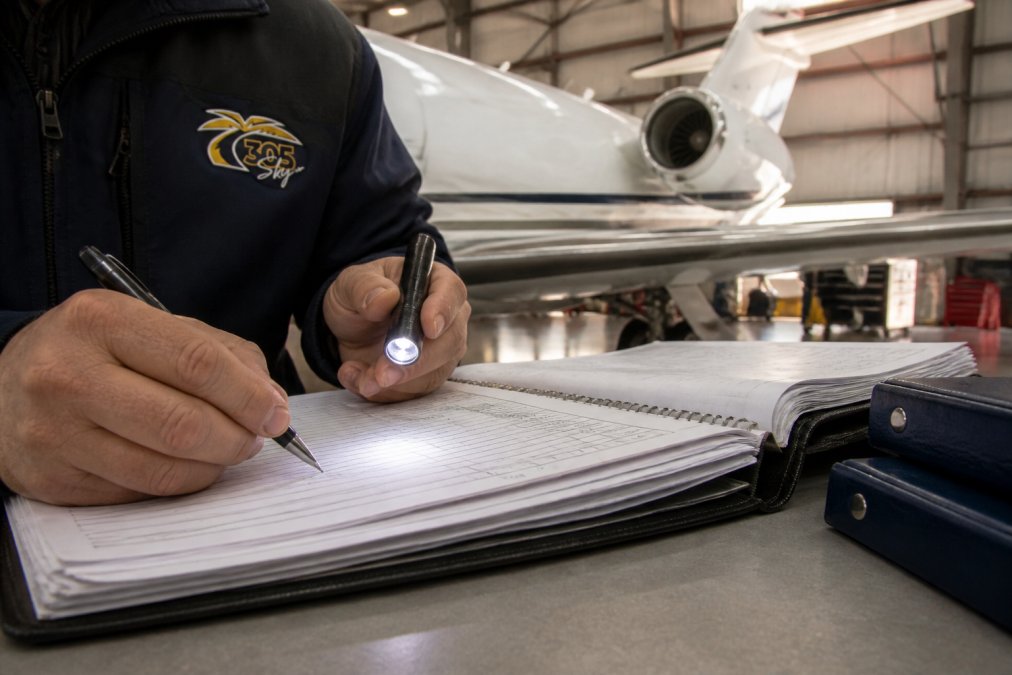
During this audit, the technician will verify that the aircraft's current status matches the logbooks. This includes checking that the transponder, altimeter, and ELT inspections are current, and that the aircraft's weight and balance data has been updated to reflect any modifications. The audit also confirms that the aircraft's total time in service matches the sum of all recorded flights. At 305 Sky, our pre-buy inspections in Fort Lauderdale include a full logbook audit as part of the standard procedure, ensuring that our clients understand exactly what they are purchasing before the transaction closes.
Step 6: Reconstruct Records and Correct Errors
If your aircraft logbook review uncovers errors or missing entries, you have options for correcting them. A common error is a transposed number in a tachometer reading or an incorrect part number, which can often be corrected with a single annotated entry.
For missing records, record reconstruction is a formal process. You will need to gather supporting documentation, such as component overhaul tags, shipping receipts, and mechanic work orders, to rebuild the aircraft's history. The goal is to create a verifiable narrative that accounts for the aircraft's entire life. Once the records are complete, consider migrating to digital aircraft maintenance tracking software. Digital systems reduce the risk of future gaps by providing automated reminders for inspections and AD compliance, and they create a secure backup that survives fire, flood, or simple loss.
| Review Stage | Primary Focus | Key Documentation |
|---|---|---|
| Chain of Title | Legal ownership and liens | FAA Registry, Bill of Sale |
| FAA Compliance | Validity of maintenance entries | Annual/100-hour inspections, signatures |
| Record Gaps | Continuity of history | Airframe, engine, propeller logs |
| AD Compliance | Mandatory airworthiness actions | FAA AD list, compliance records |
| Pre-Buy Audit | Physical vs. documented status | Weight and balance, current inspections |
| Reconstruction | Correcting errors and gaps | Component tags, work orders |
An aircraft logbook review is a specialized skill that carries significant responsibility. For brokers who buy and flip distressed aircraft, a thorough review is the difference between a profitable transaction and a liability nightmare. If you are managing a corporate flight department, it ensures your fleet remains compliant and ready for the FAA's surveillance and enforcement programs.
When you are ready to have a professional review performed on an aircraft you are buying, selling, or managing, the team at 305 Sky brings over 55 years of combined aviation experience to the task. We serve owners and operators across the Miami to Port St. Lucie corridor with routine maintenance, AOG emergency response, and comprehensive pre-buy inspections that include a detailed logbook audit. Get a quote on our website and let us help you verify your aircraft's history with the transparency you deserve.
Frequently Asked Questions
What is the difference between a maintenance record and a flight logbook?
A maintenance record documents all work performed on the aircraft, including inspections, repairs, and alterations. It must contain a description of the work, the date, and the signature and certificate number of the person who performed it. A flight logbook, or pilot logbook, records flight time for pilots, such as PIC time, SIC time, and instrument time. For an aircraft logbook review, the maintenance records are the critical documents that establish airworthiness.
What are common red flags found during an aircraft logbook review?
Common red flags include gaps in the chain of ownership, missing annual or 100-hour inspection sign-offs, unaddressed Airworthiness Directives (ADs), and damage history that lacks a proper repair sign-off. Also look for inconsistencies in total time in service between the airframe, engine, and propeller logs. Any of these issues can ground an aircraft until the records are corrected or reconstructed.
How do you verify compliance with FAA Airworthiness Directives in logbooks?
You must check each applicable AD against the aircraft's records. Find the AD list for your specific model on the FAA website, then confirm the logbook shows the required action, the date it was completed, the method of compliance, and the signature and certificate number of the mechanic. Pay special attention to recurring ADs with specific compliance times. An unresolved AD makes the aircraft unairworthy.
How does digital aircraft maintenance tracking software help with a logbook audit?
Digital aircraft maintenance tracking software helps by consolidating all records in one searchable place. It can automatically track AD compliance, component life limits, and upcoming inspection due dates. During an audit, this software makes it easier to spot record gaps and verify total time in service. For a pre-purchase inspection, it allows for a faster, more thorough review of the aircraft's history.