Table of Contents
- What FAA Logbook Entry Requirements Mandate
- 14 CFR Part 43.9 and Core Documentation Standards
- FAR Part 43 Maintenance Entry Examples
- Managing Aircraft Maintenance Records Digitally
- FAA Maintenance Record Retention Requirements
- Airworthiness Directives and Compliance Documentation
- Common Audit Red Flags and How to Avoid Them
- Frequently Asked Questions
Last Updated: August 31, 2026
What FAA Logbook Entry Requirements Mandate
The Federal Aviation Administration requires meticulous documentation of every maintenance action performed on an aircraft. These aren't suggestions, they're regulatory mandates that determine whether your aircraft remains airworthy and compliant. The FAA logbook entry requirements explained in 14 CFR Part 43 form the foundation of aircraft maintenance compliance, and getting them wrong can ground your aircraft or expose you to enforcement action (faa.gov).
During a ramp check or pre-purchase inspection, incomplete or unclear entries can trigger questions about whether maintenance was actually performed correctly. A missing signature, omitted certificate number, or vague description of work can invalidate the entry entirely, meaning that maintenance action may not count toward compliance.
What separates compliant logbook entries from ones that create regulatory headaches is clarity, completeness, and traceability. You need to document not just what was done, but who did it, when they did it, and what they found.
14 CFR Part 43.9 and Core Documentation Standards
14 CFR Part 43.9 is the regulatory foundation for all aircraft maintenance record entries. This regulation specifies exactly what information must appear in every logbook entry and applies to general aviation aircraft operating under Part 91. Compliance isn't optional, it's a condition of continued airworthiness.
The regulation requires that each entry contain five core elements: the date of completion, the total time in service of the aircraft, a description of work performed, the signature of the person performing the work, and that person's certificate number (faa.gov). Missing any one of these elements means the entry fails to meet regulatory standards, even if the maintenance itself was performed correctly.
Date of Completion and Total Time in Service
The date must be the actual date the work was completed, not the date it was approved or the date the aircraft was returned to service. Total time in service (TIS) refers to the aircraft's cumulative flight hours and is critical because many maintenance requirements are time-based, an annual inspection due at 500 hours, for example. Recording TIS at the time of maintenance creates an audit trail that proves the work was done within the required interval.
You must record the aircraft's TIS at the beginning of the work, not at the end. If an inspection started at 1,247 hours and concluded at 1,251 hours, log the 1,247 figure. This establishes the baseline for that maintenance action.
Description of Work Performed
This is where many entries fall short. "Engine overhaul" or "annual inspection completed" are too vague. The FAA expects specificity that would allow another mechanic to understand exactly what was inspected, tested, or repaired.
For routine maintenance, describe the system or component and the action taken: "Replaced left main landing gear tire, inspected wheel assembly for cracks, reinstalled wheel." For inspections, reference the inspection type and note any discrepancies found or corrected: "100-hour inspection completed per FAA Form 337 requirements; replaced spark plugs cylinders 1, 3, and 5; no airworthiness directives outstanding." This level of detail protects you during an audit because it demonstrates that the work was thorough and properly documented.
Signature and Certificate Number
The person who performed the work must sign the logbook entry. This isn't a digital checkbox, it's a literal signature that creates legal accountability. The signature certifies that the person performed the work as described and that the entry is accurate.
Equally important is the certificate number. For mechanics, this is the mechanic certificate number issued by the FAA. For certified repair stations, it's the repair station certificate number. Recording the certificate number allows anyone reviewing the logbook to verify that the person was authorized to perform that work.
FAR Part 43 Maintenance Entry Examples
Understanding the regulation is one thing; applying it correctly is another. Real-world examples show how to structure entries that meet FAA standards and withstand scrutiny.
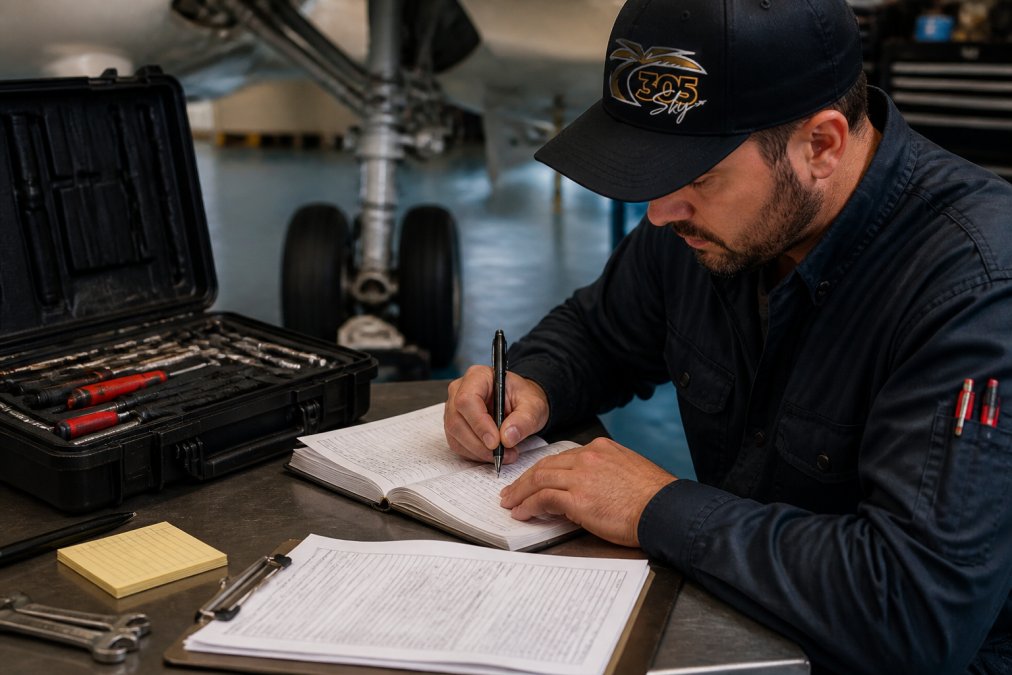
Routine Maintenance and Inspection Entries
Routine maintenance entries cover scheduled service items that don't require major documentation. Here's what a compliant entry looks like:
"Date: 08/15/2026 | TIS: 1,847.3 hours | Replaced engine oil and oil filter per manufacturer service manual; added 8 quarts Shell Aeroshell 15W-50. Inspected oil cooler for leaks, no discrepancies found. Aircraft returned to service. | Signed: [Mechanic Name] | Certificate #: [Mechanic Certificate Number]"
Notice the specificity: you've identified the exact product used, the quantity, the reference document, and the inspection result.
Inspection entries require more detail because they're comprehensive checks of systems and components. An annual inspection entry might read:
"Date: 08/20/2026 | TIS: 1,851.2 hours | Annual inspection completed per 14 CFR Part 43, Appendix D. Engine compartment inspected for corrosion, loose fasteners, and fluid leaks, no discrepancies. Flight controls inspected and tested for proper operation and cable tension. Landing gear extension and retraction tested through full cycle, operation normal. Airworthiness Directive compliance verified; no outstanding ADs. Aircraft released to service. | Signed: [IA Name] | Certificate #: [IA Certificate Number]"
Repairs and Alterations Requiring FAA Form 337
When you repair or alter an aircraft in ways that affect its airworthiness, you must use FAA Form 337 (Major Repair and Alteration) (faa.gov). The logbook entry should reference the form number and provide a summary:
"Date: 07/10/2026 | TIS: 1,802.5 hours | Major repair completed: cracked fuselage skin panel repaired by riveting per Boeing Service Bulletin SB 51-10-01. New skin panel installed and inspected. FAA Form 337 completed and filed. Aircraft returned to service. | Signed: [Repair Station Representative] | Certificate #: [Repair Station Certificate Number]"
Managing Aircraft Maintenance Records Digitally
The aviation industry is shifting toward digital logbook systems, but the regulatory requirements remain unchanged. Whether you're using paper or digital records, the same information must be captured and preserved.

Digital vs. Paper Logbook Compliance
Digital logbooks offer clear advantages: searchability, backup protection, and reduced risk of lost or damaged records. However, the FAA hasn't published specific guidance on what makes a digital logbook compliant. The regulation simply requires that entries be legible, complete, and retained.
The safest approach is to ensure your digital system captures all the required elements: date, TIS, description, signature, and certificate number. If you're using a digital signature, verify that your system creates an audit trail showing when the entry was made, who made it, and whether it was modified.
Data Acceptable to the Administrator Standards
The FAA uses the phrase "data acceptable to the Administrator" to describe what qualifies as valid maintenance documentation. This means the information must be clear, complete, traceable, and verifiable. A digital entry that's illegible, incomplete, or unsupported by backup documentation doesn't meet this standard.
If you're transitioning to a digital system, ensure it produces records that are as clear and complete as paper entries. Print a sample entry and ask yourself: would an FAA inspector accept this as proof that maintenance was performed?
FAA Maintenance Record Retention Requirements
The FAA doesn't specify a single retention period for all maintenance records. Instead, retention depends on the type of entry and the aircraft's operational history.
Record Retention Timeline by Entry Type
Routine maintenance entries must be retained for at least one year. Inspection entries, including annual and 100-hour inspections, must be retained for at least two years. Major repairs and alterations, documented on FAA Form 337, must be retained for the life of the aircraft. Airworthiness Directive compliance entries must be retained for the life of the aircraft.
Develop a record retention system that keeps routine maintenance accessible for at least a year, inspection records for at least two years, and major work for the aircraft's lifetime. Digital systems make this easier because you can archive old records without losing access to them.
Correcting Erroneous Entries
Never cross out or white-out an entry. Instead, make a new entry that references the erroneous one and explains the correction:
"Date: 08/22/2026 | TIS: 1,855.0 hours | Correction to entry dated 08/20/2026: Annual inspection was completed by [IA Name], certificate #[number], not by [previous name]. Previous entry contained typographical error. Corrected entry is hereby noted for the record. | Signed: [IA Name] | Certificate #: [IA Certificate Number]"
This approach creates a clear audit trail showing that you discovered the error and corrected it transparently.
Airworthiness Directives and Compliance Documentation
Airworthiness Directives are FAA-issued orders that require specific maintenance actions on aircraft with known safety issues. Documenting AD compliance in your logbook is essential for proving that your aircraft meets current airworthiness standards.
Every AD specifies a compliance deadline and the action required. Your logbook entries must clearly document that you performed the required action within the deadline:
"Date: 06/15/2026 | TIS: 1,720.0 hours | Airworthiness Directive 2024-12-15 complied with: Inspected landing gear actuator for corrosion per AD requirements; no corrosion found; aircraft returned to service. Compliance deadline was 07/01/2026. | Signed: [Mechanic Name] | Certificate #: [Mechanic Certificate Number]"
This entry proves you knew about the AD, completed the required action, and did so before the deadline.
Common Audit Red Flags and How to Avoid Them
FAA inspectors and pre-purchase mechanics look for specific patterns that suggest maintenance records may be incomplete or unreliable.
Missing signatures or certificate numbers are the most common issue. An entry without a signature or certificate number is technically non-compliant, even if the maintenance was performed correctly. Vague descriptions raise questions about whether the work was actually thorough, "Engine maintenance" doesn't explain what was done. Gaps in maintenance records suggest that work may have been performed but not documented. Inconsistent TIS entries indicate careless record-keeping; TIS should always increase or stay the same, never decrease. Unsigned or undated entries fail to meet regulatory standards. Missing AD compliance documentation is a serious issue that suggests the AD hasn't been addressed.
Proper FAA logbook entry practices protect your aircraft's airworthiness, support your maintenance schedule, and preserve your aircraft's value. Whether you're managing records digitally or on paper, the same regulatory standards apply: every entry must be complete, legible, traceable, and verifiable.
At 305 Sky, we understand that regulatory compliance is non-negotiable in aviation. Our team helps operators throughout the Fort Lauderdale area maintain logbooks that meet FAA standards and withstand scrutiny. From routine maintenance documentation to major repairs and airworthiness directive compliance, we ensure your records are accurate, complete, and properly retained. Get a quote from 305 Sky today and discover how transparent, expert aircraft maintenance can simplify compliance and keep your aircraft mission-ready.
Frequently Asked Questions
What specific information must be included in an FAA logbook entry?
Every FAA logbook entry must include the date of completion, description of work performed, total time in service, and the signature and certificate number of the authorized mechanic or inspector. The entry must be legible and contain enough detail for another mechanic to understand what was done. For major repairs or alterations, FAA Form 337 must be completed and attached to the aircraft records.
How do I correct an erroneous entry in my aircraft maintenance logbook?
Never erase or completely black out an incorrect entry. Instead, draw a single line through the error, write the correction above or below it, and sign and date the correction with your certificate number. This maintains the integrity of the maintenance record and shows the audit trail clearly. Digital systems should similarly preserve the original entry with a timestamped correction notation.
How long must aircraft maintenance records be retained under FAA regulations?
Aircraft maintenance records must be retained according to FAA regulations, which vary by entry type. Routine maintenance entries must be retained for at least one year, inspection entries for at least two years, and major repairs, alterations, and Airworthiness Directive compliance entries for the life of the aircraft. Owners transferring an aircraft must provide all maintenance records to the new owner. Digital records are acceptable if they meet FAA standards for data integrity and accessibility.
Who is authorized to sign off on aircraft maintenance in the United States?
Only certificated airframe and powerplant (A&P) mechanics, inspection authorization (IA) holders, or authorized instructors can sign off on maintenance entries. The person signing must include their full certificate number and the date. Sport Pilot and Recreational Pilot endorsements have different rules; consult 14 CFR Part 43 for your aircraft category. All signatories must be current and not subject to FAA enforcement action.
What is the difference between a maintenance record and a flight logbook?
A maintenance record documents work performed on the aircraft, engines, and components. A flight logbook records flight time, pilot experience, and training. Both are required regulatory documents. Maintenance records must be kept with the aircraft permanently; flight logbooks belong to the pilot. A ramp check or audit will verify both are complete and compliant with FAA standards.
What are common audit red flags in aircraft maintenance records?
Red flags include incomplete entries without descriptions of work, missing signatures or certificate numbers, illegible handwriting, alterations that lack proper dating and initials, gaps in inspection records, and missing Airworthiness Directive compliance documentation. Entries that are vague (e.g., 'checked engine') instead of specific, and records that don't match the aircraft's total time in service, will trigger closer FAA scrutiny during a ramp check.
This article was written using GrandRanker