
Table of Contents
- Understanding Aircraft Airworthiness
- Step 1: Locate and Review the ARROW Documents
- Step 2: Verify Required Aircraft Documents for Flight
- Step 3: Review Maintenance Records and Logbooks
- Step 4: Check FAA Airworthiness Directives Search Results
- Step 5: Confirm Inspection Compliance and Status
- Managing Aircraft Maintenance Records Digitally
- Common Mistakes to Avoid When Verifying Airworthiness
Last Updated: August 28, 2026
Understanding Aircraft Airworthiness
Aircraft airworthiness is the condition where an aircraft conforms to its type design, is in a safe physical condition, and is equipped and maintained to operate safely. At 305 Sky, we help aircraft owners and operators verify this status through systematic review that ensures FAA compliance.
An airworthy aircraft protects your investment, keeps crew and passengers safe, and maintains federal compliance. A single missed maintenance requirement or overlooked airworthiness directive can ground your aircraft or create a safety hazard.
Verifying aircraft airworthiness status is methodical, built on documentation, inspections, and regulatory compliance checks. This guide walks you through the exact steps to verify airworthiness status, whether you're a prospective buyer, aircraft owner, or charter operator. We'll show you what documents to check, where to find them, and what red flags signal problems.
Step 1: Locate and Review the ARROW Documents
The ARROW documents are the foundation of aircraft airworthiness verification. ARROW stands for Airworthiness Review Record, Registration, and Other Records. These core documents prove an aircraft meets FAA standards.
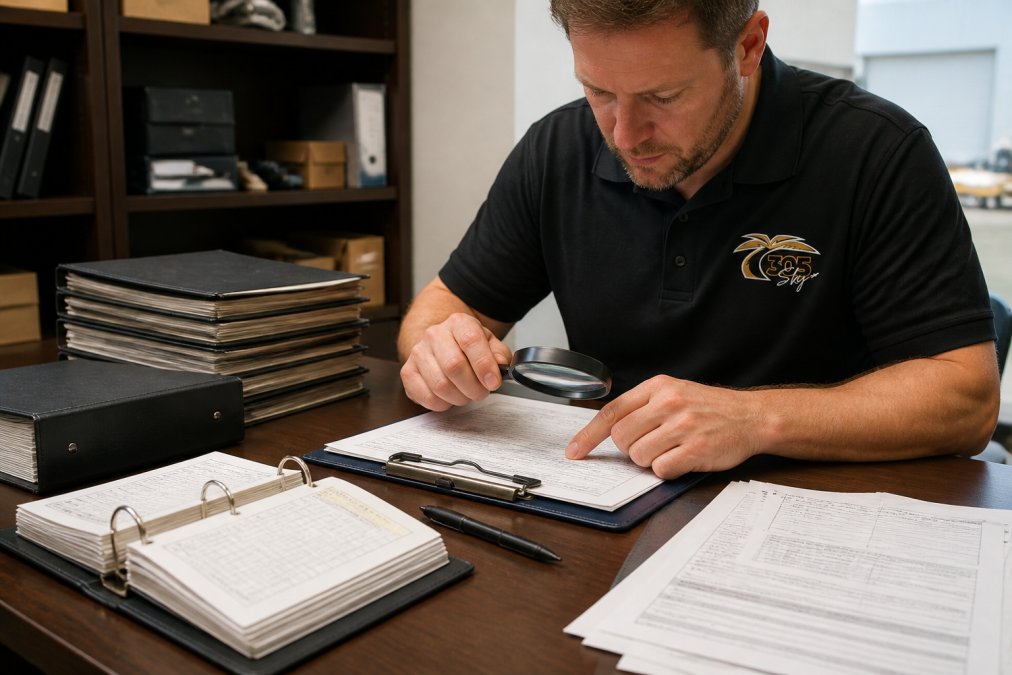
The ARROW documents include four essential items: the Airworthiness Certificate (FAA Form 8100-2), the Aircraft Registration Certificate, the Aircraft Logbook (maintenance records), and the Engine Logbook.
What the ARROW Documents Include
The Airworthiness Certificate is issued by the FAA and certifies that the aircraft conforms to its type design and is in safe condition for operation. This document must be displayed in the aircraft. If missing or expired, the aircraft cannot legally fly. Standard airworthiness certificates remain valid as long as the aircraft is maintained according to FAA requirements and passes required inspections (faa.gov).
The Aircraft Registration Certificate proves the aircraft is registered with the FAA and identifies the current owner. This document must be aboard during flight. Check that the registration matches the aircraft's tail number and is current; registration lapses can occur if renewal fees are overlooked.
The Aircraft Logbook is a detailed record of all maintenance performed on the airframe. Every inspection, repair, and modification must be logged with dates, descriptions, and the mechanic's signature and certification number. This logbook is critical for verifying that required inspections have been completed and airworthiness directives addressed.
The Engine Logbook tracks all engine maintenance separately from the airframe logbook. Engine overhauls, major repairs, and time-between-overhaul (TBO) tracking all appear here. An engine approaching TBO without an overhaul scheduled is a red flag for airworthiness status.
Request these documents from the current owner or operator before proceeding. If any are missing, the aircraft's airworthiness status is immediately in question.
Step 2: Verify Required Aircraft Documents for Flight
Beyond the ARROW documents, several other required aircraft documents must be present and current.
The Aircraft Flight Manual (or Pilot's Operating Handbook) contains operating limitations, performance data, and emergency procedures for the specific aircraft type. This must be aboard and accessible to the pilot in command.
The Equipment List specifies which instruments and systems are installed on the aircraft, determining what operations it can perform (for example, instrument meteorological conditions versus visual flight rules only).
The Weight and Balance Report documents the aircraft's current weight and center of gravity. This must be current and accurate. If major modifications or repairs have been made, the weight and balance must be recalculated and documented.
The Airworthiness Directives Compliance Record lists all applicable airworthiness directives and their compliance status. Every AD that applies must be complied with and documented.
For aircraft operating in certain airspace or under specific regulations, additional documents may be required. Check with the FAA or a qualified aviation professional to confirm what documents your specific aircraft needs.
Step 3: Review Maintenance Records and Logbooks
Maintenance records tell the story of an aircraft's condition. A well-maintained aircraft with detailed, consistent logbook entries is far more likely to be truly airworthy than one with sparse records or gaps.
Start by reviewing the aircraft logbook chronologically. Regular entries show the owner is maintaining the aircraft. Long gaps can indicate neglect. Entries should be detailed: "changed oil, filter, and spark plugs; checked mag drop; aircraft test-flown and performs normally" rather than simply "oil change."
Check for recurring maintenance items. Annual inspections should appear every 12 calendar months. If the aircraft is flown frequently, 100-hour inspections should appear regularly. Each entry should reference the specific inspection checklist used and any discrepancies found and corrected.
Look for major repairs and modifications. Anything involving the airframe, engine, or avionics should be documented with a detailed description, date, mechanic's certificate number, and sign-off. Major work without proper documentation is a serious red flag.
Verify that any previous airworthiness directives have been complied with. The logbook should show when each AD was completed, what work was done, and the mechanic's certification. An AD listed but showing no compliance action is a problem.
Check the engine logbook separately. Note the total time on the engine and when the last overhaul was performed. If the engine is approaching or has exceeded its TBO limit without an overhaul completed, the aircraft may not be considered fully airworthy for all operations.
Step 4: Check FAA Airworthiness Directives Search Results
Airworthiness directives (ADs) are mandatory compliance requirements issued by the FAA to address safety issues. Every aircraft has a list of ADs that apply based on its type, model, and serial number. You must verify that all applicable ADs have been complied with.
The FAA maintains a searchable database of all active airworthiness directives available online at no cost. Search by aircraft type and model to find every AD that applies to the specific aircraft you're verifying.
When you search, note the AD number, issuance date, and compliance requirement. Some ADs require one-time compliance; others require recurring actions at specific intervals. An AD might require component replacement, system inspection, or equipment modification.
For each AD, check the aircraft's logbook to confirm compliance. The logbook entry should clearly reference the AD number, describe the work performed, and be signed and dated by an appropriately certified mechanic. If an AD shows no compliance action, the aircraft is not airworthy until that AD is addressed.
Pay special attention to ADs with short compliance deadlines. If an AD requires compliance within 50 hours of flight time and the aircraft has already flown 45 hours since issuance, compliance is urgent.
Step 5: Confirm Inspection Compliance and Status
Two types of inspections are fundamental to airworthiness: the annual inspection and the 100-hour inspection.

The Annual Inspection is required every 12 calendar months for any aircraft that carries passengers or is operated for compensation. This comprehensive inspection covers the airframe, engine, systems, and equipment. The inspection must be performed by an authorized inspector (an A&P mechanic with an Inspection Authorization).
The 100-Hour Inspection is required for any aircraft flown for hire or used in commercial operations. It's more detailed than the annual and must be performed every 100 flight hours. A regular A&P mechanic can perform it.
Check the logbook for the most recent annual inspection entry. It should include the date, inspector's name and certificate number, and a description of the inspection performed. The entry should note any discrepancies found and how they were corrected. If the annual inspection is overdue or missing, the aircraft is not airworthy.
For the 100-hour inspection, check how many flight hours have accumulated since the last inspection. If the aircraft has flown more than 100 hours since the last 100-hour inspection, it's overdue and must be brought current before further flight.
Verify that all required inspections of specific systems have been completed. These include transponder checks (every 24 calendar months), altimeter system tests (every 24 calendar months), and pitot-static system tests (every 24 calendar months) (faa.gov). Each must be documented in the logbook with the date and technician's certification.
An emergency locator transmitter (ELT) inspection is also required. The ELT must be inspected every 12 calendar months and tested annually.
Step 6: Managing Aircraft Maintenance Records Digitally
Modern aircraft operations increasingly rely on digital record-keeping. Digital logbooks are searchable, automatically backed up, and accessible from anywhere. However, the FAA requires that aircraft maintenance records be maintained and available for inspection.
If transitioning to digital maintenance records, understand that the FAA accepts electronic logbooks as long as they meet specific requirements. Records must be legible, accurate, and retained for the life of the aircraft. Digital records must be backed up and protected against loss or corruption.
Many operators use specialized aviation maintenance software that integrates with aircraft management systems. These platforms allow mechanics to log maintenance in real-time, track recurring items automatically, and generate compliance reports.
When verifying airworthiness status, ask whether the aircraft's records are maintained digitally or on paper. If digital, confirm that you have access to the complete record history and that the system is certified or recognized by the FAA. Digital records should be as detailed and complete as paper records.
One advantage of digital records is automatic reminders for recurring maintenance items. An aircraft with digital management is less likely to miss an inspection deadline or overlook a recurring AD requirement.
Step 7: Common Mistakes to Avoid When Verifying Airworthiness
The process of verifying aircraft airworthiness status is straightforward, but small oversights can lead to serious problems.
Skipping the AD search. Don't assume you know which ADs apply. Search the FAA database every time you verify airworthiness status. New ADs are issued regularly, and missing even one means the aircraft is not fully airworthy.
Accepting incomplete logbook entries. If a logbook entry is vague or lacks required details (mechanic's certificate number, specific work description), it's not sufficient documentation. Require detailed entries that clearly describe what was done and by whom.
Confusing inspection types. The annual inspection and 100-hour inspection are different. An annual inspection does not count as a 100-hour inspection, and vice versa. Verify that both have been completed within their required intervals.
Overlooking engine time. An engine approaching TBO may still be technically airworthy, but its remaining useful life is limited. Factor this into your assessment, especially if considering purchasing the aircraft.
Not verifying mechanic credentials. Every logbook entry should be signed by a mechanic with appropriate certification (A&P, IA, or specialized ratings). Verify that the mechanic's certificate was valid on the date of the work.
Ignoring gaps in maintenance records. If there's a gap of several months with no entries, that's a red flag. The aircraft may have been inactive, but you need to understand why and confirm that any required inspections were completed before the aircraft resumed flight.
Failing to check supplemental type certificates. If the aircraft has been modified (avionics upgrades, interior changes, structural modifications), those modifications must be documented with a Supplemental Type Certificate (STC) or field approval. Without proper documentation, the aircraft may not conform to its type design.
Assuming recent work means current compliance. A recent oil change doesn't satisfy an overdue airworthiness directive or a missed annual inspection.
Not requesting a pre-purchase inspection. If you're buying an aircraft, never rely solely on the owner's records. Hire a qualified pre-buy inspector to physically examine the aircraft and verify that the documentation is accurate and complete.
Verifying aircraft airworthiness status requires attention to detail and a systematic approach. The ARROW documents, required maintenance records, airworthiness directives, and inspection compliance all work together to prove that an aircraft is safe to fly.
If you're managing aircraft maintenance or preparing for purchase in the Fort Lauderdale area, 305 Sky offers comprehensive pre-buy inspections and airworthiness verification services. Our team brings over 55 years of combined aviation experience to every inspection, ensuring that nothing is overlooked. We maintain detailed, compliant digital records for all aircraft we service, and we handle the full scope of maintenance and compliance verification. Get a Quote to learn how we can help ensure your aircraft remains airworthy and compliant.
Frequently Asked Questions
How do I prove an aircraft is airworthy?
Verify aircraft airworthiness by confirming three essentials: a valid airworthiness certificate (FAA Form 8130-6), current maintenance records showing all required inspections completed, and compliance with all applicable FAA airworthiness directives. Review the ARROW documents (Airworthiness certificate, Registration, Restricted Category certificate if applicable, Operating limitations, and Weight and balance), check that annual or 100-hour inspections are current, and confirm the aircraft has passed all mandatory AD compliance checks. If purchasing an aircraft, request a pre-buy inspection from a qualified mechanic.
What documents must be on board to prove airworthiness?
Required aircraft documents for flight include the airworthiness certificate, aircraft registration certificate, operating limitations, weight and balance information, and the aircraft flight manual or approved equivalent. Additionally, keep current maintenance records accessible, including logbook entries documenting the most recent annual inspection, any 100-hour inspections, and compliance status for all applicable FAA airworthiness directives. These documents collectively demonstrate that your aircraft meets all regulatory requirements for safe operation.
How do I search for FAA airworthiness directives for my aircraft?
Use the FAA's online AD search tool at faa.gov to look up airworthiness directives by aircraft type, serial number, and component. Search by your aircraft's make, model, and serial number to identify all active ADs. Review each directive's effective date and compliance deadline, then cross-reference your maintenance logbooks to confirm completion. Document the compliance status of each AD in your aircraft maintenance records. If any ADs are overdue, contact a qualified maintenance facility to address them before flight.
How long does an aircraft airworthiness certificate remain valid?
An airworthiness certificate remains valid indefinitely as long as the aircraft is maintained in an airworthy condition and all required inspections and maintenance are current. However, the aircraft must pass an annual inspection every 12 calendar months or a 100-hour inspection every 100 hours of flight time (whichever occurs first) to maintain airworthiness status. If either inspection lapses, the airworthiness certificate becomes invalid and the aircraft cannot legally fly until inspections are completed and the certificate is reinstated.
This article was written using GrandRanker