Table of Contents
- Why Deep Cleaning Matters for Private Jet Interiors
- 1. Follow Your Aircraft Maintenance Manual for Cleaning Compliance
- 2. Use FAA-Approved Aircraft Cleaning Products Only
- 3. Build an Aircraft Interior Detailing Checklist
- 4. Establish a Private Jet Cabin Maintenance Schedule
- 5. Master Galley and Lavatory Deep Cleaning
- 6. Protect Cabin Air Quality and Ventilation Systems
- 7. Document Your Cleaning Process for Regulatory Compliance
- Frequently Asked Questions
Last Updated: September 10, 2026
Why Deep Cleaning Matters for Private Jet Interiors
Private jet interior deep cleaning is the scheduled, material-specific restoration of every cabin surface, from leather seats and carpet fibers to galley counters and air vents. At 305 Sky, we treat it as a maintenance discipline, not a cosmetic chore. In Fort Lauderdale, Florida, where humidity, salt air, and year-round heat punish cabins faster than almost anywhere in the country, a skipped deep clean becomes a corrosion and odor problem within months. This guide from 305 Sky breaks down the seven practices we apply across Challenger, Citation, King Air, Learjet, Falcon, Hawker, Gulfstream, Beechjet, and Pilatus interiors. Below, we'll show you exactly how to build a program that protects resale value and keeps you inspection-ready.
1. Follow Your Aircraft Maintenance Manual for Cleaning Compliance
Your maintenance manual is the controlling document for what you may apply to any cabin surface. Manufacturers publish approved cleaners, dwell times, and prohibited solvents by material type, and deviating from those instructions can void warranties or trigger findings during an audit. A common mistake is treating the cabin as separate from the airworthiness record. It isn't.
Start by pulling the cleaning and appearance sections for your specific serial number, not a generic type guide. Citation and King Air manuals, for example, differ on acceptable leather treatments. Cross-reference every product against the approved list before it touches the aircraft.
FAA Advisory Circular library on continued airworthiness
2. Use FAA-Approved Aircraft Cleaning Products Only
FAA-approved aircraft cleaning products are those documented as compatible with the specific materials in your cabin and safe for the aircraft's systems. There is no single universal approval stamp; approval flows from the manufacturer's manual plus applicable FAA guidance. Household cleaners fail this test constantly.
Surface Compatibility and Non-Abrasive Cleaners
Ammonia, bleach, and abrasive pads destroy acrylic windows, avionics faceplates, and factory leather finishes. Use pH-neutral, solvent-free, non-abrasive cleaners matched to each substrate. Test any new product on a hidden area first.
Sustainable and Eco-Friendly Aviation Cleaners
Low-VOC, biodegradable options now perform at the level of traditional chemistry. They reduce crew exposure and cabin odor retention, which matters on long missions. Verify eco-friendly claims against the approved list rather than assuming green means safe for aircraft.
3. Build an Aircraft Interior Detailing Checklist
An aircraft interior detailing checklist converts tribal knowledge into a repeatable process any crew or vendor can follow. Build it by zone, then by material, and attach it to the work order every time. This is the single highest-use document in your cleaning program.
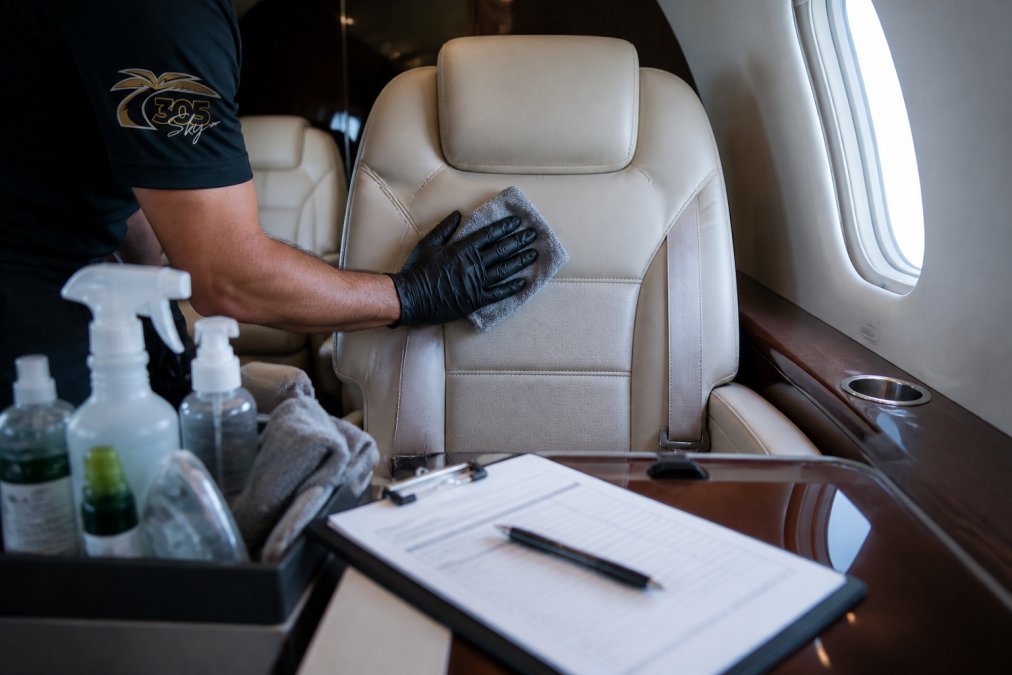
High-Touch Surfaces and Sanitization Protocols
Sanitization protocols should target what hands actually touch: tray tables, armrests, door handles, lavatory latches, and galley switches. Wipe in one direction with fresh microfiber, and never reuse a cloth across zones.
Leather Upholstery Conditioning and Carpet Extraction
Leather preservation requires cleaning followed by a conditioning step matched to the hide's finish. Carpet extraction removes embedded grit that abrades fibers; spot-treat stains immediately rather than at the next deep clean.
| Zone | Method | Frequency |
|---|---|---|
| Leather seating | pH-neutral clean, then condition | Every deep clean |
| Carpet and textile | Hot-water extraction | Every deep clean |
| High-touch surfaces | Microfiber wipe, one direction | Every stopover |
| Acrylic windows | Non-abrasive, approved cleaner only | As needed |
4. Establish a Private Jet Cabin Maintenance Schedule
A private jet cabin maintenance schedule sets the cadence: what happens after every flight, what happens weekly, and what happens at the deep-clean interval. Without a written schedule, cleaning drifts into reaction mode and the cabin degrades unevenly.
Stopover Cleaning vs. Deep Cleaning Cycles
Stopover cleaning is a fast reset between legs: trash, galley wipe-down, lavatory disinfection, and high-touch surfaces. Deep cleaning is the full material-by-material restoration. Keep them on separate calendars so a quick turn never substitutes for the real thing.
5. Master Galley and Lavatory Deep Cleaning
Galley and lavatory are the two highest-moisture, highest-microbial zones in any Challenger, Citation, King Air, Learjet, Falcon, Hawker, Gulfstream, Beechjet, or Pilatus cabin, and they are where informal inspections fail first. In Fort Lauderdale, where ramp humidity routinely sits above 70 percent and salt air rides in on every turn, a galley drawer that is wiped but not dried becomes a mold nursery inside a week (the CDC).
Galley: Pull, Dry, Then Disinfect
Food residue and condensation collect in places a quick wipe never reaches: drawer tracks, the underside of the coffee maker, the drip tray lip, the trash compartment gasket, and the gap between the counter and the cabinet face. The working sequence is:
- Pull every drawer, bin, and removable insert fully out of the cabinet.
- Vacuum loose crumbs and debris from the tracks with a soft brush attachment before any liquid touches the surface.
- Wipe with a pH-neutral, approved cleaner, then dry every surface with a separate microfiber, never let the galley air-dry in a humid cabin.
- Disinfect high-touch galley points: coffee and espresso handles, oven and microwave latches, faucet levers, cabinet pulls, and trash flap.
- Leave drawers and cabinet doors open for at least 30 minutes after cleaning so residual moisture escapes before the cabin is closed up.
Lavatory: The Highest-Load Zone on the Aircraft
The lavatory carries the highest microbial load in the cabin. Treat it as a separate cleaning zone with its own cloth set that never touches the galley or seating. The waste flap, latch assembly, sink drain collar, and the seam where the vanity meets the wall are the four spots most often skipped and most likely to harbor odor.
- Disinfect the waste flap and latch assembly on every deep clean, not just on stopovers.
- Flush the sink drain with approved cleaner, then dry the collar and surrounding seam completely.
- Wipe the mirror and acrylic surfaces with a non-abrasive, approved cleaner only, ammonia and bleach cloud acrylic and void the finish.
- Dry the floor and the base of the lavatory door last, because that is where moisture pools during flight.
Florida-Specific Mold and Odor Prevention
South Florida's combination of heat, humidity, and salt air is the single biggest driver of cabin odor complaints we see on aircraft based at FXE, FLL, and OPF. Three practices cut the risk sharply:
- Run the cabin air system or a portable dehumidifier for a short cycle after any wet cleaning, especially during the rainy season from May through October.
- Never store cleaning cloths, mops, or wet vacuums inside the aircraft between jobs, they seed the cabin with spores.
- Inspect galley and lavatory gaskets, seals, and drain collars monthly for black spotting; treat early rather than waiting for the next deep clean.
Keep a dedicated galley cloth set and a dedicated lavatory cloth set, color-coded and stored separately. Cross-contamination between zones is the most common cause of repeat odor complaints on charter aircraft.
6. Protect Cabin Air Quality and Ventilation Systems
Cabin air quality is a maintenance item, not a comfort feature. Vents, return grilles, and cabin air filters are the parts of the interior most often skipped during cleaning, and they are the parts that determine whether the cabin smells fresh or recycled on the next leg. On Challenger, Citation, King Air, Learjet, Falcon, Hawker, Gulfstream, Beechjet, and Pilatus cabins, the air distribution layout differs, but the cleaning logic is the same: keep airflow paths clear, keep moisture out of the ducting, and keep liquids away from anything flight-critical.
Vent and Grille Cleaning Mechanics
Dust-loaded vent faces reduce airflow and recirculate odor through the cabin. The correct sequence is:
- Vacuum vent faces and return grilles with a soft brush attachment on low suction, never high suction, which can bend louvers or push debris deeper into the duct.
- Wipe the vent surround and the adjacent panel with a barely damp microfiber, then dry immediately.
- Never spray cleaner directly into a vent. Spray the cloth, not the aircraft.
- Inspect the vent for visible moisture or staining; either one means the ducting needs attention beyond routine cleaning.
Cabin Air Filter Replacement Intervals
Cabin air filters and recirculation filters are replaced on the interval published in your specific aircraft maintenance manual, not on a generic schedule. In practice, most operators in South Florida find that the humid, salt-laden air at FXE, FLL, and OPF shortens filter life compared to drier climates, and filters are inspected at every deep clean rather than only at the manual interval. Log the filter part number, install date, and aircraft hours in the maintenance record so the next interval is never a guess.
Protecting Avionics, Pitot Tubes, and Static Ports
Avionics faceplates, pitot tubes, and static ports are flight-critical and are not part of the cleaning zone. Keep all liquids away from them during any cabin work. Before starting a deep clean:
- Mask or cover avionics panels, circuit breaker panels, and any exposed connector.
- Confirm pitot covers and static port covers are in place on the exterior before any interior liquid work begins.
- Use only a dry or barely damp microfiber on avionics glass, and never a spray bottle near the panel.
Spraying cleaner near vents or avionics panels can push moisture into sensitive electronics and trigger intermittent faults that are expensive to trace. Mask and protect those areas before you start, and dry every surface completely before closing up the cabin.
Documentation for the Airworthiness Record
Vent cleaning, filter replacement, and avionics protection steps belong in the same log as the rest of the deep clean. Record the date, the vent and filter locations serviced, the part numbers installed, and the person who performed the work. That record supports warranty claims, supports the interior condition story at pre-buy, and gives the next crew a clear starting point.
FAA Advisory Circular library on continued airworthiness
7. Document Your Cleaning Process for Regulatory Compliance
Regulatory compliance documentation turns your cleaning program into evidence. Record the date, products used, surfaces treated, and the person who performed the work. This matters for warranty claims, audits, and resale.
Post-Cleaning Inspection Checklists
A post-cleaning inspection checklist confirms the job is actually done: no residue on windows, no moisture in seams, no streaks on avionics glass, vents clear, and lavatory dry. Sign and date it, then file it with the aircraft records. In Florida's climate, document humidity conditions during cleaning as well, since they affect dry times and material behavior.
The cabins that hold their value are the ones with a paper trail: approved products, a zone checklist, a schedule, and a signed inspection after every deep clean.
Deep cleaning a private jet interior is a compliance exercise as much as a cosmetic one, and the operators who treat it that way avoid the corrosion, odor, and documentation problems that surface at resale. If you'd rather hand the whole program to specialists, 305 Sky provides aircraft maintenance, aircraft interior, and AOG service across Fort Lauderdale and the wider South Florida corridor, backed by 55+ years of combined aviation experience and four strategically located facilities. Our team handles everything from routine maintenance and aircraft inspections to bespoke cabin transformations, with transparent pricing and secure digital record keeping. Get a Quote from 305 Sky and keep your cabin airworthy, compliant, and genuinely clean.
Frequently Asked Questions
How often should a private jet undergo a deep interior cleaning?
Most private jet cabin maintenance schedules recommend a deep interior cleaning every 90 days or 100 flight hours, whichever comes first. High-traffic charter aircraft may need it monthly. Between deep cleans, perform stopover cleaning after each flight to manage high-touch surfaces. In South Florida's humidity, more frequent cleaning helps prevent mold and mildew in carpets and upholstery.
What specialized cleaning products are safe for private jet leather and wood?
Only use FAA-approved aircraft cleaning products formulated for aviation interiors. For leather, choose pH-balanced cleaners and conditioners that preserve the finish without leaving residue. For wood veneers, use non-abrasive, solvent-free cleaners applied with a microfiber cloth. Never use household all-purpose cleaners, which can damage acrylic windows, avionics displays, and protective coatings.
What is the difference between standard cabin cleaning and deep detailing?
Standard cabin cleaning covers visible surfaces, trash removal, and vacuuming between flights. Deep detailing involves carpet extraction, leather upholstery conditioning, galley and lavatory disinfection, cabin air vent maintenance, and acrylic window care. Deep cleaning also includes inspecting and documenting surface conditions for regulatory compliance. The two complement each other: standard cleaning maintains appearance, while deep detailing preserves materials and resale value.
Are there FAA-approved cleaning agents for aircraft interiors?
The FAA does not publish a standalone list of approved cleaning agents, but it requires that all cleaning products comply with the aircraft manufacturer's maintenance manual. Products must be non-flammable, non-corrosive, and compatible with cabin materials. Always check your specific aircraft's maintenance manual for approved chemicals. Using unapproved products can void warranties and compromise avionics safety.
How does professional deep cleaning impact the resale value of a private jet?
A well-maintained interior signals to buyers that the aircraft has been cared for, which supports resale value. Documented deep cleaning records, including post-cleaning inspection checklists, show regulatory compliance and preventative maintenance. Aircraft with clean, conditioned leather and stain-free carpets typically sell faster. For brokers and owners preparing to sell, professional interior refurbishment is a worthwhile investment.