Table of Contents
- The Real Price of Ignoring Aircraft Corrosion
- What Is Professional Aircraft Corrosion Control?
- Aircraft Corrosion Repair Costs vs. Prevention: A Financial Comparison
- Your Aircraft Corrosion Inspection Checklist: What to Look For
- Preventing Corrosion in Coastal Environments: South Florida Realities
- Protecting Your Asset: Insurance and Resale Value Impact
- Conclusion: Professional Corrosion Control as an Investment
- Frequently Asked Questions
Last Updated: September 4, 2026
The Real Price of Ignoring Aircraft Corrosion
Corrosion is the slow, silent killer of aircraft value and airworthiness. Unlike a bird strike or a hard landing, it doesn't announce itself; it spreads beneath paint and sealant, compromising structural integrity long before it becomes visible to the untrained eye. For owners of Challenger, Citation, King Air, Learjet, Falcon, Hawker, Gulfstream, Beechjet, and Pilatus aircraft, the question isn't whether corrosion will appear, but when you'll find it. This guide from 305 Sky, a South Florida maintenance provider, examines whether professional aircraft corrosion control is worth the cost by comparing the price of prevention against the financial and operational toll of neglect.
The math changes dramatically depending on where you operate. An aircraft based in a dry desert climate faces a different risk profile than one parked near the salt air of the coast (faa.gov). For owners in humid, coastal regions, corrosion is not a theoretical concern; it is an inevitability that demands a preventative strategy. The most expensive corrosion is the type you discover after it has already begun to compromise a primary structure, turning a routine inspection into a major repair event.
What Is Professional Aircraft Corrosion Control?
Professional aircraft corrosion control is a systematic program of inspection, surface treatment, and protective coating application performed by certified technicians to prevent and arrest oxidation on an airframe. It goes far beyond a visual wipe-down, involving specialized chemical treatments, corrosion inhibitors, and organic coatings designed to seal out moisture and contaminants.
The process typically begins with a thorough corrosion assessment to identify existing damage and areas of high risk. Technicians then remove any active corrosion, treat the surface with inhibitors, and apply protective coatings tailored to the specific alloy and location. For aircraft operating in salt air environments, this is not a one-time event but a recurring maintenance commitment tied to inspection intervals. A professional program also addresses areas owners often overlook, including avionics protection, bilge areas, and hidden structural pockets where moisture accumulates.
Aircraft Corrosion Repair Costs vs. Prevention: A Financial Comparison
The gap between prevention and repair is where owners either protect their investment or watch it erode. While a scheduled corrosion prevention treatment involves predictable costs for labor, materials, and downtime, an unscheduled repair triggered by structural corrosion involves far more than surface work. Repair often requires sheet metal fabrication, part replacement, and extensive rework, costs that multiply quickly when corrosion has compromised a primary structure.
| Approach | Typical Scope | Downtime Impact | Long-Term Effect |
|---|---|---|---|
| Preventative Treatment | Inspection, cleaning, inhibitors, coatings | Scheduled, minimal | Preserves structural integrity and value |
| Minor Corrosion Repair | Localized removal, touch-up coating | Moderate, unscheduled | Halts active corrosion if caught early |
| Major Structural Repair | Part replacement, sheet metal work | Extended, often AOG | Necessary for airworthiness, high cost |
The DIY vs. Professional Cost Reality for Private Owners
A common pattern among owners of Challenger, Citation, King Air, and Pilatus aircraft is attempting to save money with DIY corrosion prevention between annual inspections. While wiping down exposed surfaces with a corrosion inhibitor (often ACF-50 or Corrosion-X) seems cost-effective, it rarely addresses the areas where corrosion actually takes hold. A DIY application typically covers visible exterior surfaces, but misses the hidden structural pockets, bilge areas, and avionics bays where moisture accumulates and oxidation begins. Professional application involves the controlled environment of a hangar, proper surface preparation, and the use of multiple product types, not just a spray-on inhibitor, to ensure complete coverage of inaccessible areas.
The more significant cost difference emerges over a multi-year ownership cycle. An owner who applies a can of corrosion inhibitor twice a year may spend on product, plus their own labor time. But if that approach misses a developing issue in a wing spar or a lap joint, the eventual repair bill, often running into five figures for a Challenger or Gulfstream, dwarfs the cumulative cost of professional treatment. Professional corrosion control programs are designed around the manufacturer's corrosion prevention and control program (CPCP) requirements, ensuring that the aircraft meets the standards that a future buyer's pre-buy inspector will check (faa.gov).
The Cost of Downtime and AOG Events
For owners who rely on their aircraft for business or travel, the true cost of corrosion is measured in lost opportunity. An AOG event triggered by corrosion discovered during a pre-buy inspection or routine check can ground an aircraft for weeks, disrupting schedules and forcing last-minute charter arrangements. The financial impact of that downtime often exceeds the repair invoice itself.
This is where the value of a preventative program becomes clear. Routine maintenance that includes corrosion inspection and treatment keeps aircraft flying on schedule, avoiding the cascading costs of an unscheduled grounding. AOG emergency support is essential when failures happen, but the best strategy is preventing the failure altogether. For a charter operator or flight department, aircraft availability is revenue, making scheduled corrosion control a direct contributor to the bottom line.
Your Aircraft Corrosion Inspection Checklist: What to Look For
Aircraft corrosion inspection is a skill that improves with knowing exactly where to look. While a certified mechanic performs the formal inspection, owners who know the warning signs can catch problems early and raise them with their maintenance team.
- Inspect drainage holes and low points: Check that drain holes in wings, control surfaces, and the fuselage are clear of debris that traps moisture.
- Examine battery compartments and bilge areas: These are prime locations for acid and moisture accumulation that accelerates corrosion.
- Look for paint bubbles, blisters, or cracking: These indicate corrosion forming beneath the protective coating.
- Check fasteners and lap joints: White or gray powdery residue around rivets and seams is a telltale sign of oxidation.
- Review the maintenance logbook: Verify that corrosion control treatments have been performed at the recommended inspection intervals.
This checklist is not a substitute for a professional corrosion assessment by an IA (Inspection Authorization) holder. It is an early warning system that helps owners spot issues between scheduled inspections. In coastal environments, these visual checks should become a habit, especially after periods of high humidity or salt air exposure.
Preventing Corrosion in Coastal Environments: South Florida Realities
South Florida presents one of the most aggressive corrosion environments in the continental United States. The combination of salt air, high humidity, and frequent afternoon thunderstorms creates conditions where unprotected metal can begin to oxidize rapidly (nasa.gov). Owners based in Fort Lauderdale, Boca Raton, West Palm Beach, and Vero Beach face a constant battle against environmental degradation that inland operators simply do not experience.
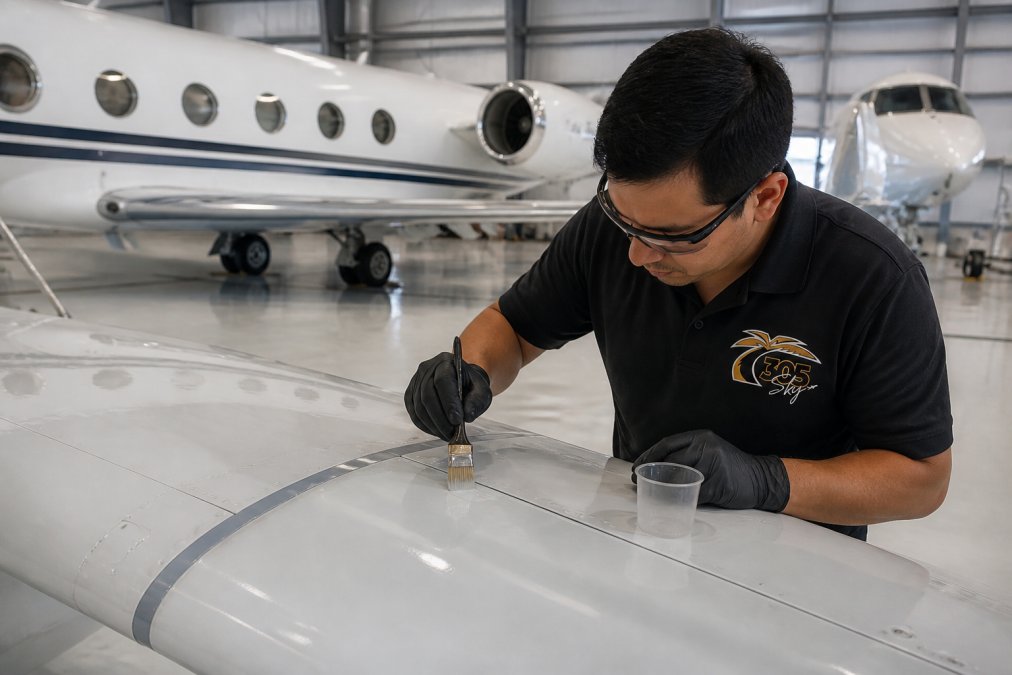
Why Fort Lauderdale Is a Different Risk Profile Than Dallas or Denver
An aircraft based at Fort Lauderdale Executive Airport (FXE) sits within a few miles of the Atlantic Ocean. The prevailing onshore breeze carries salt-laden moisture directly across the ramp. Compare that to an aircraft hangared in Dallas, where the climate is drier and the salt concentration in the air is negligible. The practical difference is that an aircraft based in South Florida may begin showing signs of surface corrosion, white powder around fasteners, paint blistering, within months of arriving from a drier climate, not years.
For owners who fly a King Air or a Citation into South Florida seasonally, the corrosion risk is tied to how the aircraft is stored while here. An aircraft left on an open ramp at FXE or Palm Beach International (PBI) during the summer wet season will accumulate salt residue and experience repeated condensation cycles as temperatures swing between the afternoon heat and evening humidity. That condensation seeps into lap joints, control surface hinges, and battery compartments, creating the exact conditions for intergranular and exfoliation corrosion to begin.
The Hyper-Local Prevention Protocol
The most effective defense is a combination of hangar storage and a disciplined preventative application schedule. Hangaring an aircraft shields it from direct salt spray and reduces the time it spends in humid, corrosive air. For aircraft that must remain on the ramp, more frequent washing and corrosion inhibitor application becomes necessary to remove salt deposits before they initiate oxidation.
A practical protocol for South Florida operators includes:
- Weekly rinsing during the wet season to remove salt deposits before they concentrate and react with the airframe.
- Monthly visual inspections of drain holes, wing roots, and landing gear wells, where salt-laden water pools.
- A professional corrosion inhibitor application at least twice per year, timed before the start of the summer thunderstorm season and again before the drier winter months.
- Hangar storage whenever possible, especially for aircraft that sit unused for more than a few days at a time.
Professional maintenance providers in the region understand these local conditions intimately. When you search for aircraft maintenance near me in South Florida, you want a team that knows the specific corrosion risks of the area and applies treatments accordingly. Humidity control inside the hangar, regular washing to remove salt residue, and consistent application of corrosion inhibitors are the cornerstones of an effective coastal prevention program.
The ROI of a Regional Corrosion Strategy
The financial case for a regional corrosion strategy is straightforward. An owner who follows a South Florida-specific prevention protocol, professional treatments twice a year plus disciplined hangar storage, incurs a predictable maintenance cost. That owner is unlikely to face a surprise corrosion finding during a pre-buy inspection. In contrast, an owner who treats the aircraft as if it were based in a dry climate will eventually face a corrosion repair bill that includes not just the repair itself, but the lost value at resale and the potential for an extended AOG event.
For aircraft brokers and management companies operating fleets of Gulfstreams, Falcons, and Hawkers in the region, the calculus is even clearer. A fleet-wide corrosion prevention program protects the asset value of every aircraft in the portfolio, reduces the risk of unscheduled grounding, and provides a documented maintenance history that strengthens the position when an aircraft moves to a new owner.
Protecting Your Asset: Insurance and Resale Value Impact
Corrosion has a direct and measurable effect on both insurance considerations and resale value. An aircraft with a documented history of regular corrosion control presents a lower risk profile than one with a logbook showing deferred maintenance or evidence of past corrosion repairs. For brokers and buyers, the condition of the airframe is a primary factor in determining market value.
A documented preventative maintenance history signals that the aircraft has been cared for properly, supporting a stronger asking price and faster sale. Conversely, visible corrosion or a history of structural repairs can significantly reduce an aircraft's value and narrow the pool of interested buyers. Pre-buy inspections routinely include a detailed corrosion assessment, and findings here often become negotiating points.
Insurance underwriters also consider maintenance history when evaluating risk. An aircraft with a proactive corrosion control program demonstrates responsible ownership and may be viewed more favorably. The cost of professional corrosion treatment is modest when weighed against the potential reduction in resale value or the difficulty of insuring an aircraft with known structural issues.
Conclusion: Professional Corrosion Control as an Investment
Professional aircraft corrosion control is not an expense to minimize; it is an investment in the long-term value, safety, and availability of your aircraft. The choice is between small, predictable costs spread across regular maintenance intervals or large, unexpected repair bills coupled with extended downtime. For owners who fly frequently or plan to sell eventually, prevention consistently proves to be the more economical path.
At 305 Sky, we bring over 55 years of combined aviation experience to every corrosion control program. Our team of 3rd generation aviators provides transparent pricing and clear communication, ensuring you understand exactly what your aircraft needs and why. We offer comprehensive aircraft maintenance across our four South Florida facilities, with 24/7 AOG emergency response when you need us most. Protect your asset and your schedule by addressing corrosion before it becomes a crisis.
Frequently Asked Questions
How often should private jets undergo professional corrosion inspections?
For aircraft based in coastal areas like South Florida, an annual professional corrosion inspection is the recommended baseline. This aligns with standard annual inspection requirements, but the corrosive salt air exposure warrants a closer look at high-risk areas like landing gear wells, wing spars, and avionics bays. Aircraft that fly frequently or are stored outdoors may need more frequent checks. A qualified inspector with an Inspection Authorization (IA) can help determine the right interval for your specific aircraft and operating environment.
What is the difference between DIY corrosion treatment and professional services?
DIY treatment typically involves surface cleaning and applying a corrosion inhibitor to visible areas. It is fine for minor, surface-level issues if you have the training. Professional services, however, go much deeper. They use specialized equipment to detect hidden corrosion, perform proper surface preparation, and apply approved protective coatings. Professionals also have the expertise to assess structural integrity, address underlying causes, and provide the correct logbook documentation required for airworthiness. For any corrosion affecting structural components, a professional is required to maintain compliance.
Does professional corrosion control impact the resale value of a Citation or Gulfstream?
Yes. A documented history of professional corrosion control is a significant value driver. It provides verifiable proof that the aircraft's structural integrity has been maintained, which is a major concern for buyers and brokers. This logbook documentation can set your aircraft apart, shorten the sales cycle, and support a higher asking price. Conversely, a history of corrosion findings or deferred maintenance will raise red flags during a pre-buy inspection and can substantially reduce your aircraft's market value.
What are the FAA requirements for corrosion inspection and control?
The FAA mandates corrosion control as part of an aircraft's continued airworthiness. This is typically fulfilled through an approved maintenance program, which often includes specific corrosion inspection tasks. For aircraft operating under 14 CFR Part 91, the annual inspection must be thorough enough to determine the aircraft's overall condition, which includes checking for corrosion. For aircraft under Part 135, a more formalized Continuous Airworthiness Maintenance Program (CAMP) is required, which includes detailed corrosion prevention and control programs (CPCP) for certain aircraft types.
Corrosion control demands expertise and consistency. The 305 Sky team delivers both, with routine inspections, protective treatments, and secure digital record keeping that keeps your aircraft airworthy and compliant. Get a quote today and see how professional corrosion management preserves your investment.
This article was written using GrandRanker