Table of Contents
- What Is ADS-B Out and Why Does It Matter for Private Planes?
- FAA 14 CFR 91.225 Regulations: Airspace Requirements and Deadlines
- How to Verify ADS-B Compliance Before You Fly
- ADS-B Avionics Installation Cost: What Shapes the Final Bill
- ADS-B In vs. Out: What Compliance Requires
- Common Installation Failures and How to Avoid Them
- Conclusion: Your Step-by-Step Path to ADS-B Compliance
- Frequently Asked Questions
Last Updated: September 6, 2026
ADS-B compliance is the FAA mandate requiring aircraft to broadcast their precise GPS position, altitude, and velocity to air traffic control and nearby aircraft, replacing older radar-based surveillance. For owners of Challenger, Citation, King Air, and Gulfstream aircraft, this isn't optional: since January 1, 2020, the FAA requires ADS-B Out in most controlled airspace, and flying without it means being grounded from the busiest airspace in the country. At 305 Sky in Fort Lauderdale, our avionics team has helped private owners navigate these requirements. Below, we'll walk through exactly what the regulation demands, how to verify your aircraft is compliant, and what common installation pitfalls to avoid.
What Is ADS-B Out and Why Does It Matter for Private Planes?
ADS-B Out is the broadcast function of Automatic Dependent Surveillance-Broadcast, a surveillance technology that transmits your aircraft's GPS position, altitude, and velocity to ground stations and other equipped aircraft every second. Unlike traditional radar, which sweeps every 4-12 seconds, ADS-B provides real-time tracking with higher accuracy, improving safety and enabling more efficient air traffic control routing.
For private plane owners, ADS-B compliance matters because it directly determines where you can fly. Aircraft without functioning ADS-B Out are simply not permitted in the airspace classes where the mandate applies, which includes most of the airspace above 10,000 feet MSL and the busy terminal areas around major cities. FAA's official ADS-B In/Out guidance provides the definitive technical breakdown of how the system operates.
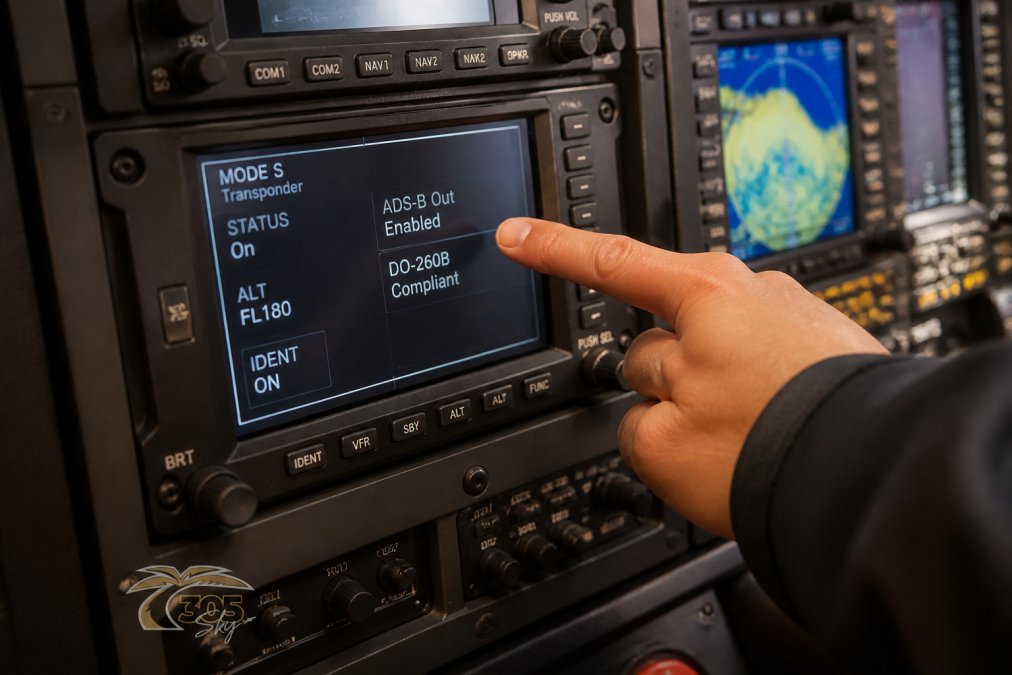
FAA 14 CFR 91.225 Regulations: Airspace Requirements and Deadlines
The controlling regulation is 14 CFR 91.225, which establishes both where ADS-B Out is required and the performance standards your equipment must meet. The compliance deadline passed on January 1, 2020, meaning every aircraft operating in the designated airspace must already be equipped, and any aircraft purchased without compliant equipment must be upgraded before it can fly in those areas.
Where ADS-B Out Is Required
The mandate applies to specific airspace classifications, and understanding these boundaries is critical for planning your routes:
- Class A airspace (18,000 feet MSL and above): Always required
- Class B airspace (busy airport terminal areas): Always required
- Class C airspace (moderate airport terminal areas): Always required
- Class E airspace at and above 10,000 feet MSL, excluding airspace below 2,500 feet AGL: Always required
- Class E airspace within 30 nautical miles of a Class B primary airport, from the surface to 10,000 feet MSL: Always required
For South Florida operators, this means flying into Fort Lauderdale Executive, Miami International, or Palm Beach International requires compliance at all times within those terminal areas.
Equipment Standards: DO-260B and Your Transponder
Your ADS-B Out equipment must meet the technical standard known as DO-260B, which governs the data format and transmission performance. This standard requires a certified GPS position source, typically WAAS-enabled, feeding a Mode-S transponder with Extended Squitter capability operating on 1090 MHz. Some light aircraft use a Universal Access Transceiver (UAT) on 978 MHz for lower altitudes, but turbine aircraft and anything operating above 18,000 feet must use the 1090 MHz Mode-S transponder-based solution.
How to Verify ADS-B Compliance Before You Fly
Verifying compliance isn't as simple as checking that your transponder turns on. The FAA requires a specific flight test to confirm your installation meets the performance requirements, and that test must be documented with a report.
The verification process involves a ground inspection followed by a flight test conducted by an authorized avionics shop. During the flight, the technician verifies GPS position accuracy, altitude encoding, and transmission performance against the DO-260B standard. The result is a compliance report that must be kept in your aircraft records.
What the FAA Compliance Report Actually Shows
The compliance report documents several critical parameters from your flight test, including GPS position integrity, horizontal and vertical accuracy, and the proper transmission of your unique ICAO aircraft address. It also confirms that your squawk code and altitude data are being broadcast correctly to air traffic control.
Without this report, your installation is not considered compliant, even if the equipment appears to work. The FAA's ADS-B performance requirements page spells out exactly what parameters are checked and the tolerances your system must meet.
ADS-B Avionics Installation Cost: What Shapes the Final Bill
The cost of an ADS-B upgrade varies significantly based on your aircraft type and existing avionics. While we don't publish a one-size-fits-all number, the final bill is shaped by three main factors: the equipment you choose, the labor required, and whether your existing transponder can be upgraded or must be replaced.
Why Installation Labor Varies by Aircraft Type
Labor is where costs diverge most between aircraft types. A King Air with accessible avionics bays and existing WAAS GPS may require only a transponder swap and wiring changes, while a Challenger with integrated avionics systems may need extensive certification work and multiple test flights. Aircraft with older analog avionics often require additional interface modifications to integrate the new digital equipment. Our team pairs avionics upgrades with routine maintenance and aircraft inspections to minimize downtime, so your aircraft can return to service efficiently.
For a current quote tailored to your specific aircraft, check the 305 Sky pricing page or contact our Fort Lauderdale facility directly.
ADS-B In vs. Out: What Compliance Requires
ADS-B In is the receive function that displays traffic and weather on a cockpit display, while ADS-B Out is the broadcast function that makes your aircraft visible to others. The FAA mandate requires only ADS-B Out; ADS-B In is optional but offers significant safety benefits.
For private owners, understanding this distinction prevents overspending. You can achieve full regulatory compliance with ADS-B Out alone, using a Mode-S transponder with Extended Squitter on 1090 MHz. Adding ADS-B In capabilities, such as a tablet receiver or display integration, is a separate upgrade that enhances situational awareness but isn't required by the regulation.
Common Installation Failures and How to Avoid Them
The most frequent issue we see is an installation that passes ground checks but fails the flight test due to GPS position source problems. A non-WAAS GPS or an antenna with poor signal reception will cause intermittent data transmission failures that ground your aircraft.
Other common failures include:
- Incorrect ICAO aircraft address programming
- Improper altitude encoder calibration
- Antenna placement causing signal shadowing
- Software configuration mismatches between transponder and GPS
Choosing an experienced avionics shop matters. A proper installation includes a thorough pre-flight ground test, a documented flight test, and troubleshooting of any discrepancies before the aircraft is returned to service. The FAA's list of approved ADS-B equipment can help you confirm your chosen components meet the standard before you commit to installation.
Conclusion: Your Step-by-Step Path to ADS-B Compliance
Getting your private plane ADS-B compliant doesn't have to be a headache, but it does require attention to detail. Start by confirming your current equipment meets DO-260B, then schedule a verification flight test with a certified avionics shop, and keep your compliance report in your aircraft records. If your aircraft needs an upgrade, work with a shop that understands your specific airframe and the South Florida operating environment.
At 305 Sky, our avionics team handles the full scope of ADS-B compliance for Challenger, Citation, King Air, Learjet, Falcon, Hawker, Gulfstream, Beechjet, and Pilatus aircraft, from equipment selection through installation, flight testing, and documentation. We also offer aircraft management and AOG service for owners who need ongoing support beyond the upgrade itself. With 55+ years of combined experience and four facilities across South Florida, we keep your aircraft airworthy and compliant. Get a quote today and let our team handle the details.
Frequently Asked Questions
Are private planes legally required to have ADS-B Out?
Yes, if you fly in airspace where ADS-B Out is mandated. FAA 14 CFR 91.225 requires ADS-B Out in Class A, B, and C airspace, and above 10,000 feet MSL in Class E airspace (excluding airspace below 2,500 feet AGL). Aircraft operating in these areas need a compliant GPS position source and a transponder broadcasting on 1090 MHz or, for certain aircraft, a UAT. Flying a private plane in these airspace classes without compliant equipment is a regulatory violation.
Can you fly under Class C without ADS-B?
No. ADS-B Out is mandatory within Class C airspace. This includes the airspace from the surface to 4,000 feet above the airport elevation, as well as the outer area that extends from the 20-nautical-mile ring to the 30-nautical-mile ring. If you operate your private plane inside Class C airspace without a compliant ADS-B Out installation, you are in violation of FAA regulations and may face enforcement action, including potential suspension of your pilot certificate.
How do I verify ADS-B compliance for my aircraft?
The FAA provides a free online Public ADS-B Performance Report tool. Enter your aircraft's tail number to see if your equipment is transmitting properly and meeting performance requirements. This report checks parameters like GPS position accuracy and message integrity. For a more thorough check, an avionics shop can run a ground test to confirm your installation meets DO-260B standards. This is especially important after any avionics work, as wiring issues can cause intermittent failures.
What is the difference between ADS-B In and ADS-B Out for compliance?
Only ADS-B Out is required for FAA compliance. ADS-B Out broadcasts your aircraft's position, velocity, and altitude to ground stations and other aircraft. ADS-B In, which receives traffic and weather data, is optional. While not required, many pilots choose to add ADS-B In capability because it provides free graphical weather and traffic information in the cockpit, enhancing situational awareness without a subscription service.
What are the FAA penalties for non-compliance with ADS-B mandates?
Operating in airspace where ADS-B Out is required without compliant equipment can result in FAA enforcement action. Penalties can include a suspension or revocation of your pilot certificate, and civil penalties can reach up to $1,100 per violation. Air traffic control may also deny clearance into restricted airspace. The practical risk is significant, especially for owners who fly regularly in busy South Florida airspace like the Fort Lauderdale and Miami corridors.
What specific airspace requires ADS-B Out equipment?
ADS-B Out is required in Class A airspace, within Class B and Class C airspace areas, within 30 nautical miles of a Class B primary airport (the Mode C veil), and above 10,000 feet MSL over the 48 contiguous states and the District of Columbia, excluding airspace below 2,500 feet AGL. For a private plane based in South Florida, this means any flight into or through the busy airspace around Fort Lauderdale-Hollywood International or Miami International requires full compliance.