Table of Contents
- Why South Florida Owners Are Upgrading Avionics in 2026
- What to Expect: Aircraft Avionics Installation Timeline
- FAA Avionics Certification Requirements Explained
- AOG Avionics Support in Fort Lauderdale: How It Works
- Glass Cockpit and ADS-B Upgrades: Cost vs. Benefit
- Avionics Providers in South Florida: What Each Does Best
- Matching the Upgrade to Your Aircraft Type
- Frequently Asked Questions
Last Updated: September 16, 2026
Why South Florida Owners Are Upgrading Avionics in 2026
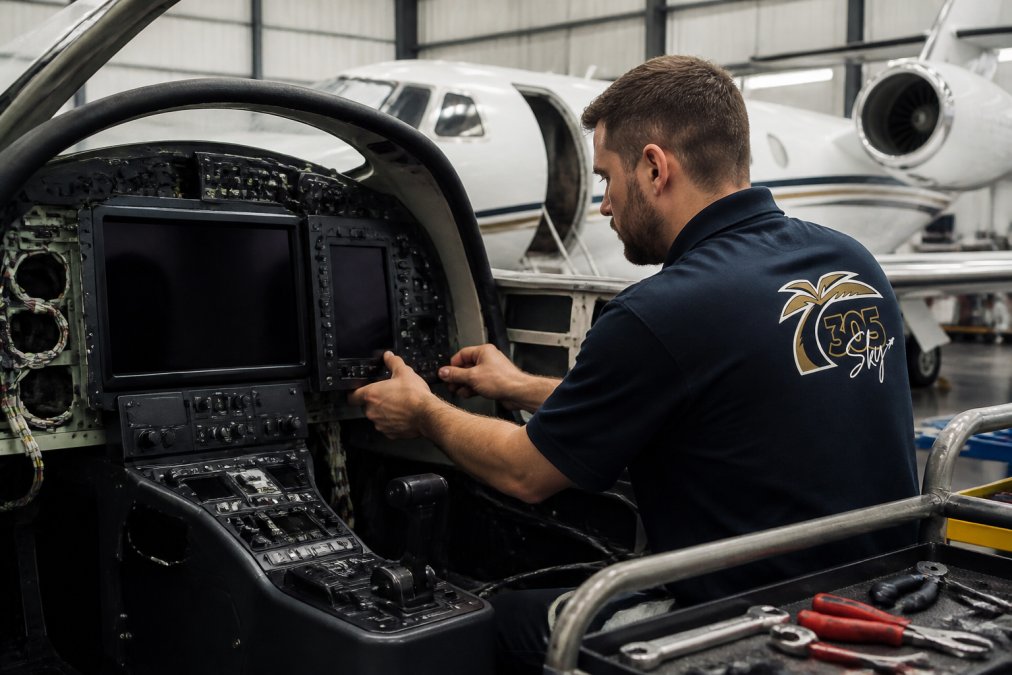
Aircraft avionics upgrades in South Florida have shifted from a nice-to-have line item to a scheduling priority for most turbine owners. This guide from 305 Sky covers what drives that shift, what the work actually involves, and how to keep your aircraft flying while it happens. The reasons are practical: legacy CRT displays and obsolete navigation radios are increasingly hard to support, and avionics shops in the Fort Lauderdale area are booking further out as demand climbs.
The single biggest driver is parts scarcity. When a legacy display or radio fails, there is no new-unit supply chain behind it, so a routine squawk can turn into weeks of downtime while a shop hunts for a serviceable core. Owners flying Challenger, Citation, King Air, Learjet, Falcon, Hawker, Gulfstream, Beechjet, and Pilatus airframes feel this most acutely because those fleets carry a wide mix of original and mid-life avionics.
South Florida adds its own pressure. High humidity and salt air punish connectors, pins, and antenna mounts, and a panel that behaves in a dry climate can develop intermittent faults here. The FAA's avionics and airworthiness guidance is the reference point for what counts as an approved installation, and it is worth reading before you commit to any scope of work.
What to Expect: Aircraft Avionics Installation Timeline
A typical aircraft avionics installation timeline runs from two weeks for a focused radio or transponder swap to several months for a full glass cockpit retrofit, depending on parts availability, panel fabrication, and how much wiring has to be replaced. Most of the calendar time is not installation. It is planning, parts procurement, and the return-to-service paperwork that follows.
A realistic sequence looks like this:
- Discovery and scope (1-2 weeks): photograph the existing panel, pull the aircraft records, confirm what is already approved.
- Quote and engineering review (1-3 weeks): determine whether the change is a minor alteration or needs a supplemental type certificate.
- Parts procurement (2-12 weeks): the largest variable. Backordered displays and radios reset the entire schedule.
- Panel fabrication (1-3 weeks): cutting, powder coating, and labeling new panel sections.
- Installation and wiring (1-4 weeks): rack mounting, harness work, antenna runs.
- Ground test and flight test (2-5 days): functional checks, then an approved flight to verify navigation accuracy and autopilot coupling.
- Records and return to service (2-5 days): logbook entries, weight and balance update, and a revised equipment list.
The thing nobody tells you about avionics scheduling is that the aircraft is often sitting idle waiting on parts, not waiting on labor. Ask your shop to order long-lead items before the aircraft arrives.
Pre-Upgrade Inspection Checklist
A pre-upgrade inspection catches the problems that turn a two-week install into a two-month one. Run through this before you approve a scope of work:
- Confirm the existing equipment list matches what is physically installed
- Inspect antenna mounts and coax runs for corrosion or chafing
- Check circuit breaker panel capacity for the new load
- Verify the aircraft's weight and balance envelope can absorb the change
- Review the last several squawk sheets for recurring avionics faults
- Photograph the full panel, front and rear, before anything is removed
- Confirm pitot-static and transponder test dates are current
- Identify any non-avionics work that makes sense to do while the panel is open
That last item matters more than most owners expect. If the interior is coming out for a panel modernization, it is far cheaper to address FAA guidance on maintenance recordkeeping items and cosmetic work in the same visit than to open the aircraft twice.
FAA Avionics Certification Requirements Explained
FAA avionics certification requirements come down to one question: is the change a minor alteration or a major one? A minor alteration can be approved by a certified mechanic with a logbook entry. A major alteration requires approved data, typically a supplemental type certificate or a field approval, and a Form 337.
For most modern avionics suites, the manufacturer already holds an STC covering your airframe, and the shop installs under that approval. That is the cleanest path and the one to ask about first. Field approvals still happen, but they depend on the local Flight Standards District Office and add time you may not have budgeted.
Where owners get surprised is in the details. A new GPS navigator may require a revised flight manual supplement. A glass display may change the aircraft's approved equipment list in a way that affects how you file. None of this is exotic, but it all has to be documented before the aircraft returns to service. Ask any shop you are considering how they handle the paperwork trail, because a clean digital record is worth as much as the hardware.
AOG Avionics Support in Fort Lauderdale: How It Works
AOG avionics support in Fort Lauderdale is the difference between a two-hour fix and a two-day wait. AOG means aircraft on ground, and it describes the situation where a fault keeps the aircraft from legally or safely flying. When that happens at 2 AM on a Sunday, what you need is a mobile van, the right test equipment, and someone who has seen the fault before.
Here is what a real response looks like. You call, describe the squawk, and the shop dispatches a mobile unit with the test gear and common spares for your aircraft type. The technician troubleshoots on site, and if the fault is a connector, a pin, or a failed line-replaceable unit, it gets resolved at the ramp.
Glass Cockpit and ADS-B Upgrades: Cost vs. Benefit
Glass cockpit and ADS-B upgrades pay off in two ways: they lower your operating risk, and they raise your aircraft's value at resale. A modern flight deck replaces mechanical gyros and vacuum-driven instruments with solid-state displays, which removes a whole class of failure modes and simplifies troubleshooting. ADS-B Out compliance is already mandatory in controlled airspace, so for most owners that box is ticked.
| Upgrade Path | Typical Scope | Best For | Main Trade-Off |
|---|---|---|---|
| Focused repair | Replace failed LRUs, restore function | Owners selling soon | No capability gain |
| Partial modernization | New GPS, transponder, one display | Most owner-flown turbines | Some legacy items remain |
| Staged retrofit | Displays now, autopilot later | Five-year-plus owners | Two downtime events |
| Full glass cockpit | New panel, displays, autopilot, radios | Long-hold and charter fleets | Highest total investment |
Avionics Providers in South Florida: What Each Does Best
South Florida has no shortage of avionics shops, and they are not interchangeable. Some are strongest on parts and legacy instrument repair. Others specialize in custom panel fabrication or in factory-level support for corporate jets. The right pick depends on your aircraft type and whether you need a one-off repair or a full retrofit.
| Provider | Strength | Best For | Watch Out For |
|---|---|---|---|
| 305 Sky | Full-service maintenance plus avionics, 24/7 AOG | Owners wanting one vendor | Mobile response is regional |
| Duncan Aviation (FXE) | Factory-level corporate jet support | Gulfstream, Citation, Learjet | Premium pricing |
| Sarasota Avionics | Parts inventory, legacy repair | Specific hardware upgrades | Retail-oriented |
| Palm Beach Avionics | Glass cockpit, safety suites | Light jets and GA panels | Full panels cost more |
| Controlled Airspace | Custom panel fabrication | Aesthetic panel overhauls | Limited capacity |
Matching the Upgrade to Your Aircraft Type
Aircraft type drives the scope more than budget does. A King Air panel and a Gulfstream flight deck have almost nothing in common in terms of parts, approval path, or downtime. Matching the upgrade to the airframe is what keeps a project from ballooning.
Frequently Asked Questions
How long does an avionics upgrade take for a private jet?
Most avionics upgrades take two to six weeks depending on scope. A simple GPS or transponder swap can finish in a few days, while a full glass cockpit retrofit with new wiring and panel fabrication often runs four to eight weeks. Aircraft avionics installation timeline also depends on parts availability and whether the shop needs to fabricate custom mounts. Scheduling during slower maintenance periods helps reduce downtime.
Do I need FAA certification for all avionics upgrades?
Yes. Any change to installed avionics requires FAA approval, typically through a Supplemental Type Certificate (STC), Parts Manufacturer Approval (PMA), or a field approval for minor alterations. FAA avionics certification requirements also mean the work must be done by an FAA-certificated repair station or A&P mechanic with Inspection Authorization. Your shop should provide the approved paperwork and logbook entries after installation.
What are the benefits of upgrading to a glass cockpit in South Florida?
Glass cockpit upgrades replace mechanical gauges with digital displays, improving situational awareness, reducing pilot workload, and often lowering long-term maintenance costs. In South Florida's busy airspace, modern displays make it easier to spot traffic and weather. They also boost resale value and keep your aircraft compliant with current navigation and communication standards, which matters for IFR operations.
How do avionics upgrades affect the resale value of my aircraft?
Modern avionics can increase resale value by making your aircraft more attractive to buyers who want ADS-B, GPS, and glass panels already installed. Modern avionics can increase resale value by making your aircraft more attractive to buyers who want ADS-B, GPS, and glass panels already installed. The exact return depends on your aircraft type and the quality of the installation.
Can 305 Sky handle avionics upgrades for Gulfstream or Citation aircraft?
Yes. 305 Sky works on Gulfstream, Citation, Challenger, King Air, Learjet, Falcon, Hawker, Beechjet, and Pilatus aircraft. They provide avionics installation, glass cockpit retrofits, ADS-B compliance, and AOG avionics support in Fort Lauderdale. With 55+ years of combined experience and four South Florida locations, they manage the full scope, from pre-buy inspections to custom panel work, without farming out the job.