Table of Contents
- What Aircraft Cabin Interior Transformation Services Include
- Quick Comparison: Top Cabin Transformation Providers
- How Long Does a Private Jet Interior Refit Take?
- FAA Part 145 Interior Certification Requirements
- Aircraft Cabin Interior Design Trends for 2026
- How Interior Upgrades Affect Resale Value
- Maintenance and Care After Your Cabin Transformation
- Choosing a Cabin Interior Transformation Partner in South Florida
- Frequently Asked Questions
Last Updated: September 17, 2026
What Aircraft Cabin Interior Transformation Services Include
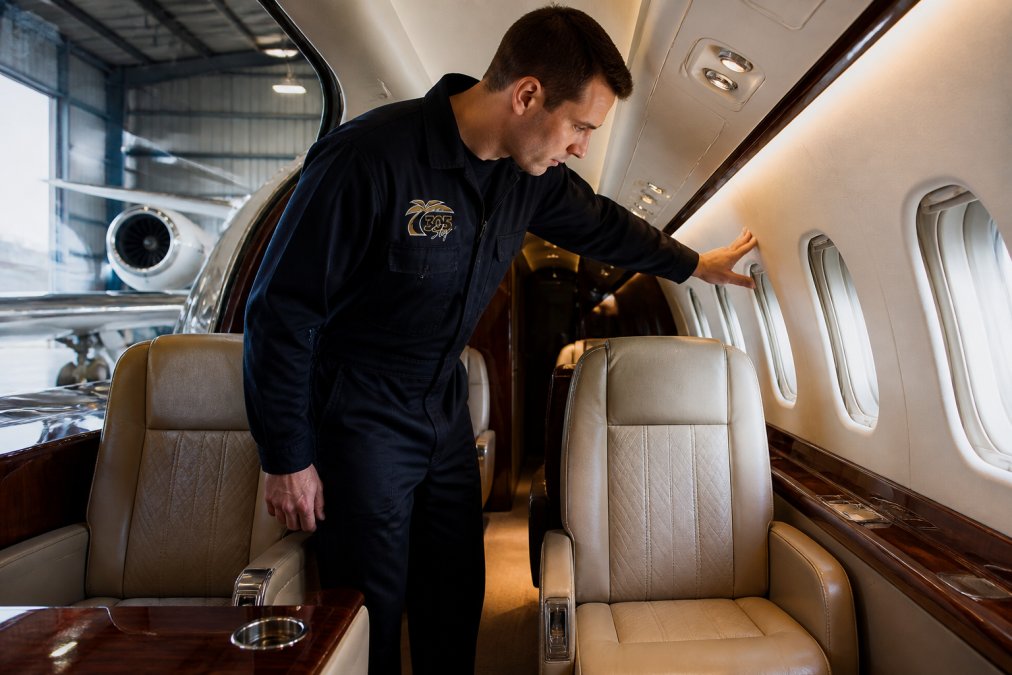
Aircraft cabin interior transformation services cover everything that changes how a cabin looks, feels, and functions, from new leather and carpet to redesigned monuments, lighting, and connectivity. At 305 Sky, we handle these projects for Challenger, Citation, King Air, Learjet, Falcon, Hawker, Gulfstream, Beechjet, and Pilatus owners across South Florida.
A full transformation typically touches:
- Soft goods: seats, divans, carpets, sidewalls, and headliners
- Cabinetry and woodwork: veneer repair, refinishing, and new monument builds
- Cabin management systems (CMS): lighting, shade, and temperature controls
- In-flight entertainment and connectivity: monitors, audio, and Wi-Fi upgrades
- Structural and mechanical work: partition changes, galley and lavatory modifications
Refurbishment vs. Full Transformation
Refurbishment replaces worn materials while keeping the existing layout. A full transformation changes the layout itself, which means engineering drawings, stress analysis, and FAA sign-off.
Quick Comparison: Top Cabin Transformation Providers
Providers split into three groups: regional MRO shops, OEM-backed programs, and component manufacturers. Each fits a different owner.
| Provider Type | Best For | Certification Scope | Typical Strength |
|---|---|---|---|
| Regional MRO (like 305 Sky) | Single aircraft, South Florida owners | Part 145 repair station | Local turnaround, AOG response |
| OEM-backed programs | Textron-family aircraft | Manufacturer engineering | Factory drawings and parts |
| Component manufacturers | Fleet-wide upgrades | Design and production approval | Seating, lighting, CMS hardware |
| Independent upholstery shops | Budget soft-goods refresh | Limited to minor alterations | Low cost on simple jobs |
How Long Does a Private Jet Interior Refit Take?
A private jet interior refit takes anywhere from two weeks for a soft-goods refresh to several months for a full structural transformation. The schedule driver is never the upholstery. It is engineering, parts lead time, and certification.
Downtime by Scope: Soft Goods vs. Structural Work
| Scope of Work | Typical Downtime | Main Schedule Risk |
|---|---|---|
| Carpet and headliner only | 1-2 weeks | Material availability |
| Seats and divans re-covered | 2-4 weeks | Foam and leather lead time |
| Cabinetry refinish, new veneer | 4-8 weeks | Veneer matching, cure time |
| New CMS and lighting | 6-10 weeks | STC availability, wiring |
| Partition or galley modification | 3-6 months | Stress analysis, FAA approval |
For a King Air or Citation, a soft-goods refresh is often a two-week event. For a Gulfstream or Falcon with a new floor plan, plan on a full quarter of downtime.
FAA Part 145 Interior Certification Requirements
FAA Part 145 certification requirements mean the repair station performing your interior work must hold a current certificate with the right ratings for the task, and every alteration must return the aircraft to a known compliant state. Cosmetic work on existing materials usually falls under minor alteration rules. Changing the cabin configuration does not.
Minor Alteration vs. Major Alteration: Which Path Applies
A minor alteration is one that does not appreciably affect weight, balance, structural strength, performance, powerplant operation, flight characteristics, or other airworthiness qualities. Re-covering an existing seat in a new leather that carries the correct burn certification is typically minor. So is replacing carpet with a like-for-like material.
The Three Technical Reviews, In Plain Terms
- Flammability: Every new material must meet the burn test standards for its specific location in the cabin. Seat cushions, sidewalls, floor coverings, and partitions each have their own requirements. The material supplier provides test data; the installer must keep it with the aircraft records.
- Weight and balance: New monuments, seats, and CMS hardware shift the envelope. The numbers must be recalculated and documented, not estimated. A heavier cabin can reduce useful load and range in ways the next buyer will notice.
- Stress analysis: Partitions, seat tracks, and galley attachments carry load and need engineering approval. This is the review that most often drives schedule, because it depends on approved data and a DER or ODA sign-off.
The Paperwork You Should Walk Away With
When the project closes, your records package should include:
- The FAA Form 337 for any major alteration, signed and filed
- Flammability test reports for every new material, matched to its location
- Updated weight and balance documentation reflecting the finished cabin
- STC or approved-data references for any installed system
- Interior component maintenance manuals for anything with a service interval
If any of those are missing, the gap tends to surface at your next annual inspection or at a pre-buy, when a buyer's inspector asks for documentation the shop never produced.
Aircraft Cabin Interior Design Trends for 2026
Aircraft cabin interior design trends in 2026 lean toward quiet luxury: matte finishes, warm neutral palettes, and fewer high-gloss surfaces that show every fingerprint. Owners are asking for lighter materials and simpler lines rather than heavy, ornate cabinetry.
Three shifts stand out:
- LED lighting systems tuned to time of day, replacing fixed cabin lighting
- Sustainable materials, including low-VOC foams, recycled-content textiles, and responsibly sourced veneers
- Connectivity as standard, with Wi-Fi and streaming treated as a baseline expectation rather than an upgrade
How Interior Upgrades Affect Resale Value
Interior upgrades affect resale value unevenly. A clean, current cabin helps a listing sell faster. A heavily customized cabin built to one owner's taste can narrow your buyer pool. The rule that holds up: neutral ages well, personal does not. Buyers pay for condition, not for your monogram.
Which Upgrades Tend to Hold Value
- Recent soft goods in a neutral palette. New leather, carpet, and headliners read as "well cared for" even when nothing structural changed. This is the highest-return, lowest-risk spend on a dated cabin.
- LED lighting and modern CMS. Buyers expect controllable, dimmable lighting and a cabin management system that works with current devices. A dated CMS reads as an upcoming expense.
- Connectivity that actually works. Wi-Fi and streaming are baseline expectations now, not upgrades. A cabin with no working connectivity narrows the buyer pool immediately.
- Documented, certified work. A clean records package lets a pre-buy move quickly. Undocumented work invites re-inspection and price negotiation.
- OEM-standard layouts. A layout that matches what the manufacturer offered resells easier than a one-off configuration.
Which Upgrades Tend to Narrow the Buyer Pool
- Heavy personalization. Monograms, unusual color schemes, and bespoke materials that reflect one owner's taste.
- One-off structural configurations. A layout that only works for a specific mission can sit on the market.
- Undocumented alterations. Anything without a Form 337, flammability data, or updated weight and balance.
- Over-improvement relative to the airframe. A cabin that outclasses the avionics and engines can be hard to price.
The Fix-and-Flip Math
If you are buying a distressed or off-market aircraft to fix and flip, interior work is often the highest-return spend, but only when it is scoped to the buyer, not to your taste. A dated cabin drags the whole listing down. A neutral, documented refresh removes the objection before the buyer raises it.
Maintenance and Care After Your Cabin Transformation
Maintenance after a cabin transformation is mostly about protecting new materials and keeping the paperwork current. Leather needs conditioning on a schedule. Veneer needs humidity control. Carpet and headliners need prompt attention when spills happen, before they set.
- Flammability test reports for every new material
- Updated weight and balance documentation
- STC paperwork for any installed system
- Interior component maintenance manuals
Choosing a Cabin Interior Transformation Partner in South Florida
Choosing a cabin interior transformation partner in Fort Lauderdale comes down to three things: certification scope, schedule honesty, and how fast they answer when something goes wrong. South Florida has no shortage of shops.
Here is what to ask before you commit:
- What Part 145 ratings do you hold, and does it cover my airframe?
- Who performs the stress analysis and flammability testing?
- What is your realistic downtime estimate, including parts lead time?
- Can you show me recent interior projects on my aircraft type?
- How do you handle billing so there are no surprises mid-project?
- What happens if my aircraft goes AOG during or after the work?
Frequently Asked Questions
How long does a full aircraft interior refurbishment take?
Timelines depend on scope. Soft goods like reupholstery and carpeting typically take two to four weeks. A full cabin interior transformation with new cabinetry, LED lighting, and cabin management systems can run eight to sixteen weeks, especially when flammability analysis and weight and balance documentation are required. Aircraft with complex structural modifications or custom monuments take longer. Scheduling around inspection cycles reduces total downtime.
Do aircraft interior upgrades require FAA certification?
Yes, most interior changes require FAA approval. Under FAA Part 145, repair stations must follow approved data for any modification affecting the airframe, weight and balance, or cabin safety. Materials must pass flammability testing, and structural changes need stress analysis. A certified shop handles this documentation and returns the aircraft with proper records, keeping your logbooks clean for resale and future inspections.
How do interior upgrades affect the resale value of a private jet?
A modernized cabin often shortens time on market and supports a higher asking price. Buyers comparing two similar airframes consistently favor the one with fresh reupholstery, updated cabin management systems, and clean LED lighting. Documented FAA-compliant work adds confidence. While no upgrade guarantees a dollar-for-dollar return, dated interiors can force price reductions that exceed the cost of a targeted transformation.
What are the latest trends in private jet cabin design?
Current aircraft cabin interior design trends lean toward quiet luxury: muted earth tones, matte finishes, and fewer high-gloss surfaces. Owners are specifying sustainable and eco-friendly interior materials, including low-VOC leathers and recycled-content carpets. Integrated connectivity solutions and upgraded cabin management systems are near the top of most upgrade lists, along with customizable LED lighting scenes that adjust for day or night flying.
What is involved in an aircraft cabin interior transformation?
A transformation covers reupholstery, new carpet and sidewall panels, cabinetry and woodwork restoration, metal plating, LED lighting, and often in-flight entertainment or connectivity upgrades. The process starts with a design consultation, then engineering and certification review, followed by disassembly, fabrication, assembly, and final inspection. A reputable shop provides a written scope, timeline, and weight and balance update before work begins.