Table of Contents
- What Makes Avionics Systems Critical for Corporate Jet Operations
- Top Avionics Platforms for Corporate Jets
- Cons:
- Cons:
- FAA Avionics Certification Requirements for Corporate Jets
- Corporate Jet Avionics Upgrade Cost and ROI Considerations
- AOG Avionics Repair Services in South Florida
- Key Features That Matter in Modern Cockpit Integration
- Retrofitting Legacy Aircraft vs. Forward-Fit Solutions
- Frequently Asked Questions
Last Updated: September 19, 2026
Modern corporate jet operations depend on the best avionics systems for corporate jets, reliable, integrated platforms that connect pilots to real-time flight data, weather, navigation, and engine monitoring. The best avionics systems for corporate jets balance situational awareness, regulatory compliance, and operational efficiency across platforms like the Citation, King Air, Challenger, Learjet, Falcon, and Gulfstream. At 305 Sky, we provide comprehensive maintenance for these systems across our South Florida facilities. Below, we'll break down the leading avionics suites, regulatory requirements, and what matters when upgrading your aircraft's flight deck.
What Makes Avionics Systems Critical for Corporate Jet Operations
Your avionics system processes flight data, manages navigation, tracks weather, monitors engines, and communicates with air traffic control in real time. A modern flight deck reduces pilot workload, improves situational awareness, and keeps your aircraft compliant with evolving FAA regulations.
Modern avionics consolidate flight data into multi-function displays, synthetic vision systems, and touchscreen interfaces, allowing pilots to spend less time scanning instruments and more time flying safely.
Regulatory pressure is also mounting. The FAA has mandated ADS-B compliance for most airspace, and NextGen implementations continue to reshape how aircraft communicate with ground stations. An avionics upgrade isn't just about capability, it's about future-proofing your aircraft against regulatory change. Research from FAA NextGen implementation guidance confirms that aircraft with modern avionics are better positioned to meet upcoming airspace requirements.
For corporate operators, downtime costs money. Choosing an avionics platform with strong support networks and local service providers minimizes repair delays and keeps your aircraft operational.
Top Avionics Platforms for Corporate Jets
Collins Aerospace Pro Line Fusion
Collins Aerospace Pro Line Fusion combines high-resolution touchscreen displays, advanced synthetic vision, and integrated flight management technology into a scalable, cohesive flight deck.
Pro Line Fusion scales across aircraft types from Citation to Gulfstream, with synthetic vision providing terrain awareness and weather integration that reduces pilot workload during approach and landing.
Installation requires significant cockpit modifications and pilot retraining.
Pros:
- Industry-leading situational awareness
- Highly scalable for various jet platforms
- Strong support network across the United States
Cons:
- High installation and integration complexity
- Significant investment required for retrofit
Garmin G3000 Flight Deck
Garmin G3000 is the workhorse of light to mid-size corporate aviation, combining intuitive touchscreen controls with advanced autopilot integration and multi-pane flight displays for Citations and Beechjets.
The G3000 is straightforward, with pilots adapting quickly.
The G3000 is optimized for smaller cockpits and shorter-range missions.
Pros:
- Intuitive user interface
- Extensive support network
Cons:
- Limited for large-cabin, long-range operations
- Less advanced synthetic vision than premium competitors
Universal Avionics InSight Display System
Universal Avionics InSight uses modular architecture, allowing incremental upgrades rather than full flight deck replacement, ideal for aging aircraft modernization.
InSight provides synthetic vision, NextGen compliance readiness, and engine monitoring with a flexible upgrade path for legacy King Airs and Citations.
InSight requires specialized installation centers.
Pros:
- Excellent for legacy aircraft modernization
- Highly reliable modular design
- Flexible upgrade path
Cons:
- Requires specialized installation centers
Honeywell Primus Epic
Honeywell Primus Epic is the standard for large-cabin, long-range aircraft like Gulfstream and Falcon, with integrated modular architecture and advanced weather radar.
Epic handles dual-channel autopilot, advanced weather integration, and cabin management connectivity, essential for international and long-range operations.
Epic is justified for demanding missions but may exceed smaller operations' needs.
Pros:
- Proven reliability in heavy operations
- Deep integration with aircraft systems
- Superior for large-cabin, long-range aircraft
Cons:
- Complexity requires specialized training
Thales TopFlight Avionics Suite
Thales TopFlight delivers high-performance flight management and navigation precision, critical for challenging airspace and low-visibility approaches.
TopFlight is popular in international operations and provides strong data link capabilities for modern air traffic management.
Aftermarket support for TopFlight is more limited in the United States.
Pros:
- Exceptional navigation accuracy
- High safety standards and redundancy
- Strong for international operations
Cons:
- Fewer certified service centers in the United States
FAA Avionics Certification Requirements for Corporate Jets
All avionics systems must meet specific FAA certification standards before installation. Understanding these requirements is essential before upgrading.
Instrument Flight Rules (IFR) Certification is required for any system used for instrument approaches under FAA Part 23 or Part 25 standards.
ADS-B compliance is now mandatory in most U.S. airspace. The FAA's ADS-B Out mandate requirements requires aircraft to transmit position and identification data to ground stations and other aircraft. Any new avionics installation must support ADS-B Out capability. Most modern systems include this as standard, but older retrofit options may not.
Terrain Awareness and Warning System (TAWS) certification is required for aircraft operating above 2,500 feet. All major avionics platforms include certified TAWS functionality.
Data Link compliance is becoming increasingly important as the FAA expands CPDLC and ADS-C capabilities in NextGen airspace.
Work with your maintenance provider to confirm your chosen system meets current FAA standards and anticipated regulatory changes.
Corporate Jet Avionics Upgrade Cost and ROI Considerations
Installation costs vary based on aircraft type and system choice. Labor, avionics components, wiring, and cockpit modifications all factor into the final bill. Request a quote from a qualified maintenance provider for accurate pricing.
Downtime is a hidden cost. Installation typically takes weeks; plan upgrades during scheduled maintenance windows or low-use periods to minimize impact.
Resale value increases with modern avionics. Well-equipped aircraft attract broader buyer pools and command higher prices.
Fuel efficiency can improve through better flight planning, more accurate navigation, and optimized altitude management on long-range missions.
Insurance premiums may decrease with modern avionics, particularly systems with advanced safety features like synthetic vision and terrain awareness.
The real ROI depends on your mission profile. High-use charter operations see returns through reduced downtime and resale value. Owner-operators flying occasional long-range missions see returns through improved safety and reduced workload.
AOG Avionics Repair Services in South Florida
An avionics failure on the ground can strand your aircraft. Having access to rapid repair services is critical.
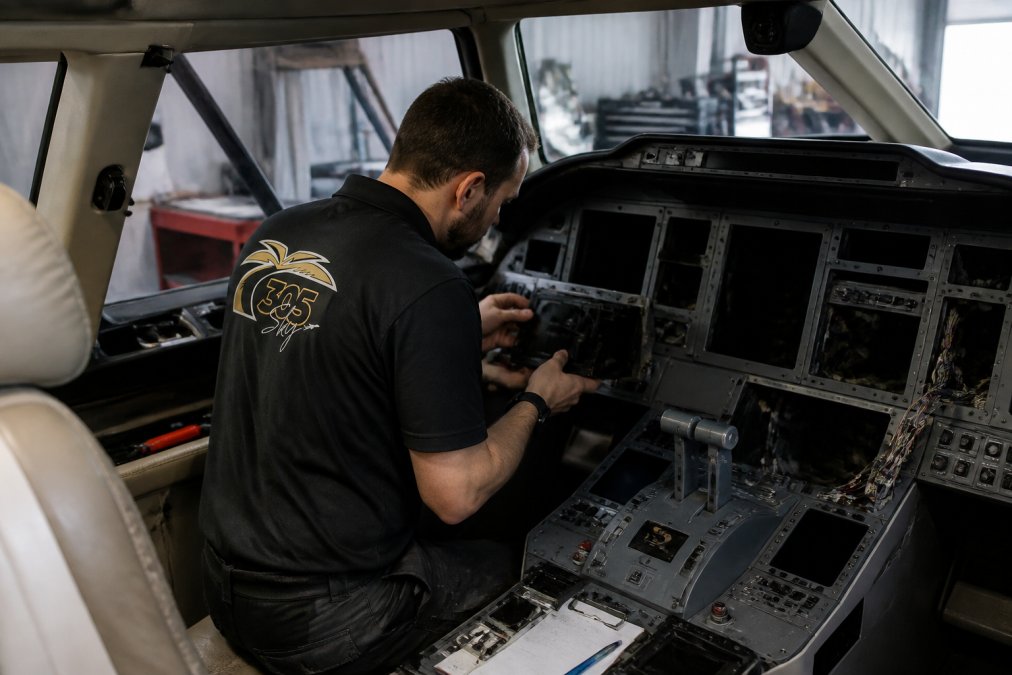
305 Sky operates 24/7 AOG service across South Florida, including Fort Lauderdale, Boca Raton, West Palm Beach, and Vero Beach. When your aircraft experiences an avionics issue, our mobile maintenance van can respond quickly with technicians trained on major avionics platforms. We carry common spare parts and can often resolve issues without requiring your aircraft to be towed to a maintenance facility.
The difference between a quick repair and a prolonged one is access to expertise and parts. When you're grounded, every hour matters. Our team's 55+ years of combined aviation experience means we've seen avionics issues across every major platform, Collins, Garmin, Honeywell, Universal Avionics, and more. We know where problems typically occur and how to resolve them efficiently.
For scheduled maintenance and complex avionics work, our four strategically located South Florida facilities provide the infrastructure to handle everything from routine maintenance to full flight deck retrofits.
Key Features That Matter in Modern Cockpit Integration
When evaluating avionics systems, focus on features that directly impact safety, workload, and compliance.
Touchscreen Displays and Interface Design
Modern avionics rely on touchscreen interfaces to consolidate flight data. The best systems balance tactile responsiveness with logical menu structures that pilots can navigate quickly, even in turbulent conditions.
Synthetic Vision and Terrain Awareness
Synthetic vision displays a computer-generated image of terrain and obstacles ahead, even when visibility is poor. This capability can reduce controlled flight into terrain accidents.
Real-Time Engine Monitoring Systems
Modern avionics integrate engine monitoring data directly into the flight deck display. Pilots can see engine parameters, temperature, pressure, fuel flow, vibration, in real time without looking at separate engine instruments.
Autopilot and Flight Control Integration
Advanced autopilots reduce pilot fatigue on long flights and improve precision during approaches. Modern systems integrate with flight management systems, allowing automated flight planning and execution.
Retrofitting Legacy Aircraft vs. Forward-Fit Solutions
The choice between retrofitting an existing aircraft and buying new equipment with modern avionics built-in depends on your aircraft's age, mission profile, and capital availability.
Frequently Asked Questions
What is the typical timeline for installing a complete avionics system upgrade on a corporate jet?
Installation timelines vary based on aircraft type and system complexity, typically ranging from several weeks to several months. A full avionics suite retrofit on a Citation or King Air generally requires 4-12 weeks of work, depending on whether the aircraft is a forward-fit or legacy platform. Coordination with FAA certification, component availability, and system integration testing all affect the schedule. Working with experienced avionics technicians familiar with your specific aircraft type ensures accurate timeline estimates and minimizes unexpected delays.
How does ADS-B compliance affect corporate jet avionics choices?
ADS-B (Automatic Dependent Surveillance-Broadcast) compliance is mandatory for aircraft operating in controlled airspace, requiring specific transponder and avionics capabilities. Most modern avionics systems like Garmin G3000, Collins Pro Line Fusion, and Universal Avionics InSight include ADS-B compliance as standard. When evaluating avionics upgrades, verify that your chosen system meets current FAA ADS-B requirements and supports future NextGen standards. This ensures your investment remains compliant and future-proof as airspace regulations continue to evolve.
What are the benefits of upgrading to a glass cockpit in a corporate jet?
Glass cockpit upgrades dramatically reduce pilot workload by consolidating flight data onto integrated touchscreen displays, improving situational awareness through synthetic vision and terrain awareness systems, and enabling advanced autopilot capabilities. Pilots spend less time managing individual instruments and more time on flight planning and decision-making. Modern avionics also provide real-time engine monitoring, weather integration, and navigation precision that legacy analog systems cannot match. These improvements enhance safety margins, reduce fatigue on long flights, and support more efficient flight operations.
Which avionics system is best for a King Air or Citation corporate jet?
The Garmin G3000 is an excellent choice for light to mid-size corporate jets like Citations and Beechjets, offering intuitive touchscreen controls and extensive support. For King Air platforms, Universal Avionics InSight provides strong modular capabilities suited to legacy aircraft modernization. Collins Pro Line Fusion delivers premium situational awareness for operators prioritizing advanced synthetic vision and integrated flight management. Your choice depends on your specific aircraft model, mission profile, and whether you prioritize retrofit flexibility or integrated system depth. Consulting with certified avionics technicians in your area helps match the right system to your operational needs.