Table of Contents
- What Is AOG Insurance Coverage and Why Aircraft Owners Consider It
- Understanding Aircraft Downtime Financial Impact
- How AOG Coverage Works: What's Protected and What Isn't
- AOG Insurance vs. Comprehensive Hull Coverage: Key Differences
- Aircraft AOG Recovery Services and Your Response Options
- Private Jet Maintenance Costs in South Florida and AOG Premium Impact
- When AOG Coverage Is Worth the Cost: A Decision Framework
- Conclusion: Making the Right Choice for Your Aircraft
Last Updated: August 30, 2026
What Is AOG Insurance Coverage and Why Aircraft Owners Consider It
AOG insurance coverage reimburses aircraft owners for extraordinary costs incurred when an aircraft becomes grounded due to mechanical failure. When your private jet can't fly, you face crew layovers, charter replacement aircraft, missed business opportunities, and operational disruptions that can cost thousands of dollars per day.
At 305 Sky, we work with aircraft owners across South Florida who face this decision constantly. A mid-size jet grounded for a week can cost $50,000 to $150,000 in indirect expenses alone, before factoring in lost business value or scrambling for alternative transportation (nbaa.org).
AOG insurance doesn't prevent mechanical failure. It converts an unpredictable catastrophic expense into a known, manageable premium. Understanding whether it's worth the cost requires examining what the coverage actually protects, how it compares to alternatives like comprehensive hull insurance, and whether your specific operation faces enough downtime risk to justify the expense.
Understanding Aircraft Downtime Financial Impact
Aircraft downtime isn't just about maintenance time. It's about the cascade of costs that begin the moment your jet can't fly.
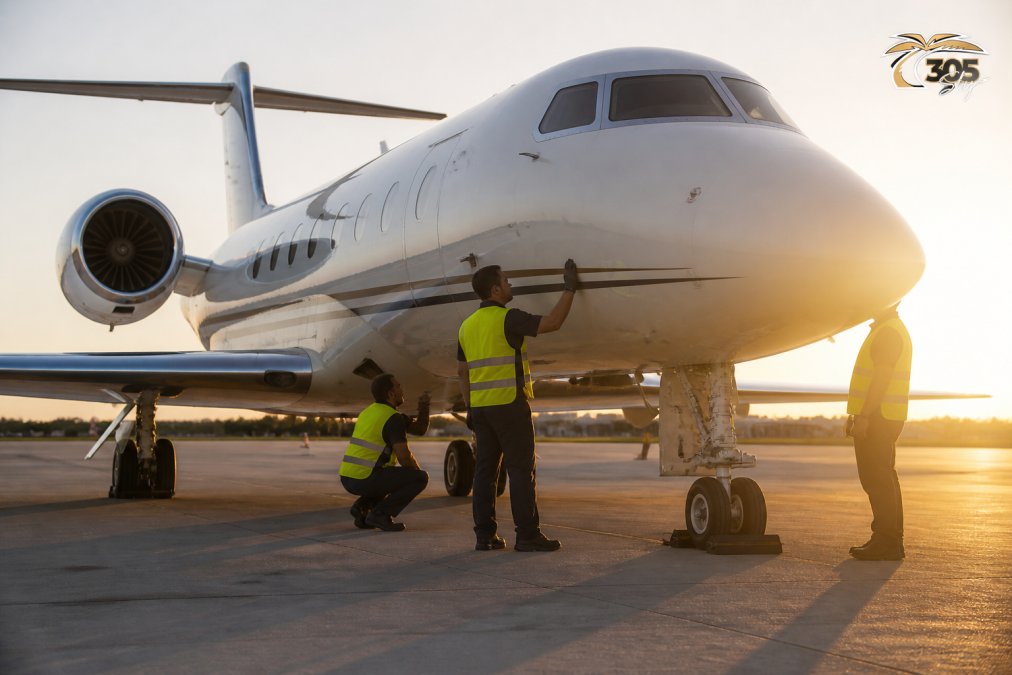
When an aircraft becomes unairworthy due to mechanical failure, you face immediate operational expenses. Charter operators need replacement aircraft at $8,000 to $15,000 per flight hour (nbaa.org). Business operators either ground their mission or pay premium rates for last-minute charter services.
Secondary expenses accumulate quickly: crew salaries continue, hangar fees persist, fuel reserves sit unused. A single mechanical failure grounding an aircraft for 10 days can easily cost $100,000 to $200,000 in lost revenue, crew costs, and replacement aircraft fees.
AOG insurance transfers this risk to an insurance carrier in exchange for a premium. Whether that premium is worth paying depends on the probability of downtime and the severity of financial impact when it occurs.
How AOG Coverage Works: What's Protected and What Isn't
AOG insurance reimburses you for specific categories of expense when your aircraft becomes unserviceable due to covered mechanical failure.
Covered expenses typically include the cost difference between your aircraft's standard operating cost and the cost of renting a replacement aircraft of similar capability. If your jet normally costs $5,000 per flight hour and a replacement costs $12,000 per hour, AOG covers the $7,000 difference. Some policies also cover hotel, meals, and ground transportation for stranded crews.
However, AOG policies come with important exclusions. Routine maintenance is never covered. Coverage activates only when mechanical failure prevents safe flight. Weather-related events are typically excluded unless added as an endorsement. Pre-existing conditions and pilot error are excluded. Most policies require a deductible of $5,000 to $25,000 before coverage applies, and coverage limits may cap reimbursement at $50,000 per occurrence or $150,000 per year.
AOG Insurance vs. Comprehensive Hull Coverage: Key Differences
Many aircraft owners confuse AOG insurance with comprehensive hull coverage. They serve different purposes.
Comprehensive hull insurance protects the physical aircraft itself. If your jet is damaged, hull coverage pays for repairs or replacement. AOG insurance protects your operational continuity and the indirect costs of downtime. It doesn't care whether the aircraft is damaged, only whether you can operate it.
Comprehensive hull insurance is mandatory if you have a loan on the aircraft. AOG insurance is always optional. Here's the practical difference: Your jet needs an engine overhaul lasting six weeks. Hull coverage doesn't apply because there's no damage, just scheduled work. AOG insurance covers the cost difference of renting a replacement aircraft during those six weeks.
The two coverages are complementary, not redundant. You need comprehensive hull to protect your asset. You consider AOG to protect your operations.
Aircraft AOG Recovery Services and Your Response Options
When your aircraft becomes unserviceable, how you respond determines whether AOG insurance actually saves you money.
Some aircraft owners carry AOG insurance but lack a structured response plan. When mechanical failure occurs, they scramble to arrange replacement aircraft and negotiate emergency charter rates. The result: they pay more than necessary because they're operating reactively.
The better approach is having a pre-arranged AOG recovery service that coordinates replacement aircraft, manages logistics, and handles claims while you focus on your mission.
305 Sky provides 24/7 AOG emergency response across South Florida with a mobile maintenance van reaching your aircraft within hours. The team handles diagnostics, determines repair needs, and coordinates recovery to minimize downtime and manage cascading costs.
Standalone AOG insurance requires you to arrange replacement aircraft and submit receipts for reimbursement. You're out of pocket initially, then wait for claims processing. Full-service AOG recovery coordinates with your insurance carrier, arranges replacement aircraft through established networks, and handles billing so you're not fronting emergency costs.
Private Jet Maintenance Costs in South Florida and AOG Premium Impact
AOG insurance premiums are calculated based on your aircraft's replacement cost and operating expense profile. A light jet worth $3 million with $4,000 per flight hour operating costs will have lower premiums than a super-midsize jet worth $15 million with $8,000 per hour costs.
In South Florida, a basic annual inspection costs $8,000 to $15,000 (faa.gov). Major inspections or component overhauls can run $50,000 to $200,000 or more. Aircraft flying 300 hours per year face more wear than those flying 100 hours, increasing mechanical failure probability and AOG risk.
The actual premium depends on your specific aircraft, claims history, and insurance carrier's underwriting. Getting a precise quote requires working with an aviation insurance broker who understands your operation.
When AOG Coverage Is Worth the Cost: A Decision Framework

The decision to purchase AOG insurance should be based on three measurable factors: your probability of downtime, the financial impact of that downtime, and the premium cost.
Probability of Downtime
How often does your aircraft become unserviceable due to mechanical failure? Ask your maintenance provider: How many unscheduled maintenance events occurred in the past three years? How often has the aircraft been grounded unexpectedly? This historical data predicts future downtime.
Financial Impact of Downtime
Calculate your actual downtime cost. Personal owners rarely face operational downtime costs. Charter operators face lost revenue plus replacement aircraft costs. Corporate operators face lost business opportunities plus crew and operational expenses. Downtime costs typically range from $10,000 to $25,000 per day for commercial operations.
Premium Cost vs. Expected Downtime Cost
Compare your annual AOG premium against your expected annual downtime cost. If your premium is $5,000 and your expected downtime cost is $50,000 annually, the premium is justified. If your expected downtime cost is $2,000, you're overpaying.
A charter company flying 1,000 hours per year with occasional maintenance issues faces genuine downtime risk; AOG insurance is a rational business expense. A personal owner flying 50 hours per year with a well-maintained aircraft faces minimal risk; AOG insurance is luxury protection.
Also consider your cash position. If you have substantial reserves and can absorb downtime costs without operational disruption, self-insuring is viable. If downtime would create genuine financial hardship, AOG insurance transfers that risk for a known premium.
Conclusion: Making the Right Choice for Your Aircraft
AOG insurance addresses the extraordinary costs incurred when your aircraft becomes unserviceable. Whether it's worth the cost depends on your operation's profile, downtime probability, and financial exposure.
For charter operators and corporate flight departments managing multiple aircraft and frequent missions, AOG coverage is typically justified. For personal owners flying occasionally, it's often unnecessary.
Calculate your specific downtime risk using historical maintenance data and your operation's profile. Compare that risk against the premium cost. If the premium is less than your expected annual downtime cost, purchase coverage. If not, self-insure.
When you need emergency AOG response and coordination, 305 Sky provides 24/7 aircraft maintenance and recovery services across South Florida with a mobile van reaching your aircraft within hours. Our team has over 55 years of combined aviation experience and manages the entire recovery process, diagnostics, coordination, and claims handling, so you stay focused on your mission. Get a Quote and discover how transparent, family-oriented aircraft care minimizes your downtime exposure and keeps your operation running.
Frequently Asked Questions
| Question | Answer |
|---|---|
| What does AOG insurance actually cover? | AOG insurance reimburses the cost difference between your aircraft's normal operating expenses and the cost of renting a replacement aircraft while yours is grounded due to mechanical failure. Coverage limits and exclusions vary by policy. |
| Is AOG insurance the same as comprehensive hull coverage? | No. Hull coverage protects the physical aircraft from damage. AOG coverage protects your operational continuity and the indirect costs of downtime. Both are complementary but serve different purposes. |
| How much does AOG insurance cost? | Premiums vary based on your aircraft's value, operating costs, use, and claims history. For a precise quote, work with an aviation insurance broker who can assess your specific operation. |
| When does AOG insurance NOT cover downtime? | Standard AOG policies exclude routine maintenance, weather-related damage, pre-existing conditions, pilot error, and operator negligence. Coverage activates only for unexpected mechanical failure covered under the policy terms. |
| Should I purchase AOG insurance for my aircraft? | Calculate your actual downtime risk using historical maintenance data. If your expected annual downtime cost exceeds your annual premium, the coverage is justified. If not, self-insuring may be the better choice. |
Frequently Asked Questions
What does AOG insurance cover for private aircraft?
AOG insurance covers financial losses when your aircraft is grounded due to mechanical failure or equipment breakdown. Coverage typically includes replacement aircraft rental costs, crew expenses, hotel accommodations, and ground transportation. However, standard AOG policies do not cover loss of charter revenue or scheduled mission delays caused by weather or other non-mechanical issues. Coverage limits and exclusions vary by policy, so review your specific endorsement carefully to understand what perils and costs are protected.
How does South Florida's weather impact the need for AOG coverage?
South Florida's hurricane season, salt spray corrosion, and high humidity increase mechanical stress on aircraft systems, raising the statistical likelihood of unexpected groundings. Windstorm damage, corrosion-related failures, and electrical system issues occur more frequently in this climate. Owners operating in the region face higher downtime risk and longer recovery periods during peak weather months. This geographic risk profile makes aircraft AOG recovery services and rapid response capabilities especially valuable, since local weather events can delay parts shipment and repair scheduling.
Is AOG coverage included in standard aviation hull insurance?
No. Standard hull insurance covers physical damage to your aircraft but does not include AOG financial protection. AOG coverage is an optional add-on or policy endorsement that covers indirect costs of mechanical failure, such as replacement aircraft rental and crew expenses. You must purchase it separately or request it as a rider to your existing policy. Many owners mistakenly assume hull coverage protects them during downtime, so confirm your current policy details with your insurance broker before an emergency occurs.
What are typical costs associated with AOG events?
AOG costs depend on aircraft type, mission duration, and availability of replacement aircraft. A single day of downtime on a mid-size jet can cost $5,000-$15,000 in replacement aircraft rental alone, plus crew expenses, hotel, and ground transportation. For charter operators or time-sensitive business flights, costs escalate rapidly. Private jet maintenance costs in South Florida also tend toward the higher end due to labor rates and parts availability in the market. Without AOG coverage, these unexpected expenses come directly from your operating budget, potentially disrupting scheduled missions and business operations.
How does AOG coverage interact with FEMA or government disaster relief?
AOG insurance and government disaster relief serve different purposes. FEMA assistance typically applies to property damage and personal hardship after declared disasters, not to aircraft operational costs. AOG coverage protects you from the financial impact of mechanical failure regardless of cause, filling the gap that disaster relief does not address. If your aircraft sustains damage during a hurricane or severe weather event, hull insurance covers the repair, but AOG coverage protects your operational costs while repairs occur. These two protections work independently and do not overlap.
This article was written using GrandRanker