Table of Contents
- What Is Aircraft on Ground Recovery?
- Immediate Assessment and Grounding Diagnosis
- How to Minimize Aircraft Downtime During AOG Events
- AOG Logistics Services and Supply Chain Coordination
- Maintenance Crew Coordination and Ground Handling
- FAA Airworthiness Compliance for AOG Recovery
- Aircraft Turnaround Management and Return to Service
- Conclusion
Last Updated: August 29, 2026
What Is Aircraft on Ground Recovery?
Aircraft on Ground recovery, or AOG recovery, is the emergency response process that kicks in when an aircraft becomes unfit to fly due to mechanical failure, system malfunction, or damage. When an aircraft is grounded unexpectedly, every hour of downtime costs operators money, disrupts schedules, and strains resources. The aircraft on ground recovery process involves rapid diagnosis, coordinated logistics, maintenance execution, and regulatory compliance to return the aircraft to service as quickly as possible.
At 305 Sky, we understand that AOG situations demand speed without sacrificing safety or compliance. An AOG event isn't just a maintenance problem, it's an operational crisis that requires simultaneous action across multiple fronts: identifying what's wrong, sourcing parts, coordinating crews, and ensuring every repair meets FAA airworthiness standards before the aircraft flies again (faa.gov).
The difference between a well-managed AOG recovery and a chaotic one comes down to preparation, communication, and having the right team in place. This guide walks you through the entire aircraft on ground recovery workflow, from the moment you discover a problem through the final return-to-service inspection.
Immediate Assessment and Grounding Diagnosis
The first hours of an AOG event determine how quickly you'll resolve it. Your immediate priority is understanding exactly why the aircraft is unfit to fly. This isn't guesswork, it's systematic troubleshooting that narrows down the root cause so you can source the right parts and deploy the right expertise.
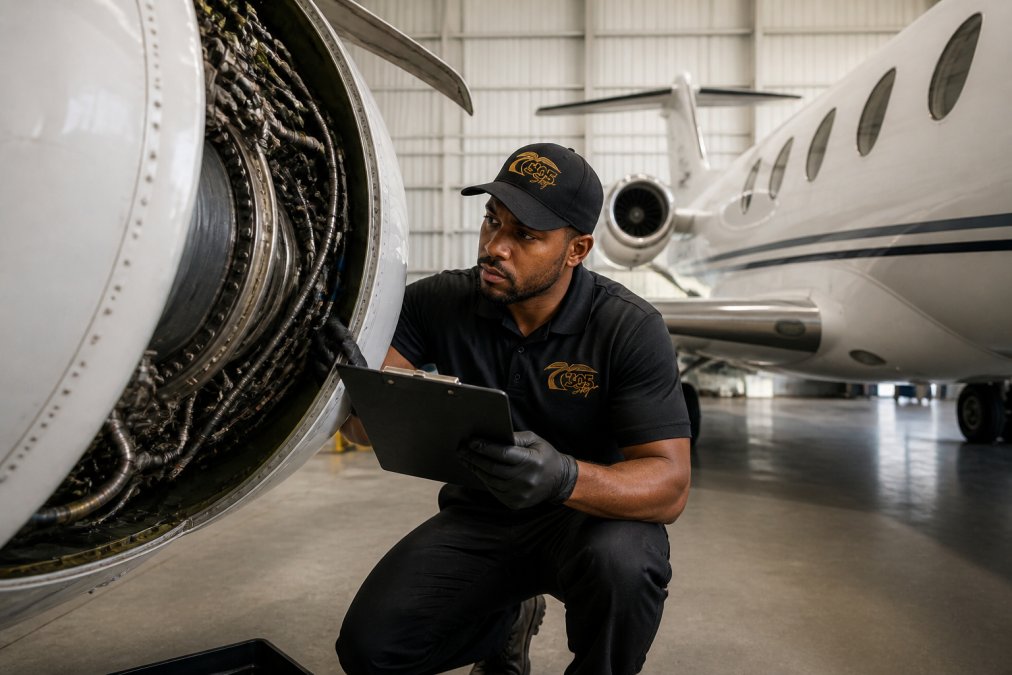
Start with a complete visual inspection of the aircraft. Look for obvious signs: fluid leaks, visible damage, burned-out components, or loose connections. Document everything with photos and written notes. Many AOG events stem from issues that become apparent only under close inspection, a cracked connector, corrosion on electrical contacts, or a hydraulic line that's been slowly weeping.
Next, run diagnostic scans on the aircraft's avionics and engine management systems. Modern aircraft log fault codes automatically. Pull those codes immediately. They point directly to failed components or system failures. If the aircraft has a glass cockpit, the flight data is often your fastest path to the root cause. A single fault code can eliminate hours of guessing.
Interview the flight crew about what happened. When did the problem first appear? Were there warning lights? Did performance degrade gradually or suddenly? The crew's account often reveals patterns, intermittent issues suggest electrical or connection problems, while sudden failures often point to component failure.
Once you've identified the problem, classify its severity. Is this a critical safety issue that grounds the aircraft indefinitely until fixed? Or is it a limitation that allows continued operation under restrictions? This classification determines your urgency level and which repair path you'll take. A non-critical issue might be deferred to the next scheduled maintenance window. A critical issue demands immediate action.
How to Minimize Aircraft Downtime During AOG Events
Downtime during an AOG event translates directly to lost revenue and schedule disruption. Minimizing that downtime requires parallel action across multiple teams, you can't afford to wait for one task to finish before starting the next.
The key to reducing downtime is predictive logistics. The moment you've diagnosed the problem, start sourcing parts before you've even begun the repair. Don't wait for the maintenance crew to remove the failed component and then start looking for a replacement. That sequential approach costs hours or days. Instead, initiate parts procurement immediately while your maintenance team prepares the aircraft for repair.
Establish a parts priority list. Identify the primary component that needs replacement, but also identify backup options and compatible alternatives. Some aircraft can accept parts from multiple manufacturers or from earlier production runs. Knowing these alternatives gives you flexibility if your first-choice part isn't available. Contact multiple suppliers simultaneously. Speed matters more than cost in an AOG situation.
For how to minimize aircraft downtime, consider these parallel workflows:
- Diagnosis and procurement happen simultaneously, not sequentially
- Maintenance crew prepares the aircraft while parts are in transit
- Regulatory documentation is drafted before the repair begins
- Return-to-service inspection is scheduled the moment you know the timeline
Many operators in Fort Lauderdale and across South Florida have learned that having a 24/7 emergency response team on standby cuts downtime dramatically. A mobile maintenance van that can arrive quickly, equipped with common replacement parts and diagnostic tools, often resolves simple AOG events before a scheduled maintenance facility even opens.
Track your actual downtime against your planned timeline. If you estimated a 6-hour repair and it's already at hour 8, escalate immediately. Call in additional crew, expedite parts delivery, or consider alternative solutions. The cost of overtime and expedited shipping is almost always less than the cost of extended downtime.
AOG Logistics Services and Supply Chain Coordination
The logistics side of AOG recovery is where most delays happen. A part that's 500 miles away might as well be on another continent if it takes 48 hours to arrive. AOG logistics demands speed and visibility across your entire supply chain.
Start with your parts suppliers. Identify which vendors can deliver AOG parts on emergency timelines. Not all suppliers offer same-day or next-day delivery. The ones that do become critical partners during an emergency. Establish agreements with multiple suppliers for critical components, engine parts, hydraulic systems, electrical components, avionics modules. You want redundancy in your supply chain.
Understand the difference between aircraft parts that are in regular inventory versus those that require special ordering. Common components like filters, seals, and hoses are usually stocked by major suppliers. Specialized parts, engine components, transmission units, avionics modules, often require lead times of days or weeks under normal circumstances. During an AOG event, expedited delivery can compress that timeline, but it comes at a premium.
For AOG logistics services Fort Lauderdale, your best option is a maintenance provider with established relationships with parts distributors and the infrastructure to coordinate rapid delivery. A provider with a mobile van, local parts inventory, and direct supplier relationships can often source and deliver parts in hours rather than days.
Coordinate with ground handling services at your location. If your aircraft is at Fort Lauderdale Executive Airport, Boca Raton, West Palm Beach, or another South Florida facility, ensure ground handlers know you're in AOG status. They'll prioritize hangar access, ramp positioning, and equipment availability. Clear communication prevents delays caused by facility logistics.
Create a parts tracking system. Once a component ships, you need real-time visibility. Know when it's leaving the supplier, when it's in transit, and when it arrives. Build in buffer time for unexpected delays, weather, traffic, or logistics hiccups can add hours to delivery timelines.
Maintenance Crew Coordination and Ground Handling
The maintenance crew executing the repair is only as effective as the coordination supporting them. A well-organized AOG response has clear roles, communication protocols, and backup resources.
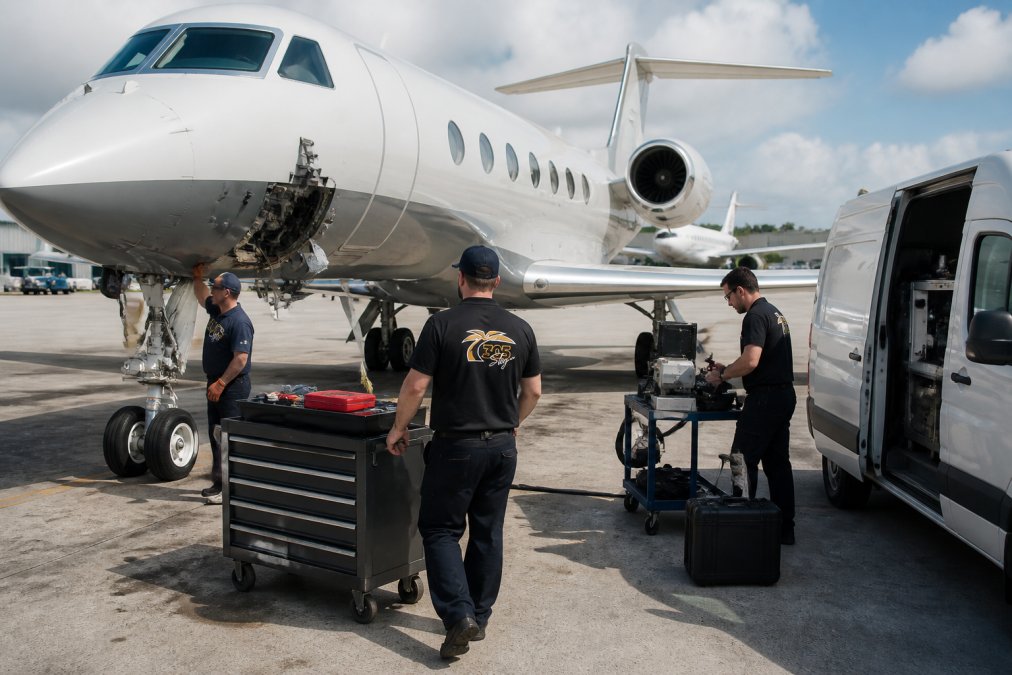
Assign a single point of contact for the AOG event, usually the maintenance manager or lead technician. This person coordinates between the flight crew, parts suppliers, regulatory compliance, and the maintenance team. All decisions flow through this person. Ambiguity during an AOG event costs time.
Ensure your maintenance crew has the right tools and equipment on-site before they begin the repair. A technician who has to stop mid-repair to locate a tool wastes critical hours. For AOG events, stage all necessary equipment in the hangar before the work begins. This includes diagnostic equipment, replacement parts, test equipment, and safety gear.
Coordinate with ground handling services for aircraft positioning and equipment access. The aircraft needs to be positioned so maintenance crews can access the failed component safely. Ground handlers provide tow services, positioning equipment, and ramp access. Clear communication with ground services prevents delays caused by facility logistics.
Brief your maintenance crew on the repair scope before they start. Walk through the job step-by-step. Identify potential complications. If a component is difficult to access or if the repair requires special techniques, discuss those details upfront. A crew that understands the full scope works more efficiently and makes fewer mistakes.
Establish a communication cadence. For AOG events lasting more than a few hours, schedule brief status updates every 30 minutes. These updates should cover: work completed, work remaining, any complications discovered, updated timeline estimate, and any additional resources needed. This keeps all stakeholders, dispatch, crew, operators, informed and allows for rapid decision-making if the situation changes.
FAA Airworthiness Compliance for AOG Recovery
Every repair performed during an AOG recovery must meet FAA airworthiness requirements. This isn't optional. An aircraft that returns to service without proper compliance hasn't actually returned to service, it's still grounded from a regulatory standpoint.
FAA airworthiness compliance for AOG recovery means documenting every step of the repair process and ensuring the work meets the standards outlined in the aircraft's maintenance manual and applicable FAA regulations. For most general aviation aircraft, this falls under Part 43 (Maintenance, Preventive Maintenance, Rebuilding, and Alteration) and Part 91 (General Operating and Flight Rules) (faa.gov).
The specific compliance requirements depend on the nature of the repair. A simple component replacement (like an engine air filter) requires minimal documentation. A major repair (like hydraulic system overhaul) requires detailed work orders, parts traceability, and potentially an FAA-approved repair station. Know the difference before you start the repair.
Maintain a detailed work order for every AOG repair. The work order documents:
- The original problem and diagnosis
- The repair plan and parts used
- The technician performing the work and their certification
- The time spent on each task
- Any deviations from the standard procedure
- The final inspection and sign-off
This documentation becomes part of the aircraft's permanent maintenance record. It's reviewed during future inspections, during any accident investigation, and by potential buyers if the aircraft is ever sold. Poor documentation can create liability and regulatory issues long after the AOG event is resolved.
Ensure the technician performing the repair is appropriately certified. For complex repairs, you may need an Airframe and Powerplant (A&P) mechanic with appropriate ratings (faa.gov). For some work, you might need an FAA-approved repair station. Don't cut corners on certification. An uncertified repair creates liability and makes the aircraft legally unfit to fly.
Perform a thorough inspection after the repair is complete. This isn't a quick visual check, it's a detailed inspection that verifies the repair was performed correctly and that the component is functioning as designed. For critical systems, this inspection should be performed by someone other than the technician who performed the repair.
Aircraft Turnaround Management and Return to Service
Once the repair is complete and documented, your focus shifts to getting the aircraft back to the air as quickly as possible while ensuring every regulatory requirement is satisfied.
The return-to-service process involves several steps. First, complete any remaining documentation. Ensure the work order is signed off by the appropriate mechanic. Update the aircraft's maintenance logbook to reflect the repair, the parts used, and the technician's certification. This documentation is critical, it's your proof that the aircraft has been properly maintained.
Next, perform a functional test of the repaired system. For an engine repair, this might be a run-up test where the engine is started and run at various power settings to verify normal operation. For avionics repairs, this might be a systems check to ensure the equipment is communicating properly with other aircraft systems. These functional tests verify that the repair actually fixed the problem.
Coordinate with the flight crew for the first flight after repair. Brief them on what was repaired, any operational limitations or cautions they should be aware of, and any monitoring they should do during flight. If the repair involved a critical system, the crew should be prepared to return to the airport immediately if any issues arise.
Schedule a post-flight inspection if the repair involved a critical system. After the aircraft completes its first flight following the repair, inspect the repaired component again to ensure it performed correctly under flight loads. This additional inspection catches any issues that might not have been apparent during ground testing.
Document the return-to-service date in the aircraft's maintenance records. This marks the official end of the AOG event. From this point forward, the aircraft is available for normal operations, subject to any operational limitations that may apply.
Conclusion
An AOG event is a crisis that demands speed, coordination, and technical expertise, but it's a crisis you can manage effectively with the right preparation and response plan. The aircraft on ground recovery process isn't mysterious. It's a systematic workflow: diagnose the problem, source the parts, execute the repair, ensure compliance, and return the aircraft to service.
When you're facing an AOG situation in Fort Lauderdale or anywhere across South Florida, having a 24/7 emergency response team makes all the difference. 305 Sky provides exactly that, rapid mobile maintenance with experienced technicians, direct parts coordination, and full FAA compliance documentation. Get a quote from 305 Sky today, and know that when an emergency strikes, expert help is available.
Frequently Asked Questions
Q: What does AOG mean in aviation maintenance?
A: AOG stands for Aircraft on Ground, a critical operational status that means an aircraft is unable to fly due to mechanical, technical, or maintenance issues. In aviation, an AOG event triggers emergency response protocols because every hour of downtime represents lost revenue, disrupted schedules, and operational strain. The aircraft remains grounded until the unfit to fly condition is resolved and regulatory compliance is confirmed through inspection and testing.
Q: How does the aircraft on ground recovery process begin?
A: The recovery process starts with immediate notification to your maintenance provider and a rapid technical assessment. A qualified technician diagnoses the problem, determines what parts or labor are needed, and establishes a recovery timeline. Simultaneously, logistics coordination begins to source spare parts, schedule ground crew, and arrange ground support equipment. The faster this initial phase moves, the sooner your aircraft returns to service.
Q: How can private jet owners prepare for an AOG situation?
A: Establish a relationship with a 24/7 AOG service provider before you need them, keep detailed maintenance records accessible, maintain a spare parts inventory for common issues, and have a clear communication protocol with your flight crew and maintenance team. Having a pre-arranged service agreement and knowing your provider's response time and capabilities means faster recovery when an AOG event occurs. Regular preventive maintenance also reduces the likelihood of unexpected groundings.
Q: What role does logistics play in aircraft recovery?
A: Logistics is the backbone of AOG recovery. Supply chain visibility and coordination ensure spare parts arrive quickly, ground handling services are available when needed, and maintenance crews have the equipment and materials to work efficiently. Effective AOG logistics services minimize delays by managing part procurement, delivery scheduling, and inventory tracking. Without strong logistics coordination, even simple repairs can extend downtime significantly.
This article was written using GrandRanker