
Table of Contents
- What Mobile AOG Repair Services Actually Do
- Aircraft AOG Recovery Costs: The Financial Case
- Mobile Aircraft Maintenance in Fort Lauderdale: Speed vs. Hangar Work
- AOG Emergency Response Time: What Real 24/7 Support Means
- When Mobile AOG Services Are Worth the Investment
- Regulatory Compliance and Insurance Considerations
- The Verdict: Is Mobile AOG Right for Your Operation?
Last Updated: August 19, 2026
What Mobile AOG Repair Services Actually Do
Aircraft on Ground (AOG) is the aviation industry's term for an aircraft that's grounded and unable to fly due to maintenance issues, mechanical failures, or component damage. When your aircraft is AOG, every hour of downtime translates directly to lost revenue, missed charter flights, or disrupted business operations. Mobile AOG repair services bring certified maintenance technicians and specialized equipment directly to your aircraft, whether it's parked at a hangar, on the tarmac, or at a remote location, to diagnose and repair the problem on site.
The core value proposition is simple: speed. Instead of arranging hangar space, coordinating towing or ferry flights, and waiting for availability at a fixed maintenance facility, mobile repair teams arrive with the tools and expertise to start work immediately. For operators in South Florida, where weather delays and scheduling conflicts are common, this responsiveness can mean the difference between losing a charter contract and completing it on time.
Mobile AOG services typically include line maintenance (routine inspections and minor repairs), avionics troubleshooting and component replacement, structural repairs, fuel system diagnostics, landing gear servicing, and emergency diagnostics to identify root causes of failures. A qualified mobile repair team operates under FAA-approved repair station standards, maintains proper maintenance logbooks, and ensures all work meets airworthiness directives and regulatory compliance requirements. At 305 Sky, our 24/7 mobile response capability means we dispatch technicians immediately when you call, not days later when hangar space opens up.
The catch is that mobile services have limits. Heavy maintenance requiring specialized equipment, engine overhauls, or major structural work may still require a fixed facility. But for the majority of AOG situations, avionics failures, fuel leaks, electrical issues, component replacements, mobile technicians can resolve the problem and get you airborne again.
Aircraft AOG Recovery Costs: The Financial Case
The financial argument for mobile AOG services hinges on two numbers: the cost of downtime and the cost of repair.
Aircraft downtime is expensive. A mid-size business jet generating charter revenue loses between $3,000 and $10,000 per day of grounded time. Corporate flight departments lose productivity when executives can't travel. Even private owners lose the utility and enjoyment of aircraft ownership. When you're AOG, every hour matters.
Fixed-base maintenance facilities charge facility fees on top of labor and parts. You're paying for hangar space, ground handling, scheduling coordination, and overhead whether your aircraft needs two hours of work or twenty. Mobile services eliminate the facility component entirely, you pay only for technician labor and parts. For a straightforward repair that takes 4-6 hours, this can save thousands of dollars compared to hangar rates.
The decision becomes clearer when you model specific scenarios. A fuel leak discovered during preflight inspection might require 3-4 hours of diagnostic work and component replacement. At a fixed facility, you'd book hangar time (often a minimum 8-hour charge), pay ground handling fees, and potentially wait days for availability. With mobile AOG response, a technician arrives within hours, diagnoses the issue, orders parts if necessary, and completes the repair at your location. The total cost is lower, and you're operational faster.
However, mobile services aren't always cheaper for complex work. An avionics system requiring deep troubleshooting or a structural repair involving multiple systems might benefit from the controlled environment, specialized test equipment, and cross-functional expertise available at a major maintenance facility. The financial case for mobile services is strongest for straightforward, time-sensitive repairs where speed and convenience offset any marginal cost difference.
Mobile Aircraft Maintenance in Fort Lauderdale: Speed vs. Hangar Work
Fort Lauderdale's location in South Florida makes it a hub for business aviation and private jet operations. The region's proximity to Caribbean destinations, combined with favorable weather for much of the year, creates consistent demand for aircraft availability. That demand also means hangar space is competitive and expensive, and scheduling delays are common.

Speed is the defining advantage of mobile maintenance in this market. When your aircraft is AOG in Fort Lauderdale, you have immediate access to multiple mobile repair teams operating 24/7. A technician can be on-site within 1-2 hours, often while your aircraft is still at the airport where the issue was discovered. Hangar-based shops, by contrast, require you to arrange towing or ferry flights, wait for hangar availability, and coordinate with their scheduling system, a process that routinely takes 24-48 hours.
The operational readiness difference is substantial. Mobile technicians work with your aircraft in its operational environment, the hangar, the tarmac, the fixed-base operator's facility, which means they can test systems under realistic conditions and identify issues that might not appear in a controlled hangar setting. They also have direct access to your aircraft's logbook, maintenance history, and operational context, which speeds diagnosis.
Hangar maintenance remains superior for certain work. Structural inspections requiring specialized lighting and access equipment, heavy maintenance involving engine work, or major interior refurbishment all benefit from the controlled environment and specialized tools of a fixed facility. But for the unscheduled maintenance events that define AOG situations, avionics failures, fuel system issues, electrical problems, component replacements, mobile technicians operating to FAA-approved repair station standards deliver faster resolution and lower total cost.
The trade-off in Fort Lauderdale is straightforward: mobile services prioritize speed and convenience; hangar services prioritize depth and specialized capability. For most operators, the answer isn't either/or, it's having both available depending on the situation.
AOG Emergency Response Time: What Real 24/7 Support Means
"24/7 support" is marketing language. Real 24/7 AOG response is operationally different and far more valuable.
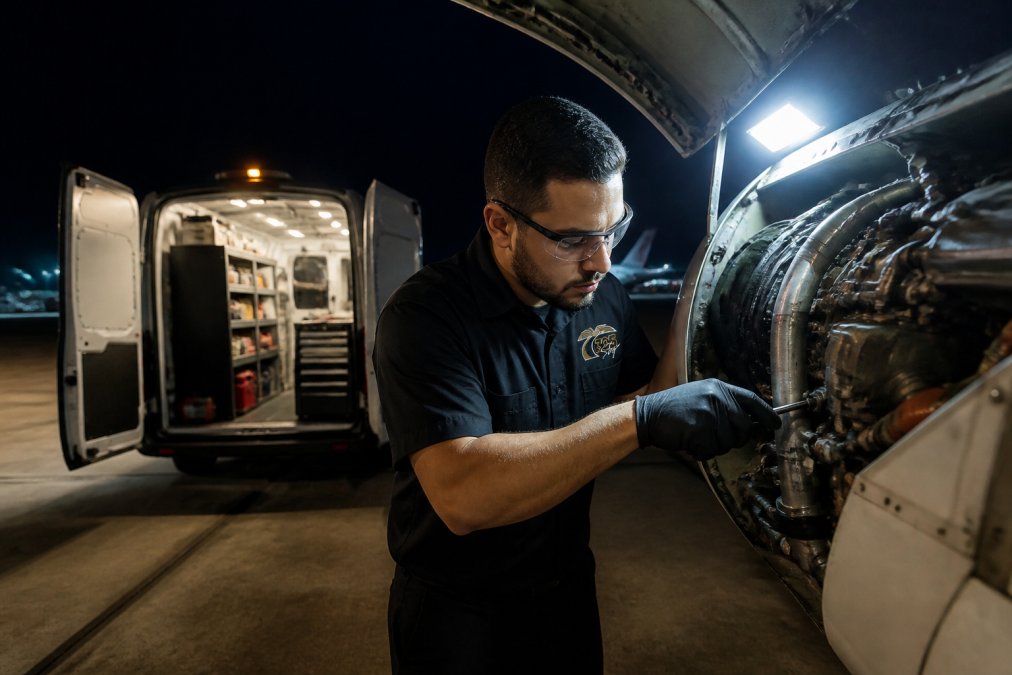
True 24/7 AOG response means a dedicated technician or team is on call at all times, not just available during business hours. When you call at 2 AM on a Sunday because your aircraft won't start, a real 24/7 provider dispatches a technician immediately, not tomorrow morning. This requires staffing depth, geographic positioning, and operational infrastructure that most maintenance shops don't maintain.
The response time difference is dramatic. A typical fixed-base facility operates 8 AM to 5 PM, Monday through Friday. If your aircraft fails on a Friday evening, you're grounded until Monday morning at the earliest, potentially losing an entire weekend of charter revenue or a critical business trip. A 24/7 mobile service dispatches within 1-2 hours, any day, any time.
Real 24/7 response also means technicians are equipped and authorized to perform emergency diagnostics and repairs immediately. They don't need to call a supervisor, wait for parts availability, or coordinate with other departments. They arrive with diagnostic equipment, common replacement components, and the technical authority to make decisions on the spot. For critical systems, electrical failures, fuel leaks, avionics outages, this immediate action capability is the difference between a 2-hour repair and a 24-hour delay.
The operational reality of 24/7 AOG response requires geographic coverage. A provider serving South Florida needs technicians positioned across the region, Fort Lauderdale, Boca Raton, West Palm Beach, Vero Beach, so response times remain consistent regardless of where your aircraft is located. This geographic distribution, combined with mobile van equipment and technician availability, is what separates genuine 24/7 response from standard business-hours support.
When Mobile AOG Services Are Worth the Investment
The decision to use mobile AOG services depends on your operational profile and risk tolerance.
Mobile AOG services are worth it if you operate regularly. If your aircraft flies multiple times per week, the probability of an unscheduled maintenance event is high enough that access to 24/7 mobile response provides genuine value. One prevented downtime event, a missed charter, a delayed business trip, a lost operational day, pays for months of access to rapid response capability.
They're worth it if your aircraft is mission-critical. Business aircraft used for time-sensitive operations (executive transport, charter revenue, medical missions) can't absorb downtime. The cost of being grounded for even one day often exceeds the cost of premium mobile response. For these operators, 24/7 mobile AOG service is insurance against operational failure.
They're worth it if you operate in a congested market. In South Florida, where hangar space is limited and scheduling conflicts are common, mobile services eliminate the coordination burden. You avoid the delays inherent in scheduling fixed-facility maintenance, and you maintain control over your aircraft's availability.
They may not be worth it if your aircraft is stored and flown occasionally. If you own a personal aircraft that flies 20-30 hours per year and is stored in a hangar at a full-service facility, the probability of AOG events is lower, and the facility-based maintenance team may be sufficient. Mobile AOG services add cost without proportional risk reduction.
They're not a substitute for scheduled maintenance. Mobile services excel at unscheduled repairs and emergency response. Routine inspections, scheduled maintenance, and preventative maintenance should follow a planned schedule at a facility with comprehensive logbook tracking and regulatory oversight. Mobile services complement scheduled maintenance; they don't replace it.
The financial case strengthens with operational intensity. High-use aircraft, mission-critical operations, and time-sensitive missions justify investment in rapid response capability. Lower-use aircraft with flexible schedules may find standard facility-based maintenance sufficient.
Regulatory Compliance and Insurance Considerations
Every aircraft maintenance action, whether performed by a mobile technician or a hangar facility, must comply with FAA regulations and airworthiness directives. This is non-negotiable and applies equally to mobile and fixed-base services.
Mobile AOG technicians must work under an FAA-approved repair station certificate. This certification verifies that the technician, the equipment, and the operational procedures meet federal standards for safety and quality. It also means all work is documented in your aircraft's maintenance logbook with proper authorization and traceability. An FAA-approved mobile service is legally equivalent to a hangar-based facility, the location of the work doesn't affect regulatory compliance.
Insurance considerations are more nuanced. Your aircraft liability insurance covers maintenance performed by any FAA-approved repair station, but you should verify coverage with your insurance carrier before selecting a mobile provider. Some policies specify approved vendors or require notification before using new service providers. A transparent provider, one that communicates openly about certifications, insurance coverage, and liability, makes this verification straightforward.
Liability for work performed by mobile technicians follows standard aviation maintenance law. The repair station is responsible for quality and compliance; you're responsible for authorizing the work and ensuring it's documented properly. If a repair causes subsequent damage, the repair station's liability insurance typically covers the claim. This is why verifying that your mobile provider carries appropriate liability coverage is essential.
The Verdict: Is Mobile AOG Right for Your Operation?
Mobile AOG repair services are worth the investment for most aircraft operators in South Florida who value operational availability and can't absorb downtime costs. The speed, convenience, and predictability of 24/7 mobile response justify the premium for mission-critical aircraft and high-use operations.
The question isn't whether mobile AOG services are objectively "worth it", it's whether they're worth it for your specific operation. An aircraft that flies 200+ hours annually and generates charter revenue? Mobile AOG response is essential insurance against downtime. A personal aircraft that flies occasionally and is stored at a full-service facility? Standard facility-based maintenance may be sufficient.
The strongest case for mobile AOG services is the one that resonates most with operators: peace of mind. Knowing that certified technicians can arrive within hours, diagnose your aircraft's problems on site, and execute repairs without facility delays removes a significant operational risk. For operators in Fort Lauderdale and across South Florida, where weather delays and scheduling conflicts are routine, that certainty has measurable value.
305 Sky's 24/7 mobile AOG response, combined with four strategically located South Florida facilities and 55+ years of combined aviation experience, delivers the speed and expertise that time-sensitive operations require. Our transparent approach means no surprises, you know exactly what to expect when you call, and you get rapid, professional service when you need it most.
The real question isn't whether mobile AOG services are worth it in theory. It's whether you can afford to be grounded when your aircraft fails. For most operators, the answer is no, and that's when mobile AOG response becomes invaluable.
Get a quote from 305 Sky and discover how 24/7 mobile maintenance can keep your aircraft operational and your business moving. With rapid response, transparent pricing, and expert technicians available any time, day or night, you'll have the reliable support that mission-critical operations demand.
Frequently Asked Questions
What does AOG mean in aviation maintenance?
AOG stands for Aircraft on Ground. It describes a situation where an aircraft is unable to fly due to a maintenance issue, mechanical failure, or unscheduled repair. AOG events halt revenue-generating operations and require immediate resolution. Mobile AOG repair services dispatch technicians and equipment directly to the aircraft's location to minimize downtime and restore operational readiness as quickly as possible.
How much does an aircraft AOG recovery cost for a private jet?
Aircraft AOG recovery costs vary widely depending on the issue severity, aircraft type, and required parts or labor. Direct repair costs may range from a few hundred dollars for minor fixes to tens of thousands for major component failures. However, the true cost includes lost revenue during downtime. Many operators find that mobile AOG services reduce total recovery costs by minimizing the time the aircraft sits idle and avoiding expensive repositioning to a distant maintenance facility.
When should you choose mobile AOG repair over moving the aircraft to a hangar?
Choose mobile AOG repair when the aircraft is already airworthy enough to reach a hangar but the repair is time-critical, or when the aircraft cannot safely fly. Mobile services work best for line maintenance, avionics troubleshooting, fuel system inspections, and component replacements that don't require specialized heavy-maintenance equipment. For structural repairs, corrosion control, or major overhauls, a full-service facility is necessary. Evaluate turnaround time, repair complexity, and downtime costs to decide which approach minimizes your operational impact.
Is mobile AOG repair FAA-approved and compliant?
Yes, legitimate mobile AOG repair services operate under FAA-approved repair station certificates and comply with all airworthiness directives and maintenance standards. Technicians must hold appropriate certifications, and all work must be documented in the aircraft's maintenance logbook with proper sign-off. Before engaging any mobile service, verify their repair station certificate, ask about their FAA compliance procedures, and confirm they carry appropriate liability insurance to protect your aircraft and operation.
This article was written using GrandRanker