
Table of Contents
- What Constitutes an Emergency Engine Repair
- Core Diagnostics and Assessment in Emergency Engine Repair
- Essential Fluids and Cooling System Checks
- AOG Aircraft Maintenance Services and Rapid Response
- Emergency Engine Repair Timeline and Deployment
- Aircraft Engine Troubleshooting Steps Before Professional Help
- When to Call for Professional Emergency Towing and Repair
- Roadside Breakdown Safety and Documentation
Last Updated: August 24, 2026
What Constitutes an Emergency Engine Repair
An emergency engine repair is any urgent maintenance intervention required to restore an aircraft to airworthy condition when unexpected mechanical failure occurs. Unlike routine maintenance scheduled in advance, emergency repairs demand immediate diagnosis and intervention to prevent safety risks and operational downtime. A warning light during preflight, unusual vibration during engine start, or a fluid leak discovered before departure all trigger emergency protocols requiring immediate assessment, rapid parts sourcing, and expert troubleshooting.
At 305 Sky, our 24/7 AOG (Aircraft on Ground) response team understands the pressure you face when an engine problem grounds your aircraft. Our mobile maintenance van and strategically located facilities across South Florida mean we can reach your aircraft quickly, diagnose the issue, and deploy a repair plan within hours, not days.
Core Diagnostics and Assessment in Emergency Engine Repair
When an emergency engine repair call comes in, technicians follow a systematic assessment protocol that identifies the root cause, determines whether the aircraft can fly safely, and prioritizes repair sequencing. This diagnostic phase typically takes 30 minutes to two hours, depending on symptom complexity. Technicians connect specialized diagnostic equipment to read engine parameters, monitor fuel flow, check ignition timing, and assess compression across all cylinders.
Engine Performance and Spark Plug Inspection
Engine performance diagnostics form the foundation of any emergency repair. Technicians measure cylinder compression, fuel pressure, and ignition system output. Low compression in one or more cylinders signals internal wear, carbon buildup, or valve problems. Abnormal fuel pressure indicates a failing pump or clogged filter.
Spark plugs are often the first component inspected during emergency diagnostics. Fouled, worn, or corroded plugs prevent reliable ignition and can cause rough running, hard starts, or complete engine failure. Replacing spark plugs is one of the fastest emergency repairs, typically 20 to 40 minutes per engine. The visual condition of the plugs tells a story: black deposits suggest running too rich, white deposits indicate running too lean, and oil fouling points to internal engine leakage. Emergency repairs always verify the complete ignition chain: plugs, wires, distributor cap, rotor, and magneto timing.
Electrical System Diagnostics
The electrical system powers ignition, fuel injection, avionics, and essential instruments. Emergency electrical diagnostics focus on three components: battery voltage, alternator output, and circuit integrity.
A dead or weak battery is the most common electrical emergency. Technicians test battery voltage under load; a healthy aircraft battery should maintain 24 volts (or 12 volts for smaller aircraft) even when the starter is engaged. The alternator is the second critical check. A failing alternator leaves the aircraft running on battery power alone, which depletes within 30 to 60 minutes of flight (faa.gov). Technicians measure alternator output at idle and at cruise RPM. Circuit integrity testing reveals broken wires, corroded connectors, or failed relays. A single corroded connector in the ignition circuit can prevent engine starting or cause intermittent ignition failure during flight.
Essential Fluids and Cooling System Checks
Aircraft engines depend on precise fluid levels and clean cooling systems to operate safely. Engine oil serves dual purposes: lubrication and cooling. Low oil pressure during flight can cause bearing failure and sudden engine seizure. Emergency diagnostics measure oil pressure at idle and at cruise RPM. Pressure below 20 PSI at idle signals a failing oil pump or internal leakage that demands immediate repair (faa.gov). Technicians also inspect oil color and consistency; dark, sludgy oil indicates overheating or contamination and requires a complete oil and filter change.
Coolant system failures cause engine overheating, which can warp cylinder heads, crack engine blocks, or trigger catastrophic failure. Emergency cooling system diagnostics include radiator leak inspection, hose integrity checks, and coolant level verification. Technicians pressurize the cooling system to locate leaks, replace cracked hoses, and top off coolant before releasing the aircraft.
Fuel system emergencies involve contamination, pressure loss, or line rupture. Contaminated fuel clogs fuel filters and injectors, causing rough running or complete fuel starvation. Emergency fuel diagnostics include fuel filter inspection, fuel pressure measurement, and fuel sample analysis. A clogged fuel filter can be replaced in 15 to 30 minutes.
AOG Aircraft Maintenance Services and Rapid Response
The difference between a minor inconvenience and a major crisis often comes down to response time. AOG (Aircraft on Ground) services exist because aircraft downtime costs thousands of dollars per hour. 305 Sky's AOG response model combines mobile maintenance vans with four strategically positioned facilities across South Florida. When an emergency call comes in, our team dispatches the nearest technician or mobile unit to your location. For aircraft at Fort Lauderdale Executive Airport, Boca Raton, West Palm Beach, or Vero Beach, our response time averages 45 minutes to two hours, depending on severity and current workload.
Mobile maintenance vans carry common emergency repair components: spark plugs, alternators, fuel filters, hoses, connectors, and diagnostic equipment. For many emergency repairs, technicians can complete diagnosis and repair on-site without towing the aircraft. Only when major engine work is required, internal bearing replacement, cylinder head removal, or complete engine overhaul, does the aircraft move to a full maintenance facility.
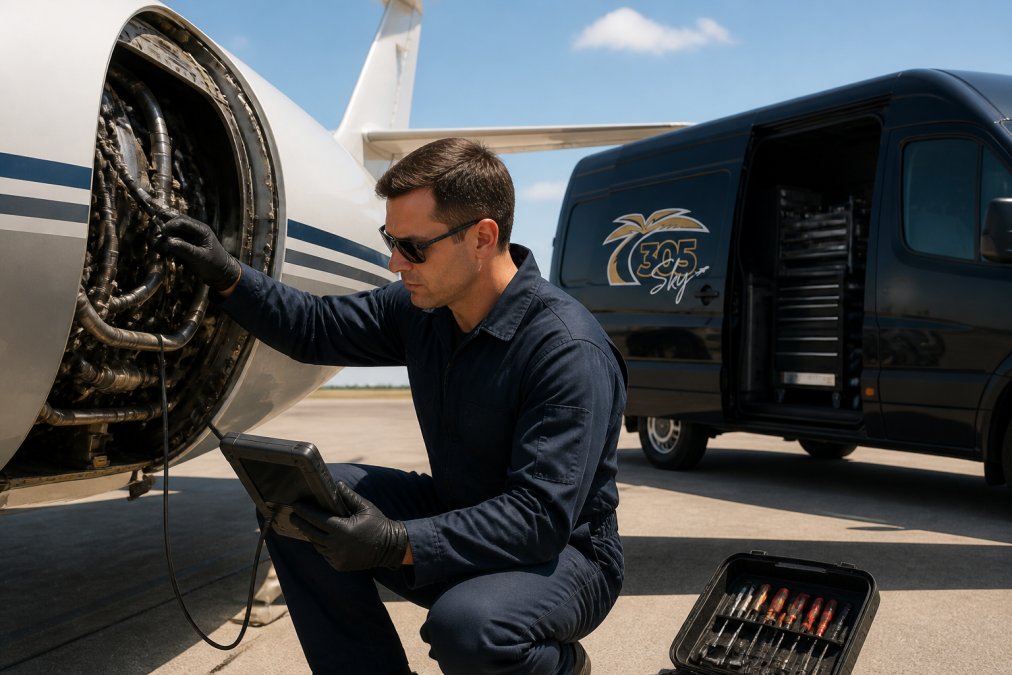
The 24/7 availability is non-negotiable. Aircraft emergencies don't respect business hours. 305 Sky maintains rotating on-call technicians to ensure someone is always available to respond, even during holidays and nights.
Emergency Engine Repair Timeline and Deployment
Understanding the timeline for emergency repair helps you plan next steps and manage expectations. Most emergency engine repairs follow a predictable sequence.
Diagnosis phase (30 minutes to 2 hours): Technicians connect diagnostic equipment, run engine performance tests, and identify the root cause.
Parts sourcing (15 minutes to 4 hours): Once the failure is identified, technicians source replacement components. Common parts like spark plugs, filters, or hoses are usually in stock.
Repair execution (1 to 8 hours): The actual repair work varies by failure type. A spark plug replacement takes 30 minutes. An alternator swap takes 2 to 3 hours. A fuel system flush and filter replacement takes 4 to 6 hours.
Testing and verification (30 minutes to 2 hours): After repair, technicians run full engine performance tests, verify all systems, and document repairs for your maintenance records.
For Fort Lauderdale-area operators, the total emergency repair timeline typically ranges from 4 to 12 hours for common failures.
Aircraft Engine Troubleshooting Steps Before Professional Help
Before calling for professional emergency repair, pilots and operators can perform basic troubleshooting to gather information and potentially resolve simple issues.
Step 1: Check essential fluids. Verify oil level, coolant level, and fuel quantity. Low levels are the fastest problem to identify and often the easiest to fix.
Step 2: Inspect visible components. Look for obvious leaks, disconnected hoses, or corroded connectors.
Step 3: Test the battery. If the engine won't start, check battery voltage with a multimeter. A reading below 20 volts indicates battery failure.
Step 4: Listen for unusual sounds. Knocking, grinding, or metal-on-metal sounds during cranking indicate internal engine damage. Do not attempt to run the engine.
Step 5: Check for fuel flow. If the engine cranks but won't start, listen for the fuel pump priming (a brief whirring sound when the ignition switches on).
Step 6: Document symptoms. Write down exactly what happened: when the problem started, what warning lights appeared, what sounds or smells were present, and what you've already checked.
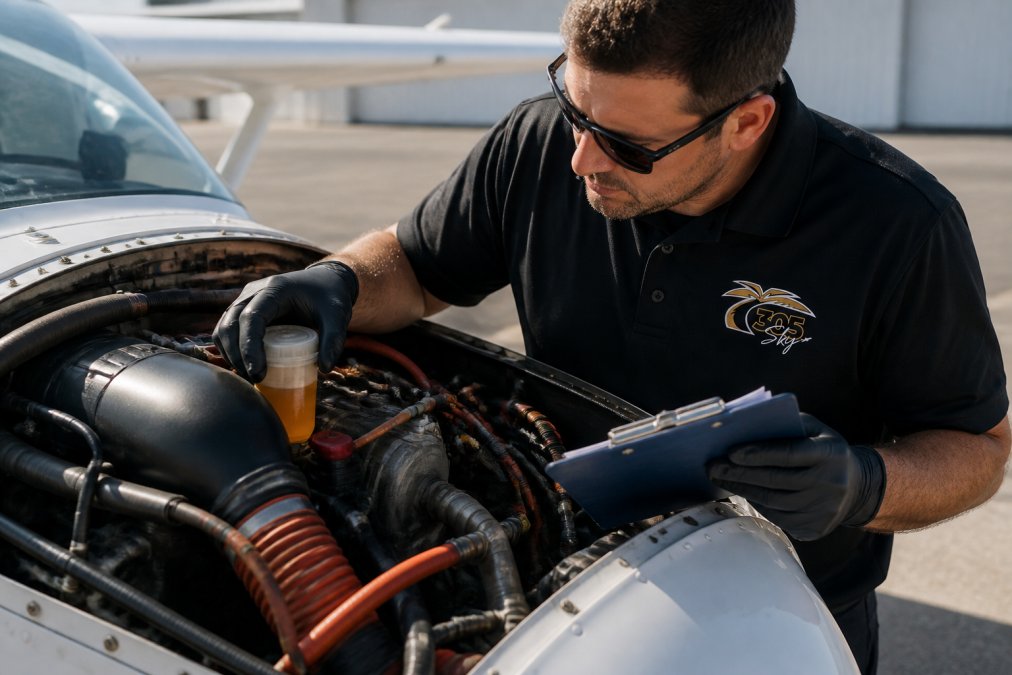
These troubleshooting steps take 10 to 15 minutes and often reveal simple fixes.
When to Call for Professional Emergency Towing and Repair
Knowing when to call for professional help is critical.
Call for professional help immediately if:
- The engine won't start and basic troubleshooting doesn't restore operation
- The engine produces knocking, grinding, or metal-on-metal sounds
- The engine overheats despite adequate coolant level
- Fuel, oil, or coolant leaks during engine operation
- Warning lights remain illuminated after engine shutdown
- The engine surges, stalls, or runs erratically even after spark plug or filter replacement
- You smell fuel, smoke, or burning odors during or after engine start
- The engine loses power during flight or fails to maintain cruise RPM
When professional towing is necessary:
If the aircraft cannot safely taxi under its own power, or if on-site repair isn't feasible, professional towing becomes necessary. Aircraft towing requires specialized equipment, trained operators, and careful coordination to prevent damage. 305 Sky coordinates with local tow services and can arrange aircraft transport to our facilities or to your preferred maintenance shop.
Roadside Breakdown Safety and Documentation
Emergency engine repairs often happen away from a full maintenance facility. Safety during roadside breakdown work is non-negotiable.
Safety protocols during on-site repair:
- Secure the aircraft: set parking brakes, chock wheels, and ensure the aircraft cannot roll or shift during work
- Isolate the ignition: disconnect the battery or secure the ignition key to prevent accidental engine start
- Clear the work area: keep bystanders, fuel trucks, and other aircraft at safe distance
- Use proper lighting: portable work lights are essential for roadside repairs
- Follow lockout/tagout procedures: place warning tags on engine controls to alert other personnel that maintenance is in progress
Documentation for emergency repairs:
Professional emergency repairs generate detailed maintenance records essential for FAA compliance, insurance claims, future maintenance planning, and aircraft resale value. When 305 Sky completes an emergency repair, we provide comprehensive documentation including the failure diagnosis, repair scope, parts replaced, labor hours, and test results.
Emergency engine repairs are stressful, costly, and disruptive to your operations. The best approach combines rapid professional response with transparent communication and thorough diagnostics. When your aircraft experiences engine trouble in Fort Lauderdale or across South Florida, 305 Sky's 24/7 AOG response team is ready to deploy. Our mobile maintenance capability, combined with four strategically located facilities and over 55 years of combined aviation experience, means your aircraft gets back in service fast. Get a Quote from 305 Sky today and discover how transparent, family-oriented emergency repair support can minimize your downtime and protect your aircraft's long-term reliability.
Frequently Asked Questions
What is considered an emergency engine repair versus routine maintenance?
Emergency engine repair addresses critical failures that prevent safe operation: complete power loss, uncontrolled overheating, severe vibration, or fuel system failure. Routine maintenance includes preventative tasks like oil changes, filter replacements, spark plug inspections, and scheduled coolant flushes. The key difference is that emergency repairs must happen immediately to restore airworthiness, while routine maintenance is planned to prevent future problems. Understanding this distinction helps you respond appropriately when issues arise.
How quickly can emergency engine repair services be deployed in Fort Lauderdale?
Professional emergency engine repair services in the area operate 24/7 with mobile units capable of responding to aircraft on ground (AOG) situations within critical timeframes. Response time depends on your location, the severity of the failure, and available mobile resources. AOG aircraft maintenance services prioritize immediate diagnostics and temporary stabilization, followed by full repair at a facility if needed. Many operators maintain service agreements that guarantee rapid dispatch, especially for critical electrical system failures or cooling system emergencies.
What documentation is required after an emergency engine repair?
After emergency engine repair, you'll need maintenance records documenting all work performed, parts replaced, and any diagnostics conducted. This includes work orders, parts invoices, and compliance certifications proving the repair meets aviation standards. Your aircraft logbook must be updated with the repair details for regulatory compliance and future maintenance tracking. Insurance claims typically require this documentation, and resale value depends on complete, verified repair history. Keep copies for your records and provide originals to your insurance provider.
How do I know if my engine issue requires an emergency response?
Call for emergency engine repair if you experience complete loss of power, rapid temperature gauge spikes, severe engine vibration, visible smoke or fluid leaks, electrical system failure, fuel system malfunction, or any warning that affects safe operation. Don't attempt to troubleshoot these issues yourself. Aircraft engine troubleshooting steps for minor concerns (like checking fluid levels or confirming gauge readings) can be done before calling, but any sign of actual failure demands immediate professional assessment. When in doubt, treat it as an emergency, the cost of professional dispatch is far less than the risk of catastrophic failure.
This article was written using GrandRanker