Table of Contents
- The True Cost of Reactive Aircraft Maintenance
- Proactive vs. Reactive Maintenance: A Direct Comparison
- How Proactive Maintenance Prevents AOG Events in Fort Lauderdale
- Managing Aircraft Maintenance Records Digitally for Compliance
- FAA Part 91 vs Part 135 Maintenance Requirements: What Owners Must Know
- The Resale Value and Insurance Benefits of a Proactive Logbook
- Building a Proactive Maintenance Schedule That Works
- Conclusion: The Financial and Safety Case for Proactive Care
- Frequently Asked Questions
Last Updated: September 7, 2026
Proactive aircraft maintenance is the systematic practice of performing scheduled inspections, component replacements, and system checks before a failure occurs. For owners of Challenger, Citation, King Air, Learjet, Falcon, Hawker, Gulfstream, Beechjet, and Pilatus aircraft, this distinction often determines whether a minor issue costs a few hours in the hangar or forces an expensive emergency repair.
A proactive approach protects your asset's airworthiness, preserves its resale value, and keeps your aircraft available when you need it. Below, we'll show how shifting from a reactive mindset to a scheduled maintenance strategy prevents emergency repairs and reduces AOG events.
The True Cost of Reactive Aircraft Maintenance
Reactive maintenance is the most expensive strategy an aircraft owner can adopt. When you wait for a mechanical failure, you lose control over timing, cost, and logistics. An unscheduled repair often requires expedited shipping, overtime labor, and last-minute hangar space.
Every hour of unscheduled downtime is an hour your aircraft is not generating value, whether that means a missed business trip, a delayed charter commitment, or a canceled flight. For charter operators, the reputational damage from a grounded aircraft can outlast the repair itself.
A minor vibration or slightly elevated oil temperature that goes unaddressed often stresses adjacent systems, turning a single-point fix into a multi-component overhaul.
Proactive vs. Reactive Maintenance: A Direct Comparison
The difference between proactive and reactive maintenance shows up in concrete operational metrics.
| Approach | Cost Profile | Downtime | Safety Impact | Best For |
|---|---|---|---|---|
| Proactive | Predictable, planned | Scheduled, minimal | Failure prevention | Owners who value reliability |
| Reactive | Unpredictable, premium | Unscheduled, extended | Emergency response | Rare, unplanned situations |
Proactive maintenance delivers its greatest advantage through predictability. You choose when the aircraft enters the hangar, coordinating around your travel schedule and charter commitments.
Proactive care requires discipline and a trusted maintenance partner. You must commit to a schedule even when the aircraft appears to be running perfectly.
How Proactive Maintenance Prevents AOG Events in Fort Lauderdale
Aircraft on Ground (AOG) events are the most disruptive and costly occurrences in aviation operations. An AOG situation means your aircraft is grounded and cannot fly, requiring immediate attention. In Fort Lauderdale, where the flying season is year-round, proactive maintenance is the most effective defense against these emergencies.
The South Florida Corrosion Accelerant
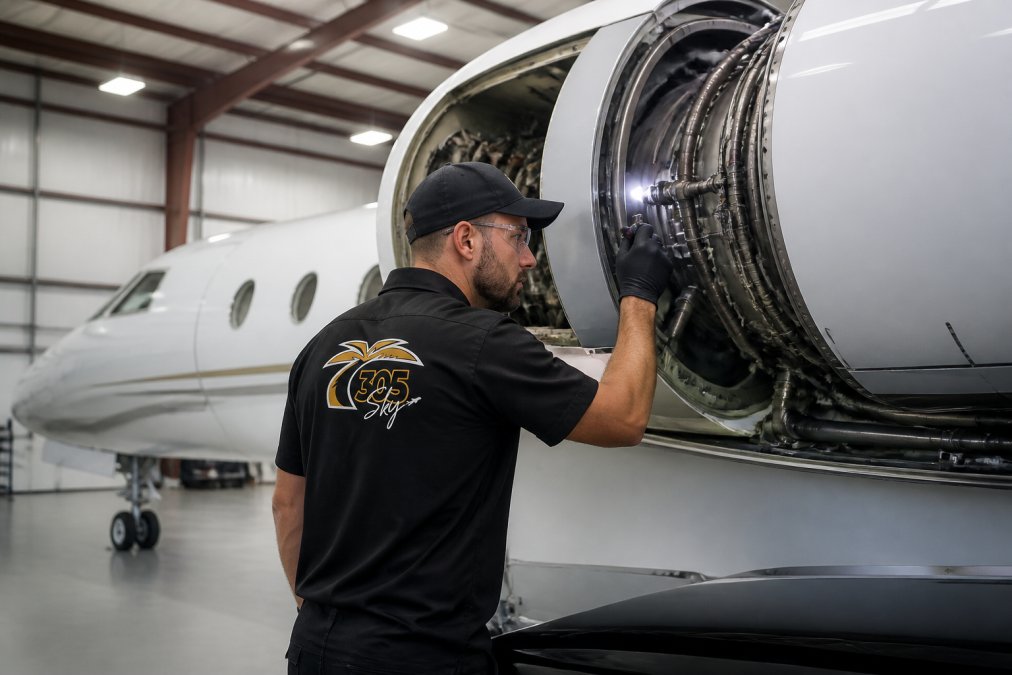
South Florida's combination of salt-laden air, persistent humidity, and intense afternoon thunderstorms creates a uniquely aggressive environment for aircraft systems. For owners basing aircraft at Fort Lauderdale Executive Airport (FXE) or Hollywood International (FLL), proximity to the Atlantic Ocean means your airframe is continuously exposed to chloride deposits. Combined with ambient humidity that routinely exceeds 70 percent, these salt particles accelerate galvanic corrosion, particularly where dissimilar metals meet (noaa.gov).
A common pattern we observe at 305 Sky is corrosion pitting under the wing-to-fuselage fairings of aircraft flying regularly in the coastal environment. The telltale white powder or grayish deposit often goes unnoticed because it forms beneath painted surfaces. Left unchecked, this pitting creates stress risers that can lead to cracking in structural members.
Thunderstorm Season and Avionics Stress
Fort Lauderdale's afternoon thunderstorm season, running roughly from May through October, introduces repeated lightning-induced voltage spikes and static discharge events. While modern aircraft are designed to dissipate lightning strikes, the cumulative effect can degrade sensitive avionics components over time. Proactive maintenance programs should include periodic checks of static wicks, bonding straps, and surge protection devices.
The Real Root Causes of Local AOG Events
AOG events rarely stem from a single catastrophic part failure. They typically trace back to a warning sign ignored, a component that exceeded its service interval, or a discrepancy deferred to a later visit. The most common root causes we see are:
- Corroded electrical connectors in landing gear and flap actuation systems, caused by salt-air intrusion into unsealed junctions.
- Premature brake wear from frequent, high-energy stops on short runway operations combined with high ambient temperatures.
- Air conditioning system failures from the strain of continuous operation in 90-degree heat, leading to compressor clutch failures or refrigerant leaks.
- Windshield pitting and delamination from sand and salt particles carried by sea breezes, which obscure vision and require replacement.
Proactive maintenance eliminates these root causes by addressing findings during scheduled downtime rather than in the middle of a trip.
The Seasonal Maintenance Calendar
A proactive schedule for a Fort Lauderdale-based aircraft should be calibrated to the local calendar. The dry season, from November through April, is the optimal window for major inspections and corrosion treatment. The wet season demands more frequent checks of seals, gaskets, and drainage paths.
Managing Aircraft Maintenance Records Digitally for Compliance
Managing aircraft maintenance records digitally is the standard for protecting your airworthiness documentation and your asset's value. Digital record keeping ensures that every inspection, repair, and component replacement is logged accurately and immediately accessible.
Paper logbooks are vulnerable to loss, damage, and transcription errors. Digital records eliminate these risks by providing secure, searchable, backed-up documentation. When a potential buyer requests maintenance history, a complete, organized digital file instills confidence and supports your asking price.
For operators managing multiple aircraft, digital records enable fleet-level visibility. You can track compliance across your entire fleet from a single dashboard, ensuring no aircraft falls behind on its maintenance schedule.
FAA Part 91 vs Part 135 Maintenance Requirements: What Owners Must Know
Understanding FAA Part 91 vs Part 135 maintenance requirements is essential because your operating certificate determines the strictness of your compliance obligations. Part 91 governs private, non-commercial operations, while Part 135 applies to on-demand charter operations (ecfr.gov).
Part 91 operators must maintain their aircraft in an airworthy condition and comply with all applicable airworthiness directives and service bulletins. The framework is less prescriptive about inspection intervals.
Part 135 operators face far more rigorous standards (faa.gov). Charter operations require an approved inspection program, specific maintenance tracking procedures, and stricter adherence to manufacturer-recommended intervals. Operators transitioning between the two must understand these distinctions before committing to a maintenance strategy.
The Resale Value and Insurance Benefits of a Proactive Logbook
A well-documented proactive maintenance history is one of the strongest arguments you can make when selling your aircraft. Buyers and brokers scrutinize logbooks during the pre-purchase inspection process, and a complete, consistent maintenance record signals proper care.
A jet with verifiable, proactive care commands a premium over an identical model with gaps in its maintenance log or a history of deferred repairs.
Insurance underwriters also factor maintenance practices into their assessments. A demonstrable record of proactive care and regulatory compliance can support more favorable terms, as it indicates lower risk.
Building a Proactive Maintenance Schedule That Works
Creating an effective proactive maintenance schedule requires matching manufacturer recommendations to your specific operating environment. The starting point is always the aircraft's maintenance manual, which defines required intervals for inspections, component overhauls, and replacements.
A practical schedule accounts for how you actually use the aircraft. An owner flying 200 hours per year in Florida's humid climate faces different corrosion risks than a charter operator flying 800 hours across varied conditions.
The Supply Chain Bottleneck: Why Planning Beats Panic
The most significant shift in aviation maintenance is the reality of parts procurement. Lead times for critical components have stretched dramatically, what once took days now often takes weeks or months. For a Challenger 604 owner waiting on a main wheel well actuator, or a Citation Excel operator needing a flap motor, the difference between a scheduled replacement and an AOG event often comes down to whether the part was ordered in advance.
A proactive maintenance schedule is fundamentally a supply chain strategy. When you plan a component replacement based on its published service interval, you create a procurement window. Your maintenance provider can order the part, receive it, inspect it, and have it ready before your aircraft enters the hangar.
The Lead-Time Buffer Strategy
Most practitioners find that a 60-to-90-day lead-time buffer is the practical minimum for non-expeditable components. This means reviewing your maintenance plan, identifying which parts will be needed in the next quarter, and placing orders early.
A common pattern among operators who rarely experience extended AOG events is the creation of a "critical spares" list, including components that are:
- Known to have extended manufacturer lead times
- Subject to recurring wear or service-life limits
- Shared across multiple aircraft in a fleet
- Difficult to source from aftermarket suppliers
Integrating Parts Planning into Your Schedule
Here is how a proactive schedule incorporates supply chain realities:
- Review your aircraft's maintenance manual and list all required intervals
- Cross-reference airworthiness directives and service bulletins for your model
- Factor in your annual flight hours and typical operating environment
- Coordinate major inspections with your travel calendar to minimize disruption
- Partner with a maintenance provider who tracks compliance digitally
- Identify long-lead components that will be required within the next two inspection cycles
- Place orders early for parts with known supply constraints, even before the inspection begins
- Verify part availability before scheduling hangar time to avoid dead-time
The Cost of Expediting vs. The Cost of Planning
Expedited shipping, rush machining, and overnight fabrication carry significant premiums. More importantly, they require the part to exist somewhere in the supply chain. For many components, no amount of expediting can overcome a manufacturer's production backlog. The only effective mitigation is time.
The most successful operators treat maintenance as a partnership rather than a transaction. Working with a team that understands your aircraft type, your flight profile, and the local operating environment ensures your schedule is both compliant and practical.
Conclusion: The Financial and Safety Case for Proactive Care
The case for proactive aircraft maintenance is clear: it prevents emergency repairs, reduces AOG events, protects resale value, and supports regulatory compliance. The cost of scheduled care is predictable and manageable. The cost of reactive repairs is not.
At 305 Sky, our 55-plus years of combined aviation experience and our 24/7 AOG emergency response capability mean we handle both ends of the spectrum. We are a family-oriented, third-generation aviation business serving Fort Lauderdale, Boca Raton, West Palm Beach, and Vero Beach. Whether you need routine maintenance, a pre-purchase inspection, or a mobile response team, we provide transparent pricing and secure digital record keeping for your Challenger, Citation, King Air, Learjet, Falcon, Hawker, Gulfstream, Beechjet, or Pilatus.
Get started with 305 Sky and protect your aircraft with proactive care that keeps you flying.
Frequently Asked Questions
What is the difference between preventive and reactive aircraft maintenance?
Preventive or proactive maintenance follows a scheduled plan of inspections, component replacements, and checks designed to catch wear before it becomes a failure. Reactive maintenance waits for a problem to occur, often grounding the aircraft unexpectedly. Proactive care reduces unscheduled downtime, keeps aircraft on their maintenance schedule, and is far less costly than emergency repairs or AOG events.
How does proactive maintenance reduce AOG (Aircraft on Ground) events?
Proactive maintenance identifies component fatigue and potential mechanical failures during scheduled inspections, before they cause a breakdown. By replacing parts at recommended intervals and addressing technical directives promptly, you avoid the surprise failures that lead to AOG situations. This approach minimizes unscheduled maintenance, reduces emergency repairs, and keeps your aircraft operational and available when you need it.
What are the FAA Part 91 vs Part 135 maintenance requirements?
Part 91 covers private, non-commercial operations with more flexible maintenance intervals, though airworthiness and manufacturer requirements still apply. Part 135 governs charter operations, requiring stricter maintenance schedules, more detailed record-keeping, and specific inspection programs. Both demand regulatory compliance, but Part 135 operators face more rigorous oversight to ensure operational reliability and safety.
How can digital record-keeping improve aircraft maintenance compliance?
Digital record-keeping creates a secure, organized, and easily searchable maintenance log. It ensures that every scheduled inspection, service bulletin, and repair is documented correctly and available for auditors or potential buyers. This reduces administrative errors, simplifies compliance with FAA regulations, and provides a clear maintenance history that boosts aircraft resale value and supports operational reliability.