Table of Contents
- Unusual Vibrations and Abnormal Sounds During Flight
- Warning Indicators and Instrument Panel Alerts You Should Never Ignore
- Fluid Leaks, Pooling, and Hydraulic Failures on the Ramp
- Burning Smells and Electrical System Failure
- Loss of Engine Performance and Oil Pressure Drops
- When to Call AOG Aircraft Maintenance Services
- FAA Airworthiness Directives Compliance and Your Legal Obligations
- Your Emergency Aircraft Maintenance Checklist: Pre-Flight vs. In-Flight
- Frequently Asked Questions
Last Updated: September 11, 2026
Unusual Vibrations and Abnormal Sounds During Flight
The top 7 signs you need an emergency aircraft repair start with what your aircraft tells you before a warning light illuminates. This guide from 305 Sky, a Fort Lauderdale maintenance provider with 55+ years of combined aviation experience, breaks down each warning sign.
Vibration is the most common early indicator of component failure. A propeller or fan blade that shed a balance weight, a worn engine mount, or a failing bearing announce themselves through feel and sound long before the panel shows anything.
Vibration has a signature. A low-frequency shudder building with airspeed points to a control surface or trim issue; a high-frequency buzz tied to engine RPM points to rotating components. Note where you feel it and at what power setting.
Abnormal sounds deserve the same respect. A popping exhaust, a scraping on gear extension, or a change in cabin noise floor each point to a specific system. Write down what you heard and when.
Warning Indicators and Instrument Panel Alerts You Should Never Ignore
An illuminated warning indicator is a directive, not a suggestion. Emergency aircraft repair decisions begin the moment a red or amber annunciator lights up, because these alerts catch failures while they are still manageable. On a Challenger, Citation, King Air, Learjet, Falcon, Hawker, Gulfstream, Beechjet, or Pilatus, the panel is a layered system.
How the annunciator system actually works
Most turbine aircraft use three-tier logic: a master warning (red, often with an aural tone), a master caution (amber, usually a single chime), and an advisory or status message (white or blue, no aural). Pressing the master switch fixes nothing, it silences the aural and resets the light so you can read the specific annunciator underneath.
The master light is a summary, not a diagnosis. A master caution on a King Air 350 could be a fuel imbalance, an anti-ice fault, or a pressurization trend. The drill is always the same: silence the aural, identify the specific annunciator, cross-check the affected gauge, then run the checklist.
Triage when more than one alert fires at once
Multiple simultaneous alerts separate a prepared crew from a reactive one. A common pattern is one root cause cascading across systems, a generator failure that trips the autopilot, drains the battery, and lights the avionics master. Treat alerts in this order:
- Anything affecting control of the aircraft first. Flight controls, trim, and primary flight displays outrank everything else.
- Anything affecting the engine or fuel next. Oil pressure, fuel pressure, and fuel flow are time-critical.
- Anything affecting electrical or pressurization third. These degrade over minutes, not seconds.
- Cosmetic and advisory messages last. Log them, but do not let them pull your attention off the red items.
If two red warnings fire at once, assume a common cause until proven otherwise. Do not troubleshoot in the air beyond isolating the source.
Reading the panel against the FAA Airworthiness Directives database
The FAA Airworthiness Directives database is where you confirm whether an alert ties to a known mandated fix on your make and model. A caution light that corresponds to an open Airworthiness Directive is a very different situation from an intermittent sensor glitch, one is a known, documented failure mode with a required remedy, the other may be a wiring or sensor issue that has not yet been characterized.
Avionics failure is its own category
A flickering primary flight display, a GPS dropping satellite lock, or an uncommanded autopilot disconnect all fall under abnormal indications. Fly the aircraft first, then troubleshoot. On glass cockpits, a display failure usually triggers reversionary mode, know that switch before you need it. On older Citation and Learjet electromechanical panels, a failed attitude indicator is a partial-panel emergency.
What to record before you land
Before changing power settings or configuration, capture the panel state. A phone photo of the annunciator panel, affected gauge, and master warning/caution status gives your maintenance provider a starting point a verbal description cannot match. Note phase of flight, altitude, power setting, and whether the alert was steady or intermittent. That record becomes the first logbook entry and often shortens diagnosis by hours.
Fluid Leaks, Pooling, and Hydraulic Failures on the Ramp
Pooling fluid under your aircraft is the clearest on-ground sign of failure. Hydraulic leaks, fuel seeps, and oil streaks are visible during a walkaround if you know where to look, and they are far cheaper to fix on the ramp than in the air.
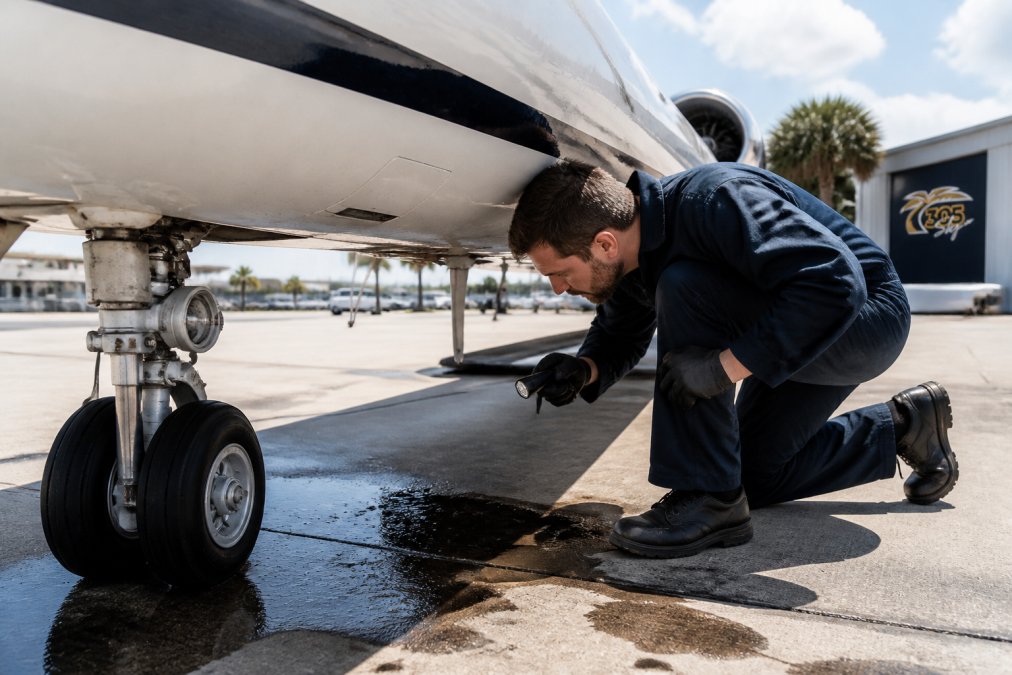
Color and location tell you the system. Red or pink fluid under the nose or main gear points to hydraulic fluid; blue or clear drips near wing roots often mean fuel; dark amber streaks along the engine cowl indicate oil. Photograph the puddle, note its size, and recheck after 30 minutes, a growing puddle means an active leak.
Corrosion deserves special attention in South Florida, where salt air and humidity accelerate it on landing gear components, control surfaces, and fasteners. A hydraulic leak that exposes bare metal compounds the problem quickly. If you operate out of Fort Lauderdale, Boca Raton, or West Palm Beach, make corrosion inspection part of every pre-flight.
Burning Smells and Electrical System Failure
A burning smell in the cabin is an emergency, not a nuisance. Electrical system failures, chafed wiring, and overheated avionics produce a distinct acrid odor that precedes smoke, and the window between smell and fire is short.
If you smell burning, don your oxygen mask if equipped, pull the affected circuit breakers, and land at the nearest airport. Do not troubleshoot in the air beyond isolating the source. On the ground, a mechanic traces the circuit, inspects for chafed insulation, and checks the avionics bay for heat damage.
What most owners overlook is that electrical faults often start small. A breaker that pops once and resets fine is still a data point. Log it. Repeated breaker trips on the same circuit are a component failure in progress, and the NTSB aviation accident reports show that in-flight electrical fires are among the least forgiving emergencies a crew can face.
Loss of Engine Performance and Oil Pressure Drops
A drop in oil pressure or loss of engine performance is the most time-critical sign on this list. Both mean a critical system is degrading in real time; reduce power, divert, and prepare for a possible shutdown.
Watch for these indicators together, not in isolation:
- Oil pressure trending below normal range at a steady power setting
- Cylinder head or exhaust gas temperatures diverging between cylinders
- A sudden loss of manifold pressure or fuel flow
- Rough running or a change in engine sound
Oil pressure loss on a turbine engine can progress from caution to failure in minutes. On a King Air, Citation, or Pilatus, the correct drill is in your checklist, follow it exactly and do not wait for the gauge to reach zero.
When to Call AOG Aircraft Maintenance Services
AOG aircraft maintenance services exist for the moment your aircraft cannot legally or safely fly. AOG, Aircraft on Ground, means the aircraft is unairworthy and needs immediate attention. Call the moment you confirm that status, not the next business morning, every hour on the ground is lost utilization, repositioning cost, and crew disruption.
The AOG trigger: when does an issue become an AOG?
Not every squawk is an AOG. The distinction drives response time, cost, and paperwork. An issue is an AOG when any of the following is true:
- A red warning or a mandatory checklist item grounds the aircraft
- A leak, structural issue, or control surface problem is found on the ramp
- An Airworthiness Directive requires compliance before further flight
- The aircraft is away from home base and cannot be legally dispatched
- A required system is inoperative and the aircraft's Minimum Equipment List (MEL) does not permit dispatch with that item deferred
The MEL is the key document. Many aircraft can legally fly with items deferred under an MEL if the deferral is documented and operational restrictions observed. If the item is not on the MEL, the aircraft is an AOG. If it is on the MEL and the deferral is valid, it is a maintenance item, schedule it, but you are not grounded.
What a mobile AOG team can actually do on a ramp
A common misconception is that AOG response means a full shop on wheels. A mobile AOG van typically carries diagnostic equipment, consumables, hand tools, and the ability to perform inspections, troubleshooting, and certain line-replaceable unit (LRU) swaps. It cannot do heavy structural repair, engine removal, or major avionics installation, those require a hangar and often a specialized shop.
The practical value of a mobile team is triage: confirming whether the aircraft is truly grounded, identifying the failed component, and either restoring it on the ramp or arranging recovery to a facility. For a Challenger, Citation, King Air, Learjet, Falcon, Hawker, Gulfstream, Beechjet, or Pilatus, LRU swap capability alone resolves a large share of AOG events without a hangar visit.
What to have ready when you call
AOG response is faster when the dispatcher has the right information in the first call. Have these ready:
- Aircraft make, model, and serial number
- Current location (FBO, ramp, or hangar) and the FBO's contact
- The specific squawk or annunciator, with a photo if available
- The last logbook entry and any open MEL deferrals
- Your operator or management company contact, if applicable
Private jet management companies and charter operators have an advantage here, they typically have this information organized and can hand it to the AOG provider in a single call.
The Fort Lauderdale and South Florida context
South Florida has a specific AOG profile. Salt air and humidity accelerate corrosion on landing gear components, control surfaces, and fasteners, and summer thunderstorms drive ramp damage and lightning-strike inspections. An aircraft down at Fort Lauderdale Executive (FXE), Boca Raton (BCT), or Palm Beach International (PBI) faces a different logistical situation than one stranded remotely, there is deep maintenance capability in the region, but good shops book out, and a 2 a.m. Sunday AOG call is a different test than a Monday morning phone call.
305 Sky operates 24/7 AOG emergency response with a mobile van across South Florida, covering Challenger, Citation, King Air, Learjet, Falcon, Hawker, Gulfstream, Beechjet, and Pilatus airframes. The team handles routine maintenance, inspections, avionics upgrades, and interior work under one roof, so an AOG event does not become a scavenger hunt for three vendors. A 2 a.m. Sunday call reaches a dispatcher, not a voicemail, the practical difference between a real AOG service and a shop that answers during business hours.
AOG versus scheduled maintenance
An AOG event is not the time to bundle in routine items. The goal is to return the aircraft to a legal, airworthy, dispatchable condition as fast as safely possible. Inspections, avionics upgrades, and interior work are scheduled separately, folding them into an AOG recovery is how a two-day grounding becomes a two-week one.
FAA Airworthiness Directives Compliance and Your Legal Obligations
FAA airworthiness directives compliance is not optional and cannot be deferred because the aircraft is flying well. An AD is a legally binding regulation. Flying with an open, non-compliant AD puts your certificate, insurance coverage, and passengers at risk.
Every AD carries a compliance threshold: calendar time, flight hours, or cycles. The FAA's Airworthiness Directive program publishes the full list, and your maintenance provider should be tracking every AD that applies to your airframe, engine, propeller, and appliances.
Digital record keeping matters here. A missed AD is usually a records failure, not a mechanical one. When you switch providers or buy an aircraft, the first question should be whether every AD is closed and documented in the logbook, pre-buy inspections exist largely to answer that before money changes hands.
Your Emergency Aircraft Maintenance Checklist: Pre-Flight vs. In-Flight
An emergency aircraft maintenance checklist works differently on the ground versus in the air. Pre-flight, you have time to investigate and decide. In-flight, your only job is to fly the aircraft and land safely.
| Phase | Your Action | Priority |
|---|---|---|
| Pre-flight | Photograph leaks, note gauge readings, check AD status | Decide airworthy or not |
| Pre-flight | Log any new vibration, smell, or sound | Establish a baseline |
| In-flight | Fly the aircraft, don oxygen if smoke is present | Control before diagnose |
| In-flight | Run the checklist drill, reduce power if engine-related | Follow the POH |
| In-flight | Divert to nearest suitable airport | Land, then troubleshoot |
| Post-flight | Preserve evidence, call AOG if grounded | Get expert eyes on it |
The pre-flight side is where you prevent emergencies. Walk the aircraft, look under it, and check the panel against the last flight's readings. A gauge that has moved since yesterday is telling you something.
If you are searching for emergency aircraft repair near me in South Florida, the answer should be a shop that responds to your ramp, not one that requires you to fly a questionable aircraft to them. 305 Sky maintains four facilities across the region and a mobile response capability built for exactly this scenario.
When an aircraft goes down, the difference between a quick recovery and a long, expensive grounding comes down to who you call and how fast they move. 305 Sky handles 24/7 AOG emergency response, routine maintenance, aircraft inspections, pre-buy inspections, and avionics and interior work for private jet owners, charter operators, and management companies across South Florida. With 55+ years of combined experience and a transparent, family-oriented approach to pricing and communication, the team keeps your aircraft airworthy, compliant, and back in service with minimal downtime. Get a quote from 305 Sky and get your aircraft flying again.
Frequently Asked Questions
How do I know if an aircraft issue requires an AOG response?
An issue requires AOG aircraft maintenance services when the aircraft cannot safely fly or is not airworthy. That includes complete system failure, hydraulic leaks affecting control surfaces, landing gear problems, avionics failure that affects critical flight instruments, or any condition that would violate FAA airworthiness directives compliance. If you are uncertain, contact a certified repair station before the next flight. A grounded aircraft is always safer than one flown with an unresolved mechanical malfunction.
What should I look for during a pre-flight inspection to avoid emergency aircraft repair?
Check for fluid pooling under the aircraft, tire and brake wear, control surface freedom, and obvious corrosion or structural damage. Look for fresh oil streaks around the engine cowling and verify that warning indicators illuminate correctly during the cockpit check. Any abnormal sounds, unusual vibration, or hydraulic leaks you notice on the ground should be logged and evaluated by an aviation mechanic before departure. Catching these signs early prevents in-flight emergencies.
Can I continue to fly with minor avionics glitches?
It depends on what the glitch affects. A flickering cabin display is different from an instrument panel alert tied to navigation or flight safety. If the avionics failure touches critical systems, do not fly. FAA regulations require the aircraft to be airworthy for the intended flight, and some equipment must work for legal dispatch. When in doubt, have a certified repair station evaluate the issue and document it with a proper logbook entry.
What are the FAA requirements for reporting emergency aircraft repairs?
Emergency repairs must be documented with a logbook entry signed by an appropriately rated aviation mechanic or certified repair station. Repairs affecting airworthiness must comply with FAA airworthiness directives compliance and applicable regulations. Certain serious events, such as emergency landings or component failure that affects flight safety, may require additional reporting to the FAA. A reputable shop handles the documentation for you and keeps digital records so your aircraft's maintenance history stays complete.
What are the most common maintenance problems that lead to emergency aircraft repair?
The most frequent causes include hydraulic leaks, electrical system faults, engine performance degradation, corrosion on structural components, and landing gear issues. Avionics failure and warning indicator problems also appear often. Many of these start small and become emergencies when preventative maintenance is skipped. Regular pre-flight inspection, scheduled inspections, and prompt troubleshooting of unusual vibration or abnormal sounds keep small findings from turning into grounding events.