Table of Contents
- What Does AOG Mean and Why Is the Cost Per Hour So High?
- The True AOG Cost Per Hour: A Breakdown of Financial Losses
- Comparing AOG Costs: Private Jets vs. Commercial Airlines
- The Real Cost of Unscheduled Aircraft Maintenance
- How AOG Emergency Response Services Fort Lauderdale Reduce Downtime
- Prevention Strategies: Managing Aircraft Maintenance Records Digitally
- Is Insurance the Answer to High AOG Costs?
- Conclusion: Calculating Your Real AOG Exposure
- Frequently Asked Questions
Last Updated: September 9, 2026
When an aircraft goes AOG, Aircraft on Ground, the clock starts draining value immediately. The aog cost per hour isn't just about the technician's hourly rate; it encompasses lost revenue, crew pay, hangar space, and logistics that compound with every minute of downtime. For private jet owners and operators in South Florida, understanding this true cost is the first step toward protecting asset value. At 305 Sky, our team of 3rd generation aviators has over 55 years of combined experience.
The real question isn't whether your aircraft will face an AOG event, but how prepared you are when it does. Unscheduled maintenance is an inevitability in aviation. The aircraft on ground scenario represents the most expensive failure mode in the industry because it attacks liquidity from multiple angles simultaneously. Below, we break down exactly what drives these costs, how they differ between private jets and commercial fleets, and the strategies that minimize your exposure.
What Does AOG Mean and Why Is the Cost Per Hour So High?
AOG is the aviation industry's most urgent maintenance status, indicating that an aircraft is mechanically unable to fly. The aog cost per hour runs high because an AOG event triggers a cascade of expenses that extend far beyond the repair itself. Unlike scheduled maintenance, which can be planned around the aircraft's revenue schedule, an AOG forces immediate action, often requiring premium pricing for parts, rushed logistics, and overtime labor.
The high hourly cost reflects the urgency premium built into every aspect of the response. Parts that might ship ground for routine work now fly overnight. Technicians who might be scheduled for tomorrow are pulled from other projects or called in during off-hours. For a revenue-generating aircraft, every grounded hour is also an hour of lost income, which is why operators accept premium costs to get back in the air quickly. The aviation industry benchmarks for AOG recovery emphasize speed because the financial bleed accelerates the longer the aircraft sits (iata.org).
The True AOG Cost Per Hour: A Breakdown of Financial Losses
Calculating your real aog cost per hour requires looking beyond the maintenance invoice to the total financial impact of the event. Industry discussions typically frame the cost in a wide range. The variance depends on aircraft class, the nature of the failure, and your operation's revenue model.
Direct Costs: Parts Procurement, Logistics, and Labor
The most visible expenses are the direct costs of the repair itself. Parts procurement often involves sourcing rotables and components from multiple vendors, with expedited shipping fees that can exceed the part's value on rare occasions. Logistics for an AOG event in a location like Fort Lauderdale might involve coordinating with local couriers, chartering a flight to bring a part from another state, or dispatching a mobile repair van to the aircraft's location. Labor costs escalate quickly because AOG work demands immediate attention, often outside normal business hours.
Indirect Costs: Lost Revenue and Crew Displacement
The indirect costs of an AOG event frequently dwarf the direct repair expenses. A grounded aircraft generates no revenue, and for charter operators, that means turning away booked flights. Crew scheduling becomes a logistical puzzle when a trip cancels mid-rotation; pilots and flight attendants may need repositioning, per diems, and rebooking, all while the aircraft sits idle. For a private jet owner, the cost is the lost opportunity of the trip itself, plus the disruption to business schedules.
Comparing AOG Costs: Private Jets vs. Commercial Airlines
The scale of an AOG event differs dramatically between a private jet and a commercial airliner. For a narrowbody commercial aircraft, the aog cost per hour includes not just the aircraft's revenue potential but also the ripple effects on passenger compensation, gate availability, and crew use across an entire network. Commercial operators also face regulatory requirements for passenger care during extended delays, adding another layer of expense (transportation.gov).
Private jet operators face a different calculation. The asset use rate for a typical private aircraft is far lower than a commercial jet, so the pure revenue loss per hour may seem smaller. However, the cost of the AOG response itself can be proportionally higher because the maintenance network for business jets is less dense, and parts may not be stocked locally. For owners of Challenger, Citation, King Air, Learjet, Falcon, Hawker, Gulfstream, Beechjet, and Pilatus aircraft, the downtime represents both a financial loss and a significant inconvenience that can disrupt personal or corporate commitments.
The Real Cost of Unscheduled Aircraft Maintenance
Unscheduled maintenance carries a hidden premium that scheduled work does not. When a maintenance event is unplanned, the MRO cannot optimize for efficiency. Technicians may not have the correct manuals on hand, parts may need to be sourced from multiple suppliers, and the diagnostic process itself can consume hours. The cost of unscheduled aircraft maintenance is therefore not just the repair, but the inefficiency of the entire response process.
Diagnostic tools play a critical role in reducing this cost. Modern aircraft generate fault data that can be transmitted to maintenance teams before the aircraft even lands, allowing them to prepare parts and procedures in advance. Operators who invest in predictive maintenance and monitoring systems can often catch developing issues before they become AOG events, converting an emergency response into a scheduled repair. This proactive approach is the single most effective way to reduce the frequency and severity of unscheduled downtime.
How AOG Emergency Response Services Fort Lauderdale Reduce Downtime
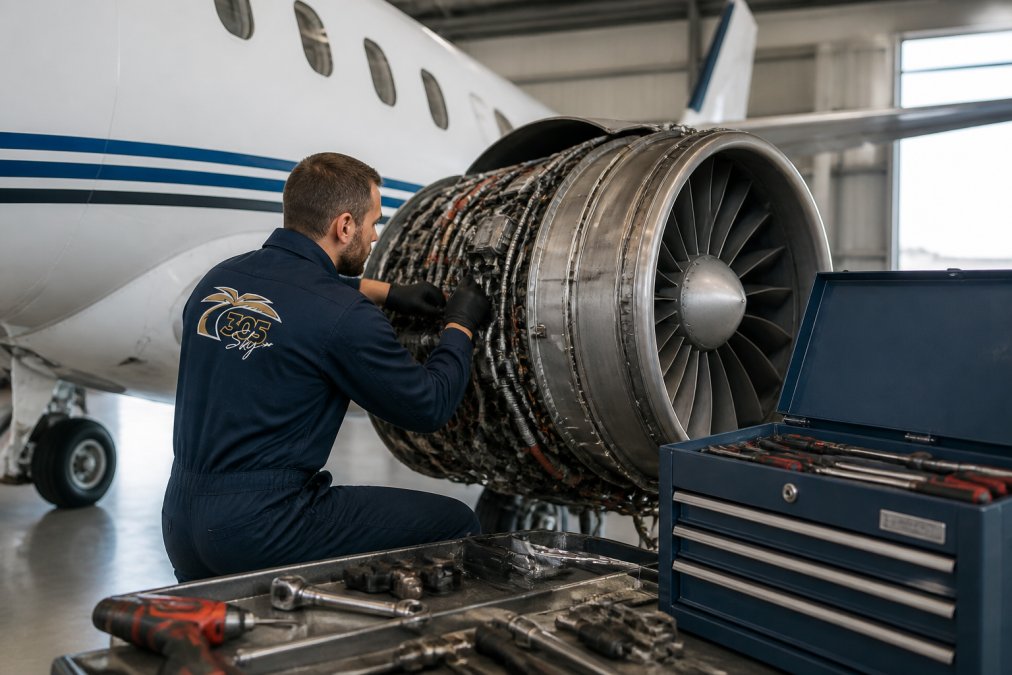
For operators based in the Miami to Port St. Lucie corridor, access to rapid AOG emergency response services Fort Lauderdale can mean the difference between a one-day disruption and a week-long grounding. A provider with a mobile response van can reach the aircraft wherever it is parked, performing diagnostics and repairs on-site rather than requiring a ferry flight to a maintenance base. This capability is critical for aircraft owners who are away from their home base when a problem occurs.
The value of local AOG response lies in its speed and familiarity with the aircraft types common in the region. A team that regularly works on Gulfstreams, Citations, and King Airs will have the experience to diagnose common issues quickly and the parts network to source what they need fast. For owners searching for "AOG support near me," the response time and technical competence of the local team are the most important factors in minimizing total downtime.
Prevention Strategies: Managing Aircraft Maintenance Records Digitally
The most effective way to reduce AOG events is to prevent them from happening in the first place. Managing aircraft maintenance records digitally transforms how operators track airworthiness, identify trends, and schedule proactive repairs. Digital records eliminate the guesswork of paper logbooks, providing instant access to maintenance history, AD compliance, and component life limits that help predict when failures might occur.
A digital system allows maintenance teams to spot recurring issues across your specific aircraft, identify components approaching their service limits, and plan replacements before a failure grounds the aircraft. This approach transforms maintenance from a reactive discipline into a predictive one. For owners managing a single aircraft or a small fleet, a digital record system provides the same visibility that large operators have, enabling smarter decisions about when to schedule maintenance and what to inspect proactively.
Is Insurance the Answer to High AOG Costs?
Insurance can cover the physical damage that causes an AOG event, but it rarely addresses the consequential losses of downtime. Most aviation insurance policies are designed to repair or replace the aircraft, not to compensate for lost revenue, crew displacement, or the business interruption of being grounded. Operators should carefully review their policies to understand exactly what is and is not covered during an AOG situation.
Some operators explore loss of use coverage, which can provide a daily benefit when an aircraft is out of service. However, these policies vary significantly in their terms, waiting periods, and payout structures. The Federal Aviation Administration's maintenance guidance emphasizes that compliance with airworthiness directives is the operator's responsibility, and an AOG caused by a maintenance oversight would not be covered by insurance. The practical answer is that insurance is a safety net for physical damage, not a solution for the operational costs of downtime.
Conclusion: Calculating Your Real AOG Exposure
The true aog cost per hour is a function of your aircraft's revenue potential, the efficiency of your maintenance response, and the robustness of your prevention strategy. Operators who understand this calculation can make informed decisions about where to invest: in predictive maintenance technology, in digital record keeping, or in building a relationship with a responsive AOG provider. The operators who fare best are those who treat AOG preparedness as a strategic priority, not an afterthought.
Frequently Asked Questions
What factors contribute most to the hourly cost of an AOG event?
The biggest drivers are the aircraft's revenue potential, the cost of expedited parts procurement and logistics, and the labor required for unscheduled maintenance. A grounded charter jet loses revenue every hour it sits. Sourcing a rotable part overnight from another state adds freight and premium costs. Technicians working around the clock command higher rates. For a light jet, total losses can reach thousands per hour; for a widebody commercial aircraft, the figure climbs well into five figures.
Does insurance cover the hourly costs associated with AOG events?
Standard aircraft hull and liability policies do not cover the cost of downtime or lost revenue. Some operators buy separate loss-of-use or business interruption coverage, but these policies have strict conditions and waiting periods. What insurance often does cover is physical damage to the aircraft that caused the AOG event. Review your policy carefully and talk to a broker who understands private jet operations to see if loss-of-use coverage makes sense for your flying schedule.
How does AOG downtime impact the resale value of private aircraft?
A well-documented AOG event does not automatically reduce resale value, but the quality of the recovery matters. Buyers and brokers look for complete, digital maintenance records showing the root cause and the corrective action. If an AOG event was caused by deferred maintenance or poor record keeping, it raises red flags. Professional AOG emergency response that fully resolves the issue, with proper documentation, protects your asset's value when it is time to sell.
What is the difference between routine maintenance costs and AOG emergency fees?
Routine maintenance is scheduled, planned, and priced accordingly. You book a hangar, order parts in advance, and manage cash flow. An AOG event is the opposite: unscheduled, urgent, and expensive. Emergency fees include overtime labor, expedited shipping for parts, and the logistical cost of getting a mobile repair team to your location. The premium you pay for AOG response reflects the speed and availability required to get you flying again with minimal downtime.
The challenge is that an AOG event will happen eventually, and your response plan determines its cost. 305 Sky offers 24/7 AOG emergency response from four strategically located South Florida facilities, with mobile vans that bring the maintenance team to your aircraft. With transparent pricing and secure digital record keeping, our team ensures you get back in the air with minimal disruption. Get a quote from 305 Sky and turn your AOG exposure into a manageable plan.