Table of Contents
- Why Verifying Aviation Maintenance Certifications Matters
- Step-by-Step: How to Verify Aviation Maintenance Certifications with the FAA Airmen Inquiry Database
- Understanding A&P vs. IA: What Each Rating Allows
- Verifying Inspection Authorization (IA) Status for Annual Inspections
- Meeting Aircraft Maintenance Compliance Requirements
- Spotting Fraudulent or Expired Certificates
- Maintenance Logs: Your Final Verification Step
- Conclusion
- Frequently Asked Questions
Last Updated: September 4, 2026
When your aircraft's airworthiness depends on a signature in a maintenance log, knowing how to verify aviation maintenance certifications is the difference between a sound investment and a liability with wings. The FAA requires that maintenance on your Challenger, Citation, or Gulfstream be performed by certificated mechanics, but the certificate itself is only half the story. This guide from 305 Sky, a South Florida maintenance provider in Fort Lauderdale, walks you through the official verification process, what each rating permits, and how to spot credentials that look right but aren't.
Why Verifying Aviation Maintenance Certifications Matters
Verifying aviation maintenance certifications is the process of confirming that a mechanic holds a valid Airframe and Powerplant (A&P) certificate or Inspection Authorization (IA) through the FAA's official records. It is a critical due diligence step for any private jet owner, management company, or broker.
The stakes are high. An improperly maintained aircraft is a safety risk, and the FAA holds the owner accountable even when work is outsourced. A common mistake is trusting a framed certificate without checking the FAA's database, since certificates expire, ratings change, and enforcement actions can suspend privileges. Before you authorize work on a Learjet or Falcon, take the few minutes required to confirm the mechanic's status directly with the source.
Step-by-Step: How to Verify Aviation Maintenance Certifications with the FAA Airmen Inquiry Database
The most reliable method to verify aviation maintenance certifications is the FAA Airmen Inquiry database, an official public portal maintained by the agency. The database provides current certificate status, ratings, and any enforcement information on file. This is the same tool that FAA safety inspectors use to confirm mechanic qualifications during routine surveillance.
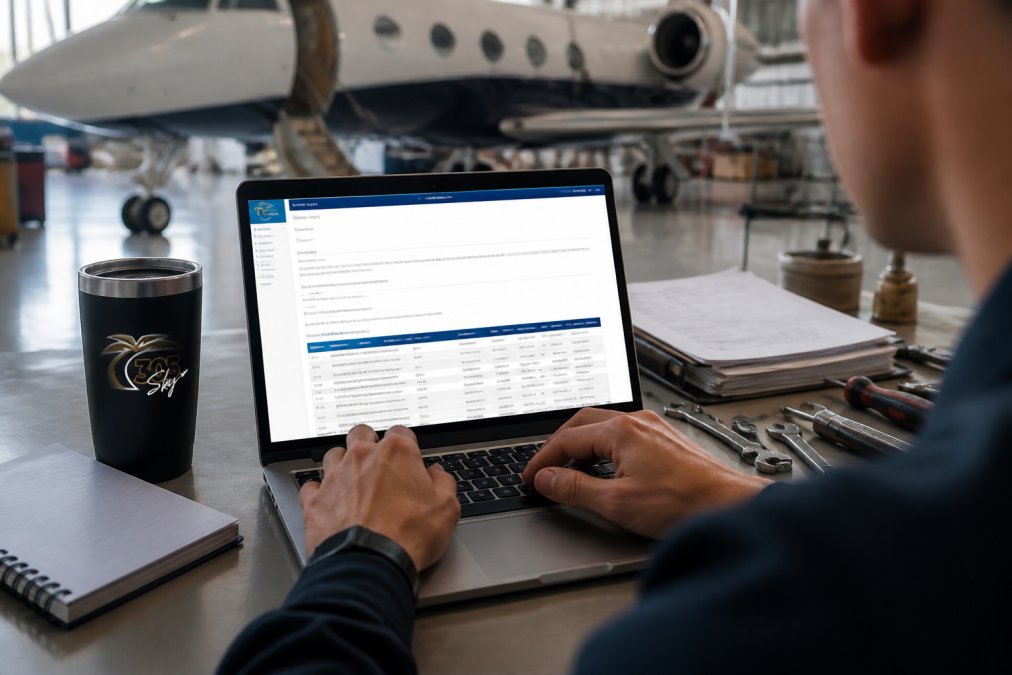
What You Need Before You Search
Before you open the database, gather the mechanic's full legal name and, if available, their certificate number, the most precise identifier. You will also need the type of certificate you are checking, typically an A&P or an IA. The mechanic's date of birth can help disambiguate search results, though it is not always required.
Searching by Name or Certificate Number
- Navigate to the FAA Airmen Inquiry main page.
- Select "Airmen Inquiry" from the menu options.
- Choose whether to search by name or by certificate number.
- Enter the information exactly as it appears on the certificate. For name searches, use the last name first, followed by the first name.
- Review the results carefully. The record will display the certificate type, the current status (e.g., "Certificate Active"), and the specific ratings held.
- Cross-reference the ratings shown in the database with the work you are requesting. An A&P with only an Airframe rating cannot legally sign off on powerplant work.
A status of "Certificate Active" means the mechanic is currently qualified. Any other status, such as "Suspended" or "Revoked," is a red flag that should immediately stop the maintenance process.
Understanding A&P vs. IA: What Each Rating Allows
The distinction between an A&P certificate and an Inspection Authorization is frequently misunderstood. An A&P certificate is the foundational mechanic license that allows a technician to perform and sign off on maintenance and alterations. The "Airframe" rating covers the fuselage, wings, and flight controls, while the "Powerplant" rating covers the engine and related systems. Most mechanics hold both, but you should confirm this in the FAA database.
An IA is a higher-level credential that an A&P mechanic earns after at least three years of experience. The IA rating authorizes the holder to perform and approve major repairs and alterations, and crucially, to conduct the annual inspection required for all aircraft. Think of the A&P as the general practitioner and the IA as the specialist who can perform the comprehensive annual exam. For routine maintenance on a King Air, an A&P is sufficient. For an annual inspection, the supervising mechanic must hold a current IA. The FAA Airmen Inquiry database clearly lists whether a mechanic holds an IA rating, so there is no reason to rely on word of mouth. This distinction is a core part of understanding FAA certification requirements for maintenance personnel.
Verifying Inspection Authorization (IA) Status for Annual Inspections
Verifying Inspection Authorization (IA) status is a specific check that requires an extra step beyond the standard A&P inquiry. While the Airmen Inquiry database shows the IA rating, the IA itself must be renewed every two years, and its currency is tied to the mechanic's recent activity.
When you search the database for a mechanic with an IA, you will see the IA listed among their ratings. However, the database also indicates whether the IA is current. An IA that has lapsed means the mechanic cannot legally perform your aircraft's annual inspection, even if their A&P remains active. This is a subtle but vital detail. For owners in Fort Lauderdale preparing for an annual inspection, confirming IA status is the single most important verification step. If the IA is not current, the inspection is not valid, and your aircraft is not airworthy. The FAA's guidance on Inspection Authorizations outlines the renewal requirements and makes clear that holding the rating is not the same as being current to exercise its privileges.
Meeting Aircraft Maintenance Compliance Requirements
Verification is not a one-time event; it is part of an ongoing aircraft maintenance compliance program. The FAA holds you accountable for ensuring all work is performed by appropriately certificated individuals, even when you outsource the work. This section outlines a practical, repeatable compliance workflow tailored to the way aircraft owners actually operate.
The Owner's Legal Responsibility
Under FAA regulations, the aircraft owner is ultimately responsible for airworthiness, a burden you cannot delegate to the shop. The owner must take proactive steps to confirm the credentials of anyone who signs off on maintenance; a framed certificate on an office wall is not proof of qualification.
A Practical Compliance Workflow for Owners
A strong compliance process is built into your standard operating procedures, not an afterthought. Here is a workflow that works for owners of Challenger, Citation, King Air, Learjet, Falcon, Hawker, Gulfstream, Beechjet, and Pilatus aircraft:
- Verify before you authorize: Before any work begins, confirm the mechanic's A&P certificate and, if required, their IA status through the FAA Airmen Inquiry database. Save a screenshot or PDF of the search result as part of your maintenance record.
- Verify at work completion: Check the mechanic's status again when the work is complete. This protects you from a scenario where a mechanic was qualified when they started a job but lost their certificate mid-project.
- Cross-reference the logbook entry: Ensure the signature and certificate number in the maintenance log match the information you found in the FAA database. If they do not match, the entry is invalid.
- Maintain a digital verification log: Create a simple spreadsheet or folder that tracks each verification check, including the date, the mechanic's name, their certificate number, and the FAA database status. This digital record demonstrates a clear commitment to regulatory compliance if the FAA audits your records.
Local FSDO Contact: Your Compliance Partner
For owners and operators in South Florida, the FAA Flight Standards District Office (FSDO) in Miramar, Florida, is your local point of contact for compliance questions and regulatory guidance. The FSDO is not just an enforcement body; it is a resource for owners who want to understand their responsibilities. If you have questions about a specific maintenance scenario or need to confirm a mechanic's status, FSDO inspectors can provide authoritative answers. Building a relationship with your local FSDO is a proactive step many owners overlook.
Why This Matters for Charter and Management Companies
For charter companies and management firms operating in Florida, this diligence is non-negotiable. The FAA can audit your records at any time, and a single unverified mechanic can put your entire operation at risk. A documented verification process is a competitive advantage that shows clients and insurers you take airworthiness seriously.
The Pre-Buy Inspection Angle for Brokers
For aircraft brokers buying, fixing, and flipping distressed and off-market aircraft, the compliance workflow is a critical part of the pre-buy inspection. A thorough review of the maintenance logs, cross-referenced against the FAA database, protects you from inheriting an aircraft with an unairworthy history. A clean set of logs provides the confidence you need to move forward with a purchase.
Spotting Fraudulent or Expired Certificates
A database check is definitive, but you should also know what to do when something feels off. Fraudulent and expired certificates are rare, but the consequences of missing one are severe enough that every owner, broker, and management company should have a response protocol.
Red Flags on the Physical Certificate
While the FAA Airmen Inquiry database is the source of truth, a quick visual inspection of the physical certificate can trigger a deeper check. Legitimate FAA certificates are printed on tamper-resistant paper with micro-printing and a distinct government seal. Look for these warning signs:
- Photocopied or digitally altered appearance: Any sign of cut-and-paste dates, names, or certificate numbers.
- Inconsistent fonts or spacing: A mismatch in the typography across the document often indicates alteration.
- Missing or mismatched photo: The photo on the certificate should clearly match the person presenting it.
- Evasive behavior: A mechanic who hesitates to provide their certificate number, discourages you from looking them up, or becomes defensive when you mention the FAA database is a significant red flag. Legitimate professionals expect and welcome verification.
The Expired IA Trap
A&P certificates do not expire, but an IA must be renewed every 24 months. The most common fraud scenario is not a forged document, but a mechanic who lets their IA lapse and continues to sign off on annual inspections. The database will show the IA rating, but you must check the status line to confirm it is current; a lapsed IA means the annual inspection is invalid and your aircraft is not airworthy.
Your Response Protocol: What to Do Next
If your search reveals a status other than "Certificate Active," or if the physical certificate shows signs of tampering, stop the maintenance work immediately. Do not let the aircraft return to service based on that mechanic's signature. Your next steps should be:
- Document everything: Take photos of the certificate, note the mechanic's name, certificate number, and the date and time of your interaction.
- Contact the FAA Flight Standards District Office (FSDO): For owners and operators in South Florida, the FAA FSDO in Miramar, Florida, is the local field office that handles enforcement and certificate actions. You can reach them to report a suspected fraudulent or expired certificate. Their inspectors are the authority on enforcement actions and can confirm the status of any certificate.
- Notify the maintenance provider: If you are working with a shop, inform the management immediately. A reputable shop will want to know if a contract mechanic is misrepresenting their credentials.
- Seek a qualified replacement: Find a mechanic with a confirmed active A&P and, if needed, a current IA before any work continues.
For brokers and management companies in the Miami to Port St. Lucie corridor, this protocol is a standard part of our pre-purchase and vendor qualification process. At 305 Sky, we provide our mechanics' certificate numbers without hesitation and encourage every client to verify them through the FAA database. If you encounter resistance to a simple database check, that is a clear signal to find another maintenance provider.
A Note on Enforcement Actions
The database also reflects enforcement actions such as suspensions or revocations, and a status of "Suspended" or "Revoked" is a definitive stop sign. However, it may not always reflect an emergency revocation immediately, which is why the visual inspection and the mechanic's transparency are important secondary checks. A history of enforcement actions should be a disqualifying factor for any work on your Challenger, Citation, or Gulfstream.
By combining the official database check with a physical inspection and a clear escalation protocol, you close the loop on fraudulent or expired certificates and protect your aircraft, your passengers, and your investment.
Maintenance Logs: Your Final Verification Step
The database check confirms the mechanic is qualified, but the maintenance logs prove the work was actually done correctly. A maintenance log entry is the final verification step, serving as the legal record that the work was performed and the aircraft is airworthy. Review the logbook entry for the following details:
- The date the work was completed
- A description of the work performed, including any parts replaced
- The mechanic's signature and certificate number
- The aircraft's total time in service after the work
Ensure the signature and certificate number in the log match the information you found in the FAA Airmen Inquiry database. If they do not match, the entry is invalid. For owners purchasing an aircraft, a thorough review of the maintenance logs by a qualified inspector is a critical part of the pre-buy process, protecting you from inheriting an aircraft with an unairworthy history.
Conclusion
Verifying aviation maintenance certifications is a straightforward process that protects your investment and your safety. Use the FAA Airmen Inquiry database to confirm a mechanic's A&P and IA status, cross-reference the ratings with the work you need, and always check the maintenance logs against the official records. It takes minutes and can prevent catastrophic and costly mistakes. For owners and operators in the Miami to Port St. Lucie corridor, 305 Sky builds this verification into every workflow, from routine maintenance to AOG emergency response. Our team of 3rd generation aviators with over 55 years of combined experience maintains the highest standards of regulatory compliance and transparent communication. Get a quote and experience aircraft care where every signature is backed by verifiable credentials.
Frequently Asked Questions
Does an FAA A&P license expire?
No, an FAA A&P certificate does not expire. However, to exercise the privileges of an Inspection Authorization (IA), the IA itself must be renewed every 24 months. While the A&P certificate remains valid, mechanics must complete required training or inspection activity within the prior 24 months to be eligible for IA renewal. You can verify the current status of any certificate through the FAA Airmen Inquiry database.
What is the difference between an A&P and an IA certification?
An Airframe and Powerplant (A&P) certificate allows a mechanic to perform and sign off on maintenance and alterations. An Inspection Authorization (IA) is an additional rating that permits a mechanic to conduct annual inspections and approve major repairs or alterations. To verify aviation maintenance certifications, you must check both ratings separately in the FAA Airmen Inquiry database, as holding an A&P does not automatically mean the mechanic has inspection authorization.
How do I confirm a technician is authorized to work on my specific aircraft model?
Check the mechanic's certificate for the appropriate ratings: Airframe (A) for the fuselage, wings, and systems, and Powerplant (P) for the engine. A combined A&P certificate covers both. For complex aircraft like a Challenger or Citation, also verify they have the proper training and tools, and check their recent maintenance logs for experience on your model. The FAA Airmen Inquiry database will confirm the certificate's status.
How can I check if a mechanic has a valid Inspection Authorization (IA)?
Use the FAA Airmen Inquiry database. Search for the mechanic by name or certificate number. The results will show their A&P certificate status and whether they hold a current Inspection Authorization. An IA must be renewed every 24 months, so confirm the renewal date is current. This step is critical before hiring someone to perform an annual inspection on your aircraft.
The challenge of managing aircraft maintenance is ensuring every mechanic who touches your jet is fully qualified. 305 Sky addresses this with a transparent, family-oriented approach across our four South Florida facilities. We handle everything from routine inspections to complex avionics upgrades, backed by secure digital record keeping and full regulatory compliance. Get started with 305 Sky and confirm your aircraft is in the most capable hands.
This article was written using GrandRanker