Table of Contents
- What Is AOG Maintenance Support and When Do You Need It?
- Step-by-Step: How the AOG Support Process Works
- AOG Response Time Expectations for Fort Lauderdale Operators
- AOG Parts Procurement Logistics and Expedited Shipping
- Emergency Aircraft Maintenance in South Florida: What Mobile Support Looks Like
- Regulatory Compliance and Airworthiness During an AOG Event
- Pre-AOG Contingency Planning: What to Set Up Before You Need It
- Frequently Asked Questions
Last Updated: September 16, 2026
What Is AOG Maintenance Support and When Do You Need It?
AOG maintenance support is the emergency response service that gets a grounded aircraft back in the air, dispatched by mobile technicians and expedited parts rather than a scheduled shop visit. The term comes from "aircraft on ground," the status an operator declares when an aircraft cannot legally or safely fly. At 305 Sky, our team treats every AOG call as a race against the clock, because a grounded Citation or Challenger in Fort Lauderdale is not just an inconvenience; it is a broken revenue day, a stranded crew, and a missed charter.
For owners and flight departments across South Florida, the distinction matters. Routine maintenance happens on your schedule. AOG support happens on the aircraft's schedule, and it rarely picks a convenient moment.
The Difference Between AOG and Routine Maintenance
Routine maintenance is planned: inspections, oil analysis, progressive checks, and component swaps booked weeks ahead. AOG is unscheduled maintenance, triggered by a failure or discrepancy that grounds the aircraft immediately.
| Factor | Routine Maintenance | AOG Maintenance |
|---|---|---|
| Timing | Scheduled in advance | Immediate, unscheduled |
| Location | Fixed hangar or facility | Ramp, hangar, or remote field |
| Priority | Standard queue | Top priority, 24/7 |
| Parts | Standard lead time | Expedited procurement |
| Goal | Prevent problems | Restore dispatch reliability |
The practical difference shows up in pressure. A routine inspection slipping a day is annoying. An AOG event at 2 a.m. on a Sunday with a charter booked for 7 a.m. is an operational emergency.
Step-by-Step: How the AOG Support Process Works
The AOG support process moves through five stages, from the first call to aircraft release, with a technician and a parts plan assigned early. Speed comes from doing these steps in parallel, not one after another.
- Triage the call. A technician gathers the discrepancy, aircraft type, tail number, and location, then confirms AOG status.
- Dispatch and diagnose. A mobile maintenance unit rolls to the aircraft while remote technical troubleshooting begins.
- Source the parts. The team identifies the unserviceable part and starts expedited shipping or local sourcing.
- Perform the repair. On-site component replacement or repair happens under aviation safety standards.
- Return to service. A mandatory inspection and airworthiness sign-off release the aircraft.
From First Call to Aircraft Release
The thing nobody tells you about AOG work is that the paperwork can ground an aircraft as long as the wrench does. A repair is not finished until it is documented, inspected, and signed off against the applicable airworthiness standards. At 305 Sky, we keep digital records of every step so your compliance trail is intact before the aircraft leaves the ramp.
AOG Response Time Expectations for Fort Lauderdale Operators
Response time expectations for AOG support hinge on three variables: technician proximity, parts availability, and the complexity of the discrepancy. A shop with a mobile van staged near Fort Lauderdale-Hollywood International (FLL) can reach most South Florida ramps faster than a provider dispatching from out of state.
For operators based in Fort Lauderdale, the practical geography matters more than any marketing promise. The business aviation corridor runs from Miami-Opa Locka Executive and Miami Executive up through Fort Lauderdale Executive (FXE), Boca Raton, Palm Beach International, and on to Vero Beach. A technician staged in the middle of that corridor can typically reach FXE, FLL, and Pompano Beach Airpark quickly, while a run up to Palm Beach or Vero Beach adds meaningful drive time. A provider dispatching from out of state is looking at a flight plus a rental car before a wrench ever turns.
Ramp access is the second variable most operators overlook. At a busy field like FLL or FXE, getting a mobile unit airside requires coordination with the FBO, the airport authority, and sometimes the control tower. A provider who already operates in the corridor knows the gate procedures, the FBO contacts, and the after-hours access rules. A provider arriving cold loses time at the security gate before the diagnosis even starts.
The third variable is parts. A technician on site in 45 minutes is not much help if the replacement component is sitting in a warehouse two states away. The fastest recoveries happen when the local provider can pull from regional stock or a nearby parts partner while the technician is still en route. That parallel work, technician rolling, parts sourcing starting, is what compresses downtime from days to hours.
For owners and flight departments, the takeaway is simple: measure your provider by where their people and parts actually sit, not by the response window printed on a brochure. In a corridor as dense as South Florida's, local presence is the single biggest lever on how fast your Challenger, Citation, or Gulfstream is back in the air.
AOG Parts Procurement Logistics and Expedited Shipping
AOG parts procurement logistics is the discipline of locating, verifying, and moving a serviceable component to a grounded aircraft faster than normal supply channels allow. It is often the single biggest driver of downtime.
- Confirm the exact part number and serial eligibility
- Verify traceability and serviceable status
- Choose the fastest realistic shipping method
- Coordinate delivery with the technician on site
- Document receipt and installation for the records
Emergency Aircraft Maintenance in South Florida: What Mobile Support Looks Like
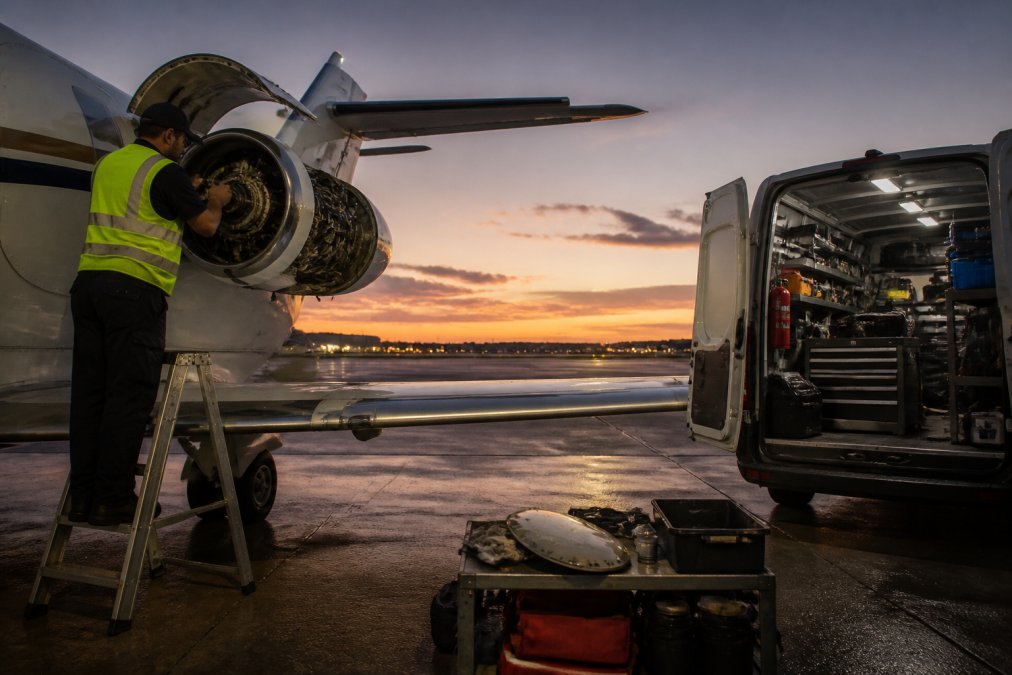
Emergency aircraft maintenance in South Florida depends on mobile capability, because a grounded jet often cannot reach a shop. A mobile maintenance unit brings the technician, tools, and ground support equipment to the aircraft.
Regulatory Compliance and Airworthiness During an AOG Event
Regulatory compliance during an AOG event is where rushed repairs go wrong. Every repair must return the aircraft to an airworthy condition and be documented under the FAA maintenance and airworthiness standards that govern return to service. Speed never excuses a missing sign-off.
- Logbook entry. The entry must describe the discrepancy, the corrective action, and the parts used, and it must be signed with the mechanic's certificate number.
- Parts traceability. Installed parts need documentation showing they are airworthy and eligible for the specific aircraft. That usually means an FAA Form 8130-3 from a repair station, or equivalent traceability from the manufacturer or a qualified supplier.
- Major repair or alteration. If the repair qualifies as a major repair under FAA definitions, additional documentation, often an FAA Form 337, may be required and submitted to the FAA.
- Airworthiness Directives (ADs). Any AD that applies to the affected component must be checked and complied with before release.
- Minimum Equipment List (MEL). In some cases, an operator may legally dispatch under an approved MEL rather than completing the repair on the spot. The MEL is a deferral tool, not a substitute for the repair, and it has its own documentation requirements.
Pre-AOG Contingency Planning: What to Set Up Before You Need It
Pre-AOG contingency planning is the work you do before anything breaks, and it is the difference between a two-hour recovery and a two-day one. The operators who recover fastest are the ones who prepared when nothing was wrong.
- Save a 24/7 AOG contact number in every crew phone and the ops desk
- Keep current aircraft records accessible digitally, not locked in a filing cabinet
- Document your preferred parts sources and traceability requirements
- Identify local ramp and hangar options near your home base and frequent destinations
- Confirm your provider's mobile capability and after-hours coverage in writing
- Review insurance and liability terms before an event, not during one
Frequently Asked Questions
What does AOG stand for in aviation maintenance?
AOG stands for Aircraft on Ground. It describes an aircraft that cannot fly because of a mechanical issue, damage, or an unserviceable part. When a jet is AOG, it is out of revenue service or unavailable to its owner until a qualified technician completes the repair and the aircraft is returned to an airworthy condition. AOG maintenance support exists to shorten that window as much as possible.
How quickly can AOG maintenance teams respond in South Florida?
Response time depends on your location and the nature of the issue. Operators based at or near Fort Lauderdale, Boca Raton, West Palm Beach, and Vero Beach generally see faster mobile dispatch because technicians are already in the region. A well-run AOG provider confirms receipt of your call within minutes, dispatches a mobile unit, and gives you an honest estimate of arrival based on traffic and parts availability.
What is the difference between routine maintenance and AOG support?
Routine maintenance is scheduled in advance: inspections, oil changes, avionics checks, and other tasks planned around your flight calendar. AOG support is unscheduled and urgent. It happens when something fails unexpectedly, often outside business hours, and the aircraft cannot fly until it is fixed. Both matter for airworthiness, but AOG work prioritizes speed, mobile response, and expedited parts to minimize downtime.
How does AOG maintenance impact FAA compliance and airworthiness?
Every repair made during an AOG event must meet FAA airworthiness standards, and the work must be documented in the aircraft's maintenance records. A reputable AOG provider uses certified parts, follows approved procedures, and returns the aircraft to service with proper sign-offs. Skipping documentation or using unapproved parts can jeopardize your airworthiness certificate and create problems during your next inspection.