Table of Contents
- Understanding Aircraft Engine Component Refurbishment
- Receiving Inspection and Initial Assessment
- Disassembly and Non-Destructive Testing for Engine Parts
- Cleaning, Degreasing, and Structural Integrity Assessment
- FAA-Certified Engine Component Repair and Reassembly
- Aircraft Maintenance Record-Keeping Requirements and Documentation
- Cost-Benefit Analysis: Refurbishment Versus New Components
- Predictive Maintenance and Extending Component Lifespan
Last Updated: August 21, 2026
Understanding Aircraft Engine Component Refurbishment
Aircraft engine component refurbishment is the comprehensive process of inspecting, disassembling, cleaning, testing, repairing, and reassembling engine parts to restore them to serviceable condition. Unlike replacement with new components, refurbishment extends the operational life of existing parts while maintaining full compliance with aviation safety standards. This approach balances cost efficiency with the uncompromising safety requirements that govern aircraft operations.
The refurbishment process sits at the intersection of precision engineering, regulatory compliance, and asset management. Every step, from the moment a component arrives at the maintenance facility through final certification, must follow FAA-established protocols and documented procedures. For aircraft operators in Fort Lauderdale and across South Florida, understanding these best practices isn't just about keeping costs down. It's about maintaining airworthiness, managing fleet reliability, and ensuring your aircraft meets every regulatory requirement.
At 305 Sky, our team has handled thousands of engine component refurbishment projects with the same commitment to transparency and precision that defines all our maintenance work. Whether you operate a single aircraft or manage a corporate fleet, the principles we cover here form the foundation of responsible component care.
Receiving Inspection and Initial Assessment
The receiving inspection is where every refurbishment project begins. When a component arrives at the facility, technicians perform a detailed visual examination to document its current condition, identify any damage, and establish a baseline for the work ahead. This step creates the paper trail that supports all downstream decisions.
During receiving inspection, technicians photograph damage, measure wear patterns, and note any corrosion or contamination. They cross-reference the component's serial number against the aircraft's maintenance records to verify its history and confirm it's eligible for refurbishment. Many components carry Airworthiness Directives or Service Bulletins that dictate specific inspection requirements or limit how many times a part can be refurbished. Missing this detail early means wasted labor later.
Documentation is critical here. The inspection report becomes part of the component's permanent record and travels with it through every subsequent stage. When FAA auditors review your maintenance files, this receiving inspection report demonstrates that you took ownership of the component's condition from day one. A thorough receiving inspection typically takes 2-4 hours depending on component complexity and the extent of visible wear (faa.gov).
Disassembly and Non-Destructive Testing for Engine Parts
Disassembly breaks the component into its constituent parts so each surface and internal passage can be thoroughly cleaned and inspected. Technicians follow manufacturer-specific procedures documented in the component's maintenance manual, working methodically to avoid damaging serviceable parts or losing critical fasteners and shims.
Non-destructive testing (NDT) is the process of evaluating material integrity without damaging the part. Common NDT methods in engine component refurbishment include magnetic particle inspection for ferrous materials, fluorescent penetrant inspection for non-ferrous metals, and eddy current testing for detecting surface and near-surface defects (peer-reviewed research). Each method reveals different types of damage: cracks, corrosion pitting, material fatigue, or subsurface voids that visual inspection alone cannot detect.
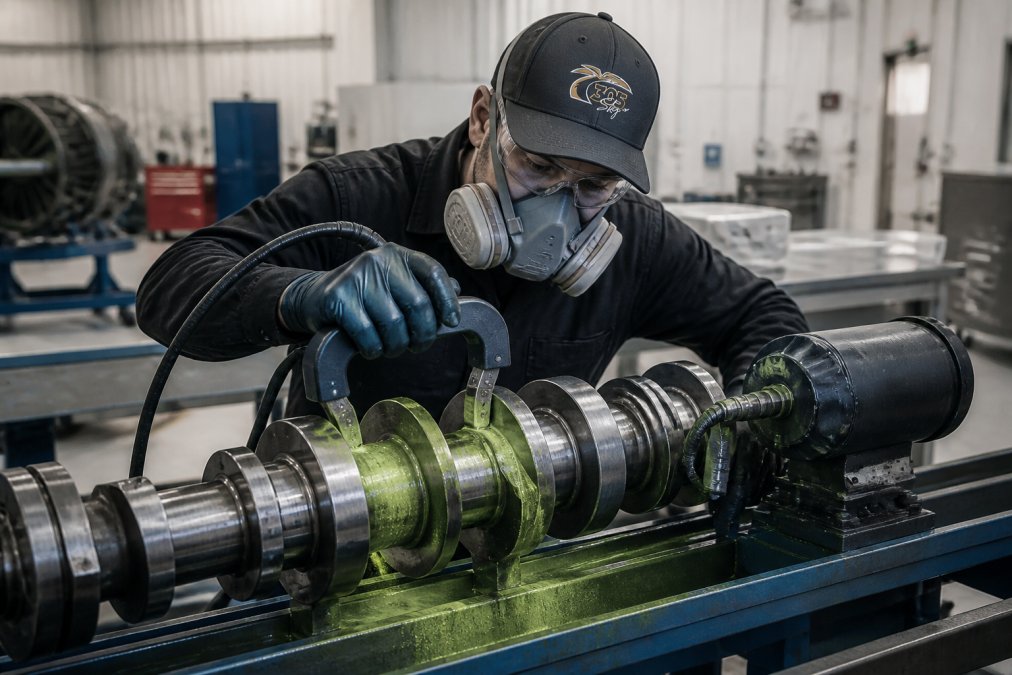
The timing of NDT within the refurbishment sequence matters. Some facilities perform initial NDT before disassembly to establish baseline condition. Others disassemble first, then apply NDT to individual components after cleaning. Both approaches have merit; the choice depends on the component type and the specific issues you're investigating. NDT technicians must hold current certifications and maintain detailed records of every inspection performed. These records become part of the component's airworthiness documentation.
Cleaning, Degreasing, and Structural Integrity Assessment
Cleaning removes accumulated carbon, oil residue, corrosion products, and contamination that obscure the true condition of the component. Degreasing uses specialized solvents and ultrasonic cleaning equipment to reach internal passages and tight tolerances where manual scrubbing cannot reach. This step is not cosmetic, it's essential for accurate inspection and for preventing contamination from entering reassembled systems.
Structural integrity assessment evaluates whether the component can safely carry its design loads. Technicians measure wall thickness in critical areas, check for deformation, and assess whether any corrosion has compromised load-bearing surfaces. For components like crankshafts, accessory gearboxes, or compressor casings, this assessment determines whether the part can be returned to service or must be retired.
Corrosion control is part of this phase. Surface corrosion that hasn't penetrated deeply can often be chemically treated and sealed. Deep pitting or material loss requires more aggressive decisions. Some components can be restored with plating or coating; others have reached the end of their useful life. The structural integrity assessment produces a clear recommendation: return to service, return with restrictions, or retire.
FAA-Certified Engine Component Repair and Reassembly
Repair work on engine components must be performed by technicians working under FAA Part 145 certification at an approved repair station (faa.gov). Not all repairs are permitted; the FAA maintains strict limits on what can be repaired versus what must be replaced. Welding a cracked compressor blade, for example, is prohibited. Replacing worn seals or reworking bearing surfaces to specification is permitted.
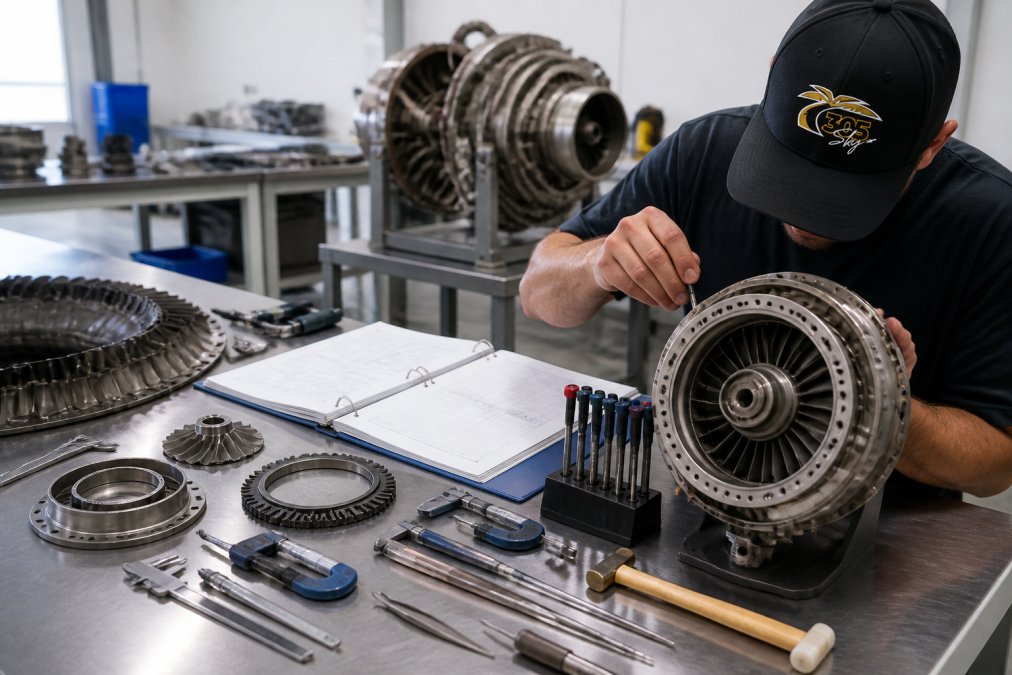
Reassembly reverses the disassembly sequence, but with critical attention to torque specifications, shim placement, and clearance verification. Every fastener must be torqued to specification using calibrated tools. Shims and spacers must be reinstalled exactly as documented. Clearances between rotating and stationary parts must be verified with precision instruments. A single assembly error, an incorrectly torqued bolt, a misplaced shim, a seal installed backwards, can cause component failure in flight.
Before the component leaves the facility, it undergoes a final functional test. For engine accessories like fuel pumps or hydraulic units, this means operating the component under load and verifying output against specification. For structural components, it means final dimensional verification and documentation that the component meets all applicable specifications.
Aircraft Maintenance Record-Keeping Requirements and Documentation
Every action taken during refurbishment must be documented in the aircraft's maintenance records. The FAA requires that maintenance records clearly identify what work was performed, who performed it, when it was performed, and what the results were. For engine component refurbishment, this documentation includes receiving inspection reports, NDT results, repair work orders, reassembly checklists, and final functional test data.
Documentation serves multiple purposes. It proves to the FAA that maintenance was performed correctly and by qualified personnel. It provides the next maintenance technician with a complete history of what was done to the component. It protects the aircraft owner by creating an audit trail. If a component fails prematurely, the maintenance records help determine whether the failure resulted from a maintenance error or a manufacturing defect.
Many operators now use digital maintenance management systems that integrate work orders, parts tracking, and compliance monitoring. These systems reduce paperwork, improve data accuracy, and make it easier to track recurring issues or identify patterns across your fleet. The FAA's Advisory Circular 120-78A provides guidance on electronic record-keeping, and systems like ModernHawk and CORRIDOR are designed to meet these requirements while automating compliance tasks.
Retain all maintenance records for the life of the aircraft plus seven years. This retention period ensures you have documentation available if an incident occurs or if the FAA conducts an audit. Digital storage with secure backups is increasingly the standard; paper records should be scanned and stored securely as well.
Cost-Benefit Analysis: Refurbishment Versus New Components
The decision to refurbish or replace a component depends on several factors: the component's age and condition, the cost of refurbishment versus new replacement, the component's availability, and the aircraft's operational timeline.
Refurbishment typically costs significantly less than purchasing a new component from the manufacturer. A new engine accessory can cost tens of thousands of dollars; refurbishment might cost a fraction of that. However, refurbishment takes time. If your aircraft is grounded waiting for a critical component, the cost of downtime may outweigh the savings from refurbishment. For scheduled maintenance where you have advance notice, refurbishment makes financial sense. For emergency AOG situations, a new part or a loaner component may be the only viable option.
The component's remaining service life also factors into the decision. Some components can be refurbished multiple times; others have a fixed service life measured in flight hours or calendar years. Once a component reaches its service life limit, it must be retired regardless of its physical condition. Understanding these limits prevents you from investing in refurbishment on a component that's approaching mandatory retirement.
Original parts versus aftermarket or overhauled alternatives also affect cost. Original manufacturer parts carry a premium but come with full factory warranty and certification. Overhauled components from established repair stations cost less but require careful verification that the facility performing the overhaul meets FAA standards and that the component's airworthiness status is clearly documented.
For operators managing multiple aircraft, a proactive refurbishment schedule often proves more cost-effective than reactive replacement. Planning refurbishment during scheduled maintenance windows, coordinating with other fleet maintenance, and maintaining inventory of refurbished components ready for installation reduces overall downtime and extends component life across your fleet.
Predictive Maintenance and Extending Component Lifespan
Predictive maintenance uses operational data and condition monitoring to anticipate component wear before failure occurs. Modern aircraft generate detailed engine performance data, fuel flow, exhaust gas temperature, vibration levels, oil pressure and temperature, that reveal degradation patterns long before a component fails.
By monitoring these parameters over time, maintenance teams identify components that are trending toward limits. A slight increase in vibration might signal bearing wear. Rising exhaust gas temperature could indicate compressor fouling or turbine damage. Increasing fuel consumption might reflect seal wear or internal leakage. Catching these trends early allows you to schedule refurbishment or replacement during planned maintenance rather than facing an unexpected failure.
Digital twin technology, creating a virtual model of your engine that mirrors real-world performance, is increasingly available for business jet operators. The digital twin compares your actual engine performance against baseline and predicted performance, flagging anomalies and recommending maintenance actions. This approach transforms maintenance from a calendar-driven schedule to a condition-driven program, optimizing both safety and cost.
Extending component lifespan also means understanding the operating environment. Aircraft operated in high-altitude, cold-weather environments experience different wear patterns than those operating in warm, humid climates. Salt spray exposure near coastal areas like South Florida accelerates corrosion. Frequent short flights with rapid thermal cycling stress components differently than long-range missions. Tailoring your maintenance program to your aircraft's actual operating profile rather than generic schedules improves component longevity.
Aircraft engine component refurbishment represents a substantial opportunity to manage maintenance costs while maintaining uncompromising safety standards. The process demands precision, documentation, and expertise at every stage. When you partner with an FAA-certified repair station that understands your operational needs and maintains transparent communication throughout the refurbishment process, you gain confidence that your aircraft remains airworthy and compliant.
305 Sky's team brings over 55 years of combined aviation experience to every refurbishment project. We handle the complete spectrum of engine component work, from receiving inspection through final certification, with the same commitment to transparency and precision that defines all our aircraft maintenance services. Whether you need routine component refurbishment, emergency AOG support, or a comprehensive maintenance program for your fleet, our four strategically located South Florida facilities and 24/7 mobile response capabilities ensure your aircraft stays in peak condition. Get a quote today and discover why operators throughout Fort Lauderdale and South Florida trust 305 Sky with their most critical maintenance needs.
Frequently Asked Questions
What are the FAA regulations for aircraft engine component repair?
Aircraft engine component repair must comply with FAA Part 145 Repair Station certification requirements. Facilities must follow Airworthiness Directives (ADs), Service Bulletins (SBs), and manufacturer overhaul manuals. All work requires documentation in maintenance records, and technicians must hold appropriate airframe and powerplant (A&P) certifications. Non-destructive testing must meet OEM specifications, and all refurbished components require certification before return to service.
How does component refurbishment differ from engine overhaul?
Component refurbishment addresses individual parts like crankshafts, fuel injectors, and accessory systems to restore them to serviceable condition. Engine overhaul is a complete teardown and rebuild of the entire engine assembly. Refurbishment extends component lifespan and reduces downtime compared to full engine replacement, while an overhaul represents a more comprehensive restoration. Many operators use refurbishment as preventative maintenance between overhauls to manage fleet maintenance costs.
What are the common non-destructive testing methods used in engine refurbishment?
Standard NDT methods include Magnetic Particle Inspection (MPI) for ferrous materials to detect internal flaws, Fluorescent Penetrant Inspection (FPI) for non-ferrous metals to identify surface cracks, and borescope inspections for internal engine components. Ultrasonic testing detects subsurface defects in critical parts. Each method serves specific materials and inspection requirements outlined in OEM technical documentation. Proper NDT prevents component failures and ensures structural integrity throughout the engine's service life.
How do you ensure traceability in aircraft engine component maintenance?
Traceability requires detailed aircraft maintenance record-keeping that documents every step: receiving inspection, disassembly, NDT results, repairs performed, parts used, technician credentials, and reassembly certification. Digital maintenance management systems track work orders, parts serial numbers, and technician qualifications. All documentation must remain accessible for FAA audits and remain with the aircraft. Proper record-keeping demonstrates compliance with Airworthiness Directives and supports the aircraft's certification status.
This article was written using GrandRanker