Table of Contents
- Understanding AOG Situations and Legacy Aircraft Parts
- Step 1: Identify the Part Number and Technical Documentation
- Step 2: Search Multiple Sourcing Channels for AOG Parts
- Step 3: How to Verify Aircraft Parts Traceability
- Step 4: Navigate FAA AC 23-27 Parts Substitution Requirements
- Step 5: Manage AOG Logistics for Legacy Aircraft
- Common Mistakes to Avoid When Sourcing Obsolete Parts
- Conclusion
Last Updated: August 20, 2026
Understanding AOG Situations and Legacy Aircraft Parts
Aircraft on Ground (AOG) situations represent one of the most time-sensitive challenges in aviation maintenance. When an aircraft becomes unserviceable due to a missing or failed component, every hour of downtime translates directly to operational losses and cancelled flights. For older aircraft built before the 1990s, sourcing replacement parts becomes exponentially more difficult because Original Equipment Manufacturers (OEMs) have long since discontinued support.
The core problem is supply chain fragmentation. Unlike modern aircraft that benefit from active manufacturer support, older aircraft depend on a scattered ecosystem of specialized suppliers, salvage operations, and repair shops. Finding the right part requires understanding multiple sourcing channels: OEM legacy databases, Parts Manufacturer Approval (PMA) suppliers, New Old Stock (NOS) inventory dealers, and repair shops willing to overhaul discontinued components. What separates a quick resolution from a multi-day search is knowing exactly where to look and how to verify that what you find meets FAA airworthiness standards.
A sourced part must be traceable, properly documented, and certified as serviceable before installation. The Federal Aviation Administration requires substantiation that any component installed on an aircraft maintains airworthiness, whether it's a new part from an OEM, a PMA-approved equivalent, or an overhauled component with documented maintenance history. This guide walks you through the complete process of sourcing AOG parts for older aircraft, covering part identification, multi-channel searching, traceability verification, FAA compliance, and logistics management.
Step 1: Identify the Part Number and Technical Documentation
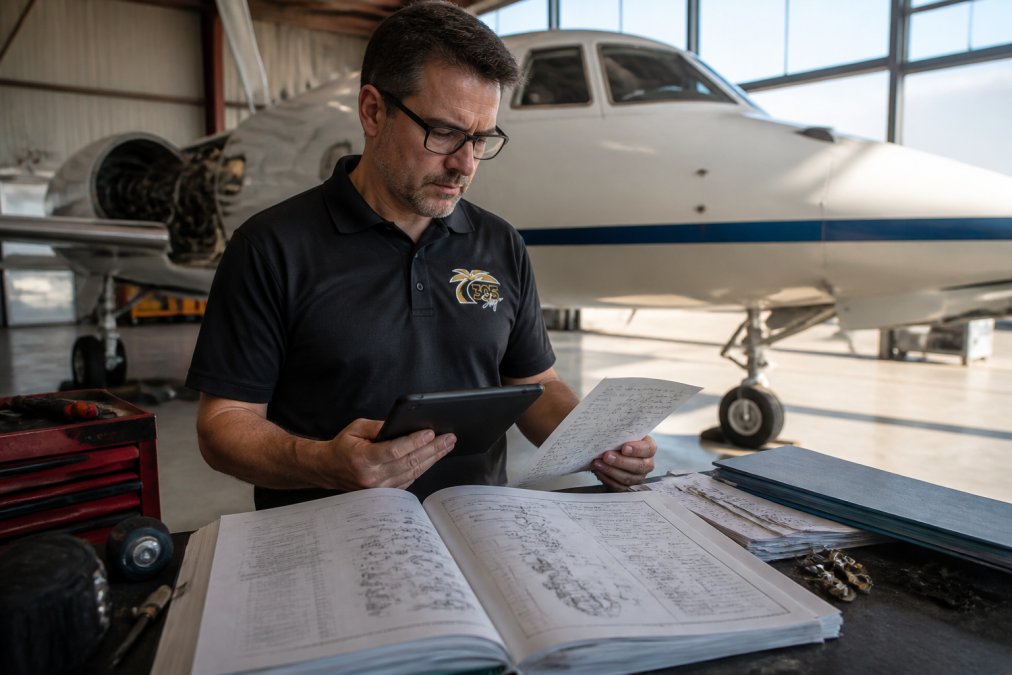
Start by gathering the aircraft's technical documentation: the maintenance manual, the Illustrated Parts Catalog (IPC), and any service bulletins specific to the failed component. The IPC contains exploded diagrams, cross-references between part numbers, and supplier information. Locate the failed component and note the part number (P/N), any revision level, and all superseding or equivalent part numbers.
If your aircraft's documentation is incomplete, contact the OEM directly. Many manufacturers maintain historical archives and can provide digital copies of IPCs even for discontinued aircraft. Be prepared to provide your aircraft's serial number and model designation. Document the exact part number, applicable specifications, and note whether the part is critical to airworthiness.
A common mistake is assuming a part number from a similar aircraft will work in yours. Always verify against YOUR aircraft's specific documentation. If the part number has been superseded, obtain the superseding number from the IPC or manufacturer. When sourcing, search using both the original and superseding numbers.
Step 2: Search Multiple Sourcing Channels for AOG Parts
Once you have the exact part number, search multiple channels simultaneously. Don't rely on a single source.
OEM Direct Contact: Call the manufacturer's parts department and ask if they stock the part or can manufacture it. OEM parts are the gold standard for airworthiness documentation, but they're the most expensive and slowest option for truly obsolete components. Get a quote and delivery estimate, but don't wait for this answer before exploring other channels.
PMA (Parts Manufacturer Approval) Suppliers: PMA parts are manufactured by FAA-approved third-party companies to the same specifications as OEM originals. They cost less and are fully airworthy. Search the FAA's PMA database online to find approved manufacturers for your specific part number. Contact multiple PMA suppliers; pricing and availability vary widely.
Online Parts Databases and Marketplaces: Aviation parts exchanges allow you to search across multiple suppliers simultaneously. These platforms aggregate inventory from repair shops, salvage operations, and parts dealers. The advantage is speed and price transparency. The risk is verifying that what you're buying is serviceable and properly documented.
Salvage Operations and Aircraft Recyclers: When legacy aircraft are retired, their serviceable components are harvested and inventoried by specialized salvage operations. These shops often stock hard-to-find parts at significantly lower prices. You must verify the part's condition and documentation carefully.
Direct Supplier Contact: For components manufactured by sub-suppliers (avionics, hydraulic systems, electrical components), contact the component manufacturer directly. They may still manufacture the part or direct you to authorized distributors who stock legacy inventory.
Regional Repair Shops and MRO Facilities: Local shops often maintain inventory of commonly needed legacy parts or have relationships with salvage suppliers. A call to local facilities can sometimes yield same-day or next-day availability. These shops also provide valuable expertise on which suppliers are reliable.
Create a tracking sheet: part number, supplier name, availability, price, delivery time, and documentation quality. This comparison becomes critical when deciding between options.
Step 3: How to Verify Aircraft Parts Traceability
Traceability means you can document the part's complete history: where it came from, what condition it's in, whether it's been overhauled, and whether it meets current airworthiness standards. The FAA requires this documentation for every component installed on an aircraft.
For new OEM parts and PMA-approved components, traceability is straightforward. The supplier provides an invoice, a parts certificate, and often a Form 8130-3 (Airworthiness Approval Tag) confirming the part meets FAA standards.
For overhauled parts, ask the supplier for maintenance records: what work was performed, what components were replaced, what tests were run, and what certifications were issued. If the supplier can't or won't provide this, walk away.
For salvage parts, ask the salvage operation:
- Where did this part come from?
- What condition was it in when removed?
- Has it been tested or inspected since removal?
- Do they have any maintenance records from the donor aircraft?
Verify the supplier's credentials. Is the supplier an authorized PMA manufacturer? Are they an FAA-certificated repair station? A quick online search and a call to the local aviation community will reveal whether a supplier is reputable.
Request the 8130-3 Form. This is the FAA's official Airworthiness Approval Tag. It certifies that a part meets applicable specifications and is ready for installation. If a supplier can't provide it, they shouldn't be selling airworthy parts.
Document everything. When you receive a part, photograph the packaging, the part itself, and all documentation. Keep copies of invoices, certifications, and maintenance records in your aircraft's file. This creates a chain of custody that protects you if questions arise later.
Step 4: Navigate FAA AC 23-27 Parts Substitution Requirements
Advisory Circular 23-27 (AC 23-27) governs the use of replacement parts on aircraft and is essential reading when sourcing alternatives to OEM originals.
The circular establishes three categories of replacement parts: OEM parts, PMA parts, and used serviceable parts. Each category has different approval pathways and documentation requirements.
OEM parts require no additional approval; they're automatically acceptable. Installation is straightforward as long as you follow the maintenance manual.
PMA parts are pre-approved by the FAA and listed in the PMA database. If you install a PMA part listed in the database for your specific aircraft, you need only the supplier's documentation (invoice and 8130-3 form). No additional FAA approval is required.
Used serviceable parts (including overhauled components and salvage parts) require more scrutiny. AC 23-27 allows their use only if you can document their airworthiness. The regulation requires substantiation: evidence that the part meets the original design specifications and is in a condition suitable for continued service. This typically comes from maintenance records, inspection reports, or an overhaul certificate from a certified repair station.
You cannot install a used part without documentation supporting its airworthiness. You must have either:
- A maintenance record showing the part was recently overhauled or inspected
- A certification from a repair station confirming the part meets specifications
- An 8130-3 form issued by an authorized supplier
Substitutions and equivalent parts are allowed if you can show that the substitute part has the same form, fit, and function as the original. For simple parts (fasteners, hoses, basic mechanical components), equivalence is often straightforward. For complex components, you may need engineering support. When in doubt, consult your aircraft's maintenance manual or contact a local repair station.
The bottom line: AC 23-27 is permissive, but it requires documentation. Every part you install must come with proof of airworthiness.
Step 5: Manage AOG Logistics for Legacy Aircraft
Once you've sourced and verified your part, you face the final challenge: getting it to your aircraft quickly and ensuring it's installed correctly.

Expedited Shipping: AOG situations demand speed. Express overnight shipping adds cost but recovers lost revenue quickly. Coordinate with your supplier on shipping method before committing to a purchase. Ask about their AOG shipping capabilities; reputable suppliers have expedited options and experience shipping to airports.
Local Pickup: If the supplier is within driving distance, arrange immediate pickup. A technician driving to retrieve a part beats waiting for overnight shipping. This is one advantage of working with regional repair shops and MRO facilities; they often have parts in stock and can hand them off same-day.
Documentation Handoff: When the part arrives, verify that all documentation is present: invoice, 8130-3 form, maintenance records, and technical data sheets. Before your maintenance technician installs the part, review the documentation together to confirm it matches your aircraft and the part number you ordered.
Installation and Certification: Your maintenance technician must follow the aircraft's maintenance manual for installation. After installation, log the work in the aircraft's maintenance records, noting the part number, source, and date. If the part came with an 8130-3 form, that goes in the records too.
For Fort Lauderdale-area operators: The density of aviation services in South Florida means you have multiple options for same-day or next-day parts availability and installation. Having a maintenance partner with established supplier relationships and AOG experience can help cut resolution time significantly.
International or Remote Locations: If your aircraft is based outside the continental United States or in a remote location, coordinate with your maintenance facility well in advance. Some suppliers specialize in remote delivery; others won't ship to certain locations. Build this into your sourcing decision.
Common Mistakes to Avoid When Sourcing Obsolete Parts
Mistake 1: Accepting incomplete documentation. A supplier quotes a great price but can't provide an 8130-3 form or maintenance records. Without documentation, you can't legally install the part. Don't buy it.
Mistake 2: Assuming a part from a similar aircraft will work. You find a part from a similar model that looks identical. It doesn't fit. Always verify against YOUR aircraft's specific documentation.
Mistake 3: Relying on a single sourcing channel. You call one distributor, get a six-week lead time, and accept it. You didn't check PMA suppliers, salvage operations, or online marketplaces. Parallel searching often reveals a part available in days instead of weeks.
Mistake 4: Ignoring supplier reputation. A supplier offers the lowest price. You don't verify their credentials or ask for references. The part arrives with incomplete documentation, or the supplier disappears if there's a problem. Reputation matters.
Mistake 5: Not documenting the sourcing process. You source a part, install it, and move on. A year later, an inspector asks where the part came from. You can't remember. Documentation is your legal protection and proof of compliance.
Mistake 6: Overlooking overhaul as an option. Sometimes the part isn't available new or as PMA, but it's available for overhaul. A certified repair station can overhaul the component, test it, and issue an 8130-3 form. Overhauled parts cost less than new OEM parts and are fully airworthy.
Mistake 7: Installing a part without understanding the manual. The part arrives and your technician installs it without consulting the maintenance manual. The installation procedure may be different than expected, or a specific inspection may be required post-installation. Always reference the manual before installation.
Sourcing AOG parts for older aircraft is a discipline that combines detective work, regulatory knowledge, and supplier relationship management. The process moves fastest when you understand where to search, how to verify what you find, and what documentation you need to stay compliant. For operators in the Fort Lauderdale area and across South Florida, having a maintenance partner with established supplier relationships and AOG experience cuts resolution time significantly.
305 Sky's 24/7 AOG emergency response team has managed dozens of legacy aircraft sourcing situations, coordinating with suppliers, verifying parts, and managing logistics to minimize downtime. Whether you're sourcing a hard-to-find component for a 1970s-era aircraft or navigating PMA alternatives for a more recent model, the principles remain the same: identify precisely, search broadly, verify thoroughly, and document everything.
| Sourcing Channel | Best For | Speed | Documentation |
|---|---|---|---|
| OEM Direct | New parts, warranty | Slow (weeks) | Excellent |
| PMA Suppliers | Approved alternatives | Medium (days) | Excellent |
| Online Marketplaces | Price comparison, inventory search | Medium (days) | Variable |
| Salvage Operations | Rare/obsolete parts, cost savings | Fast (same-day pickup) | Requires verification |
| Local Repair Shops | Same-day availability, regional expertise | Fast (same-day) | Good |
| Overhaul Facilities | Non-available parts, cost-effective | Medium (1-2 weeks) | Excellent |
FAA Advisory Circular 23-27 on Parts Substitution
PMA (Parts Manufacturer Approval) Database
Aviation Maintenance Technician Handbook
Frequently Asked Questions
Can you buy old airplane parts for flight-critical systems?
Yes, but with strict requirements. Flight-critical parts must come from FAA-approved sources: OEMs, certified PMA (Parts Manufacturer Approval) suppliers, or overhauled components with 8130-3 airworthiness certificates. You cannot use salvaged or uncertified parts for systems that affect safety. Non-critical components like interior trim or cabin hardware have more flexibility. Always verify the part's classification and obtain proper documentation before installation.
How do I verify the airworthiness of salvaged aircraft parts?
Request the 8130-3 form, which certifies that a part meets FAA airworthiness standards. Check the part's traceability through maintenance records and supply chain documentation. Verify the supplier's credentials: are they FAA-certified, PMA-approved, or authorized by the OEM? For older aircraft, cross-reference the part number (P/N) against the IPC to confirm it matches your aircraft. If documentation is incomplete, the part is not airworthy and should not be installed.
What is the FAA guidance on parts substitution for vintage aircraft?
FAA AC 23-27 provides guidance on using substitute parts when original equipment is unavailable. The substitute must be equivalent in form, fit, and function. You must document why the original part is unavailable and how the substitute meets airworthiness requirements. This typically requires engineering analysis or manufacturer substantiation. Not all parts qualify for substitution; flight-critical components usually require OEM approval. Work with your MRO or maintenance facility to ensure compliance with FAA Advisory Circulars.
Where can I find airplane parts suppliers for hard-to-find components?
Start with OEM parts catalogs and authorized distributors. Use aviation parts databases like Aircraft Spruce, Wag-Aero, and specialized brokers for legacy components. Contact MRO (Maintenance, Repair, and Overhaul) facilities that support your aircraft type. For extremely obsolete parts, reach out to aircraft salvage yards and New Old Stock (NOS) dealers. Network with other operators of the same aircraft model. Always verify supplier credentials and request documentation before purchasing.
This article was written using GrandRanker