
Table of Contents
- Understanding Fixed vs. Variable Maintenance Costs
- The Hidden Impact of Deferred Maintenance and Corrosion
- Predictive Maintenance Aviation: Preventing Costly Surprises
- Aircraft Documentation Importance for Cost Control
- Maintenance Tracking Software Aviation: Digital Tools for Smaller Operators
- MRO Cost Optimization: Negotiating Contracts and Managing Labor Expenses
- Hidden Costs by Aircraft Type: Piston, Turboprop, and Jet Considerations
- Practical Steps for Avoiding Hidden Costs in Aircraft Maintenance
Last Updated: July 23, 2026
Avoiding hidden costs in aircraft maintenance requires a strategic, proactive approach. At 305 Sky, we understand that aircraft owners and operators often face unexpected expenses that can dramatically impact their bottom line. This guide breaks down the most common hidden costs, explains why they happen, and provides actionable steps to prevent them.
Understanding Fixed vs. Variable Maintenance Costs
Your aircraft maintenance expenses fall into two distinct categories. Fixed costs remain constant regardless of flight hours: hangar fees, insurance, annual inspections, and compliance certifications. Variable costs scale with aircraft usage: fuel, engine overhaul reserves, and labor for unscheduled repairs.
Most operators confuse these categories during budget planning. Grounding your aircraft won't reduce costs proportionally, your hangar rent, insurance, and annual inspection requirements remain unchanged. A single engine failure can trigger labor costs, parts procurement, and weeks of aircraft on ground (AOG) time. Predictive maintenance catches problems early when repairs are cheaper than emergency overhauls.
The Hidden Impact of Deferred Maintenance and Corrosion
Deferring maintenance is the most expensive false economy in aviation. An inspection finding that costs $5,000 to fix today becomes a $25,000 problem in six months if ignored. Corrosion is the silent killer, it spreads invisibly inside panels and accelerates structural degradation.
Aircraft operated in coastal environments face accelerated corrosion. Salt air penetrates seals, corrodes fasteners, and weakens aluminum structures. By the time visible corrosion appears, structural damage has already begun. The cost difference between treating early corrosion and replacing corroded components is staggering, sometimes a factor of 10 or more.
Deferred maintenance creates compounding problems. A cracked engine mount bracket that you decide to monitor instead of replacing can eventually damage the engine itself. The initial $3,000 repair becomes a $50,000 engine replacement. Airworthiness Directives (ADs) and Service Bulletins (SBs) establish hard deadlines. Missing these deadlines creates safety risks, legal liability, and can ground your aircraft indefinitely.
Predictive Maintenance Aviation: Preventing Costly Surprises
Predictive maintenance aviation uses data from inspections, engine monitors, and maintenance history to anticipate failures before they occur. This approach reduces unscheduled repairs by 40-60% compared to reactive maintenance.
Engine trend monitoring is the cornerstone of predictive maintenance. Modern engines generate data on exhaust gas temperature, cylinder head temperature, oil pressure, and fuel flow. Comparing this data across flight hours reveals trends, a gradual increase in oil consumption might indicate piston ring wear, allowing you to plan an overhaul before catastrophic failure.
Structural health monitoring works similarly. Regular inspections document the condition of fasteners, rivets, welds, and composite materials. Trending this data reveals which areas are degrading and at what rate. The investment in predictive maintenance typically costs 8-12% of your total maintenance budget and is recouped within 18-24 months through reduced unscheduled repairs.
According to research from the FAA's Continuing Airworthiness Center, operators using structured predictive maintenance programs report 35% fewer unscheduled maintenance events and 28% lower total maintenance costs over five years. FAA Continuing Airworthiness guidance
Aircraft Documentation Importance for Cost Control
Your maintenance records are your most valuable cost-control asset. Complete, accurate documentation of every inspection, repair, and component replacement creates a historical baseline that reveals patterns and justifies maintenance decisions to inspectors, buyers, and insurance companies.
Poor documentation creates invisible costs. When you can't prove that a component was recently overhauled, inspectors must assume it's at the end of its service life and recommend replacement. When you lack records of Service Bulletin compliance, you face re-inspection and potential rework.
Aircraft with complete, organized maintenance records command 15-25% higher prices than comparable aircraft with spotty records. Insurance companies also offer better rates for well-documented aircraft. Digital record-keeping systems have transformed aircraft documentation. Cloud-based platforms allow you to track maintenance schedules, flag upcoming ADs and SBs, document every work item with photos and notes, and generate compliance reports in seconds.
Maintenance Tracking Software Aviation: Digital Tools for Smaller Operators
Maintenance tracking software aviation has become accessible to operators of all sizes. Cloud-based platforms designed specifically for aviation serve solo owners and small fleets with affordable, user-friendly solutions.
Core features include a searchable maintenance log, automated alerts for upcoming inspections and AD compliance, parts inventory tracking, and compliance report generation. Many platforms integrate with your aircraft's avionics to pull real-time flight data, eliminating manual hour logging.
Manual systems require hours of administrative work monthly. Software automation reduces this burden to minutes, saving 5-10 hours monthly, equivalent to $1,000-2,000 in labor costs annually. The best platforms offer mobile access, allowing technicians to log work in real-time from the aircraft, eliminating transcription errors and creating audit trails.
MRO Cost Optimization: Negotiating Contracts and Managing Labor Expenses
Maintenance, Repair, and Overhaul (MRO) providers vary wildly in pricing, quality, and service speed. The lowest-cost MRO isn't necessarily the best value, you might save 10% on labor rates but lose that savings through inefficient scheduling or quality issues requiring rework.
MRO cost optimization starts with understanding their pricing structure. Most charge hourly labor rates (typically $75-150 per hour), plus parts at cost plus markup (usually 25-40%), plus facility fees for hangar time. Hidden costs appear in minimum charge requirements, expediting fees for parts, and after-hours premiums.
Negotiating transparent maintenance contracts protects you from surprise costs. The best contracts specify hourly rates, parts markup percentages, facility fees, and minimum charge policies upfront. They also establish a change-order process, if work scope expands during the job, the MRO must notify you and get approval before proceeding.
Labor expenses represent 60-70% of typical maintenance costs. Reducing labor means improving efficiency. Work that's well-planned and properly documented takes less time. An MRO with your maintenance history available can diagnose problems faster. These operational efficiencies translate directly to lower labor costs.
Hidden Costs by Aircraft Type: Piston, Turboprop, and Jet Considerations
Different aircraft types hide costs in different places.
Piston Aircraft (Cessna 172, Piper Cherokee, Cirrus) Piston engines require overhaul every 1,800-2,000 hours of operation, costing $15,000-25,000. Many owners budget incrementally ($8-12 per flight hour), but costs often exceed estimates if the engine develops unexpected damage during teardown.
Turboprop Aircraft (Beechcraft King Air, Pilatus PC-12) Turboprops hide costs in hot-section inspections. The engine's turbine section requires periodic inspection and component replacement costing $20,000-40,000. Propeller overhauls run $8,000-15,000 per engine. Turboprops also require more complex avionics and systems, increasing both routine maintenance and emergency repair costs.
Light Jets (Embraer Phenom, Cessna Citation) Jet engines require hot-section inspections and borescope inspections at regular intervals, costing $5,000-10,000 each. Auxiliary Power Unit (APU) overhauls run $15,000-30,000. Avionics in jets are significantly more complex and expensive than piston aircraft, with glass cockpit upgrades costing $100,000+.
Heavy Jets (Bombardier Global, Gulfstream G650) Heavy jets have multiple engines, complex hydraulic systems, and advanced avionics that multiply maintenance costs. Component life limits are strict, creating sudden replacement needs. The cost difference between maintaining a light jet and a heavy jet is often 3-5 times higher.
The hidden cost pattern across all aircraft types is the same: component overhauls and life-limited replacements create unpredictable expense spikes. Budgeting for these requires reserve accounts or engine/component programs with MROs.
Practical Steps for Avoiding Hidden Costs in Aircraft Maintenance
These five steps create a framework that prevents most common hidden costs from materializing.
Step 1: Establish a Preventive Maintenance Schedule
A preventive maintenance schedule is your roadmap for avoiding hidden costs. It specifies what gets inspected, when, and by whom. Without a schedule, maintenance becomes reactive.
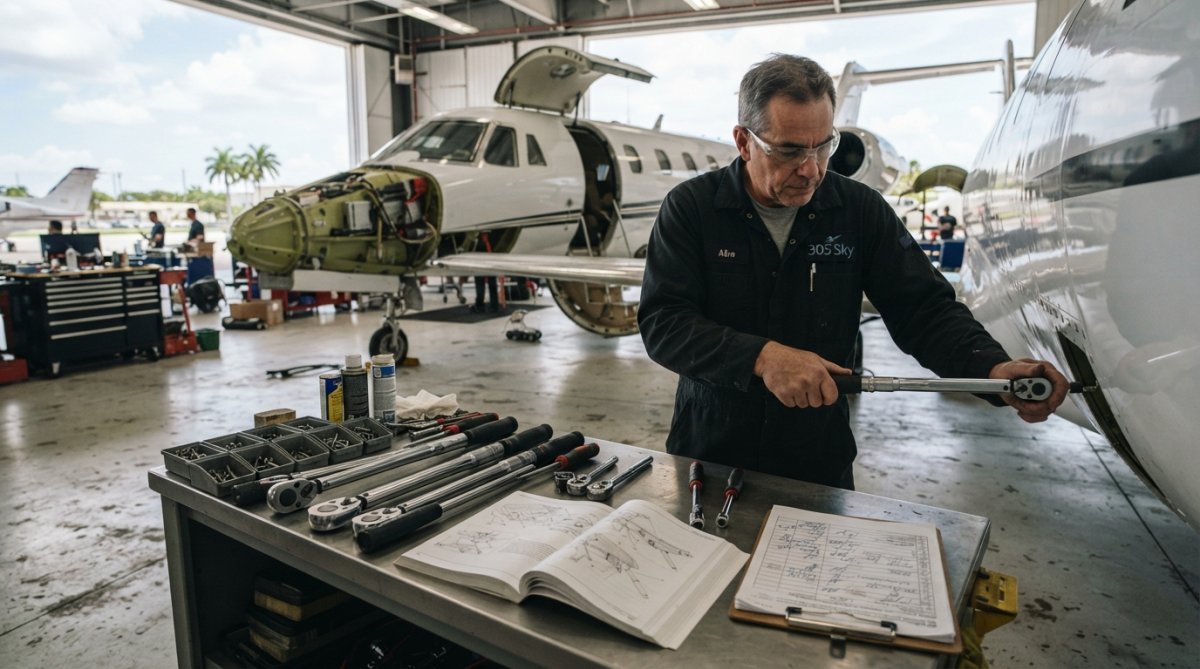
Your schedule should include manufacturer-recommended inspections, FAA-mandated inspections (annual, 100-hour, progressive), and supplemental inspections based on your aircraft's history. Document your schedule in writing, including inspection intervals measured in calendar months and flight hours, using whichever comes first.
Step 2: Create and Maintain Comprehensive Records
Comprehensive records are the foundation of cost control. Every inspection, repair, and component replacement should be documented with the date, technician name, work performed, parts used, and cost.
Use a consistent format for all records. Digital maintenance tracking software aviation platforms standardize this format and make searching and reporting trivial. Include photos in your records, a photo of corroded fasteners or cracks provides visual evidence supporting future maintenance decisions.
Step 3: Monitor Airworthiness Directives and Service Bulletins
Airworthiness Directives (ADs) are mandatory compliance requirements issued by the FAA. Service Bulletins (SBs) are manufacturer recommendations that improve safety or reliability. Both create maintenance obligations that, if missed, can ground your aircraft.
A typical aircraft might have 50-100 active ADs and hundreds of applicable SBs. Automated tracking is essential. Maintenance tracking software aviation platforms flag upcoming AD and SB compliance dates and often integrate with the FAA's AD database, automatically updating your list when new ADs are issued.
Step 4: Plan for Obsolescence and Avionics Upgrades
Avionics and components become obsolete. Planning for obsolescence means identifying which systems will become unavailable and budgeting for replacement before they fail.
Avionics upgrades are the most common obsolescence issue. Glass cockpit systems that were state-of-the-art 15 years ago are now incompatible with modern data systems. The FAA's mandate for ADS-B Out equipment forced many operators to upgrade avionics earlier than planned, costing $50,000-150,000.
Research your aircraft's avionics roadmap. Contact your avionics shop and ask which systems are approaching end-of-life. Plan upgrades during scheduled maintenance events when the aircraft is already down for work.
Step 5: Negotiate Transparent Maintenance Contracts
Contract terms determine whether you pay fair prices or premium prices for maintenance. A transparent contract specifies labor rates, parts markup, facility fees, minimum charges, and change-order procedures upfront.
When negotiating, provide your MRO with your maintenance history and planned schedule. MROs that understand your aircraft's condition can offer better pricing because they can plan their workload and inventory. Request hourly labor rates broken down by technician certification level.
| Step | Primary Focus | Typical Duration | Frequency |
|---|---|---|---|
| Establish Preventive Schedule | Define inspection intervals and costs | 2-4 weeks initial setup | Annually review and update |
| Maintain Comprehensive Records | Document all work with details and photos | Ongoing, 30 min/month | Every maintenance event |
| Monitor ADs and SBs | Track compliance dates and implement changes | 2-3 hours monthly | Continuous throughout year |
| Plan for Obsolescence | Identify upcoming part/system end-of-life | 4-6 weeks research | Annually reassess |
| Negotiate Contracts | Establish clear pricing and terms | 1-2 weeks negotiation | Every 2-3 years or contract renewal |
Conclusion
Avoiding hidden costs in aircraft maintenance comes down to three principles: planning ahead, maintaining detailed records, and building transparent relationships with your maintenance providers. Aircraft owners who implement these practices consistently report 30-40% lower maintenance costs and significantly fewer emergency repairs.
The difference between an aircraft that costs $30,000 annually to maintain and one that costs $50,000+ is rarely the aircraft itself, it's the owner's approach to maintenance. At 305 Sky, we help operators implement these systems with our comprehensive aircraft maintenance and management services. Our 24/7 AOG emergency response, transparent pricing, and detailed documentation practices ensure your aircraft remains compliant and cost-efficient. With over 55 years of combined aviation experience, our team knows how to identify hidden costs before they become expensive problems. Get a quote today and discover how proper maintenance management protects both your aircraft and your budget.
Frequently Asked Questions
What are the most common hidden costs in aircraft maintenance that owners overlook?
Common hidden costs include progressive corrosion damage, unscheduled AOG (Aircraft on Ground) repairs, labor overruns due to human error during maintenance, obsolescence of avionics requiring expensive retrofits, and costs associated with deferred maintenance that compounds over time. Many owners underestimate the financial impact of extended downtime, inventory management for spare parts, and the cumulative expense of regulatory compliance tasks like Airworthiness Directives and Service Bulletins. Preventive maintenance and accurate documentation help identify these costs before they become emergencies.
How can predictive maintenance aviation reduce unexpected aircraft expenses?
Predictive maintenance aviation uses data analysis and monitoring to identify potential failures before they occur, allowing you to schedule repairs during planned downtime rather than facing costly emergency AOG situations. By tracking engine hours, flight cycles, and component condition through maintenance records and digital tools, operators can address wear patterns proactively. This approach reduces labor costs associated with rushed repairs, minimizes unscheduled maintenance events, and extends the life of critical components. The key is consistent data collection and analysis to spot trends that indicate when parts or systems need attention.
Why is accurate aircraft documentation importance so critical for controlling maintenance costs?
Accurate documentation ensures regulatory compliance with FAA requirements, provides a complete history for pre-buy inspections and insurance claims, and enables mechanics to identify patterns in component failures or recurring squawks. Comprehensive maintenance records reduce labor costs by eliminating redundant inspections, support warranty claims on parts and materials, and help MROs provide accurate quotes based on actual aircraft condition. Poor documentation can result in duplicate work, missed compliance deadlines, and higher insurance premiums. Digital record-keeping also speeds up the process and reduces human error in tracking life-limited components and service bulletins.
What strategies help negotiate better maintenance contracts with MROs to optimize costs?
Request detailed quotes that break down labor rates, parts markups, and overhead separately so you understand pricing structures. Compare rates across multiple MROs and ask about volume discounts if you operate multiple aircraft. Negotiate fixed-price contracts for routine inspections and annual maintenance rather than hourly labor rates. Clarify what's included in service packages and what constitutes additional charges. Ask about parts pricing policies, some MROs source components at better rates than others. Establish clear communication about quality assurance (QA) standards and liability coverage. Understanding your aircraft's specific maintenance needs by type helps you identify which MRO specializes in your platform and can offer competitive pricing.
[EXTERNAL_LINK: FAA Airworthiness Directives database and compliance requirements | faa.gov]
[EXTERNAL_LINK: Aviation Maintenance Technician Handbook guidance on inspection standards | faa.gov]
[EXTERNAL_LINK: Aircraft Owners and Pilots Association maintenance cost analysis | aopa.org]
This article was written using GrandRanker