Table of Contents
- What Makes an Interior Material Durable in a Private Jet?
- Quick Comparison: The 5 Best Private Jet Interior Materials
- 1. Premium Aviation-Grade Leather: The Best Leather for Aircraft Seats
- 2. Engineered Wood Veneers: Stable Luxury for Cabin Panels
- 3. Satin-Brushed Titanium: Hardware That Handles High-Touch Areas
- 4. Lightweight Composite Panels: Impact-Resistant Sidewalls and Bulkheads
- 5. Aviation-Grade Stain-Resistant Carpeting: Built for Heavy Foot Traffic
- Understanding FAA Aircraft Interior Flammability Standards
- Frequently Asked Questions
Last Updated: September 6, 2026
When you fly a Gulfstream or Challenger out of Fort Lauderdale, the cabin is the surface you touch and the first impression you leave on clients. Choosing durable jet interior materials determines how often you are grounded for repairs. We have refurbished dozens of cabins across South Florida and seen which materials survive years of service and which fail within months.
The core tension in aircraft design is weight versus toughness: a material heavy enough to resist impact costs range, while a lighter one may not hold up to daily use. Durability is defined by wear resistance, impact resistance, and compliance with FAA flammability rules. We will show you which materials to specify and where they work best.
What Makes an Interior Material Durable in a Private Jet?
Durability in an aircraft cabin is not the same as durability in a car or a home. An interior material for a private jet must pass FAA flammability and smoke emission requirements, resist constant UV exposure at altitude, and survive repeated cleaning cycles with aviation-grade chemicals. The cabin environment cycles between dry cabin air and humid ground conditions in Florida, which stresses materials in ways residential products never experience.
The FAA sets the baseline with strict flammability standards, but durability goes beyond passing a burn test (ecfr.gov). A truly durable material resists scuffing from luggage, holds its color under direct sunlight, and does not degrade with weekly cleaning.
Quick Comparison: The 5 Best Private Jet Interior Materials
| Material | Primary Use | Key Durability Benefit | Best For |
|---|---|---|---|
| Aviation-Grade Leather | Seating and upholstery | Scuff resistance, long lifespan | High-use charter and owner-flown jets |
| Engineered Wood Veneers | Cabin paneling and tables | Won't warp with humidity changes | Challenger, Gulfstream, and Citation cabins |
| Satin-Brushed Titanium | Latches, galley, high-touch hardware | Corrosion resistance, masks scratches | Galleys and lavatories |
| Composite Panels | Sidewalls and bulkheads | Impact resistance, lightweight | Learjet and Citation refurbishments |
| Aviation-Grade Carpet | Flooring | Stain resistance, tight weave | High-use aircraft |
1. Premium Aviation-Grade Leather: The Best Leather for Aircraft Seats
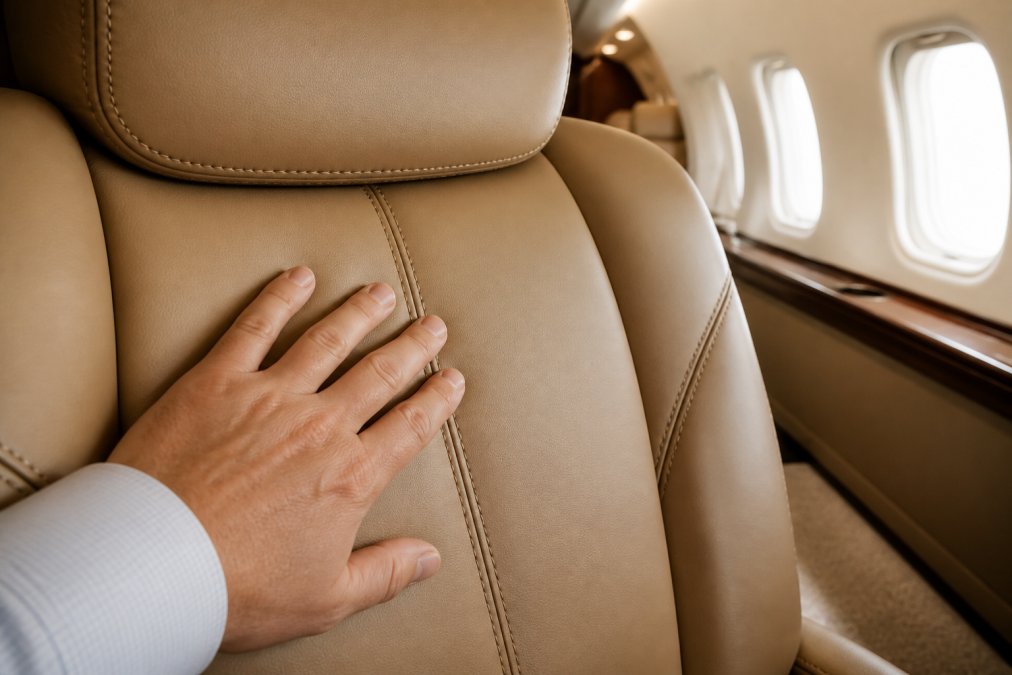
Premium aviation-grade leather is the best choice for aircraft seats because it is tanned and treated to meet FAA flammability requirements while withstanding the abuse of boarding and service. Unlike automotive leather, aviation-grade hides are selected for consistent thickness and finished with fire-retardant treatments that do not wash off over time.
What separates good aviation leather from a luxury car seat is the stitching and backing. Hand-stitched seams with high-strength thread prevent rips, and the natural topcoat resists scuffing while developing a patina that hides minor wear. The one drawback is maintenance: it requires periodic conditioning to prevent cracking in dry cabin air.
2. Engineered Wood Veneers: Stable Luxury for Cabin Panels
Engineered wood veneers solve the warping problem that plagues solid timber in aircraft. Solid exotic hardwoods expand and contract with the humidity changes that occur every time the cabin door opens in South Florida. Reconstituted veneers are sliced from fast-growing wood, dyed to match exotic species, and laminated onto stable substrates, giving you the look of precious woods with predictable performance.
The stability advantage means cabinetry and table leaves stay flush and rattle-free years after installation. When a panel is damaged, the consistent grain pattern makes it easier to match a repair. Solid wood is lighter in some cases, but the stability tradeoff is not worth it for an aircraft that lives on the ramp in humid climates.
The Florida Factor: Humidity, Salt Air, and UV
For aircraft based in South Florida, the environmental stress on veneers is relentless. The daily cycle of high humidity on the ramp and dry, air-conditioned cabin air creates a constant expansion-contraction loop. Solid wood veneers, even when sealed, will eventually develop hairline cracks; engineered veneers remain dimensionally stable.
Salt air from coastal operations is a second, often overlooked threat: it accelerates degradation of the adhesives bonding veneers to their substrates. When specifying veneers for an aircraft operating out of Fort Lauderdale, insist on marine-grade, waterproof adhesives. Standard interior-grade adhesives will break down, leading to delamination and bubbling.
UV exposure at altitude is the third factor. The sun's rays are more intense above the clouds and will fade and embrittle the finish on veneers. A high-quality UV-inhibiting clear coat prevents the wood from becoming dry and brittle.
Repairability vs. Replacement: A Cost-Benefit View
A common assumption is that any damage to a wood panel means a full cabin teardown. That is rarely the case. The repairability of engineered veneer is one of its strongest durability features.
- Scratches and Scuffs: Light surface scratches in the clear coat can often be buffed out with a fine abrasive pad, avoiding a full refinish.
- Dents and Chips: A localized dent can be repaired using a wood filler matched to the veneer color, then touched up with a lacquer pen. This is a routine maintenance item.
- Deep Gouges or Cracks: If the damage penetrates the veneer layer itself, a skilled cabinetmaker can often inlay a new piece of matching veneer. Because engineered veneer is dyed and sliced to a consistent pattern, the repair is nearly invisible.
Full panel replacement is only necessary when the substrate is compromised, such as from a water leak or structural impact. Have a technician assess localized damage before committing to a full replacement.
A Maintenance Protocol for Longevity
The durability of your veneer is directly tied to your maintenance routine. An effective protocol for an aircraft cabin includes:
- Dust Weekly: Use a soft, lint-free microfiber cloth to remove dust. Grit acts as an abrasive and will dull the finish over time.
- Clean with a Damp Cloth: Use a cloth dampened with distilled water and a drop of mild dish soap. Wipe with the grain and dry immediately. Avoid commercial wood polishes that contain silicone, which can leave a residue that attracts dust and complicates future refinishing.
- Control Humidity Onboard: When the aircraft is parked for extended periods, use a desiccant system or run the environmental control system periodically to keep the cabin humidity between 40% and 50%. This prevents the veneer from drying out and the adhesive from becoming brittle.
- Protect from Direct Sun: When parked on the ramp, use window shades to block direct sunlight on veneered surfaces. This prevents UV damage and reduces the temperature cycling that stresses the material.
Understanding the environmental threats and repairability of engineered veneers lets you balance aesthetics with long-term durability and maintenance costs.
3. Satin-Brushed Titanium: Hardware That Handles High-Touch Areas
Satin-brushed titanium is the answer for the parts of the cabin that take the most mechanical abuse: latches, hinges, tray table mechanisms, and galley fixtures. It has a superior strength-to-weight ratio, making it lighter than steel but just as strong, and it resists corrosion from coastal salt air.
The satin finish masks fingerprints and minor scratches that would be obvious on polished chrome or anodized aluminum. The higher cost versus aluminum or plastic is justified in high-touch areas like galleys and lavatories, where cheaper hardware fails first.
4. Lightweight Composite Panels: Impact-Resistant Sidewalls and Bulkheads
Lightweight composite panels are the workhorse of modern cabin refurbishment, engineered to resist denting from luggage while saving significant weight over older materials. These panels use a fire-resistant honeycomb or foam core sandwiched between thin layers of carbon fiber or fiberglass. The weight savings directly improve range and fuel efficiency.
Composites also resist moisture and temperature-related degradation, critical for the cabin envelope's structural integrity. Their one limitation is that repairs require specialized technicians. For an owner modernizing an older cabin, composite panels bring the interior up to current durability standards without a weight penalty.
5. Aviation-Grade Stain-Resistant Carpeting: Built for Heavy Foot Traffic
Aviation-grade carpeting differs from residential or commercial carpet. Its tight-weave, low-pile construction prevents edge fraying and resists crushing from constant foot traffic. The fibers are treated with anti-stain and anti-static coatings, and the backing meets FAA smoke and toxicity requirements.
The practical benefit is in the quick-turn environment: spills wipe up, stains do not set, and the carpet can be cleaned aggressively without losing color or texture. The tradeoff is fewer color and pattern options than luxury wool blends. For a charter operator or frequent flyer, the reduced aesthetic range is a fair price for a floor that looks new after years of service.
The Technical Construction: Fiber, Twist, and Backing
The durability of aviation carpet is about the entire construction. Key specifications to look for are:
- Fiber Type: Nylon is the industry standard for high-use aircraft. It is inherently resilient, meaning it springs back after compression from seat tracks and foot traffic. Polyester and wool are softer but will crush and show wear much faster in an aircraft that flies multiple legs a day.
- Twist Level: The tighter the twist in each fiber, the more resistant it is to matting and fuzzing. Look for a high twist level, which is a sign of a durable, long-lasting pile.
- Pile Density: A dense, low-profile loop or cut-pile is more durable than a high, loose pile. It prevents dirt from becoming trapped deep in the carpet and makes vacuuming more effective.
- Backing System: The backing is what holds the carpet together and secures it to the aircraft floor. A high-quality backing system is critical for preventing delamination and edge fraying. It also provides a barrier against moisture, which can lead to mold and mildew in the cabin.
Impact Resistance: The Real-World Test
While stain resistance is a primary selling point, the real test is impact resistance. In a high-use cabin, roller bags are dragged across the carpet, heavy service carts are rolled over it, and dropped objects can leave a mark.
A common failure point is not the fiber but the cushioning underlayment. High-quality aviation-grade carpet is often installed over a lightweight foam or rubber underlayment that absorbs impact, protecting the carpet from being crushed against the hard floor and extending its life.
For high-traffic areas like the galley and entryway, specify a carpet with a denser, tighter loop construction that resists snagging and crushing. Some operators also opt for a replaceable runner in these zones.
Cleaning and Maintenance: A Proactive Approach
The best carpet will fail prematurely without a proper maintenance routine. The goal is to remove grit before it acts like sandpaper on the fibers. A recommended protocol for an aircraft is:
- Daily Vacuuming: Use a vacuum with a soft brush attachment to lift dirt and grit from the pile. This is the single most important step.
- Immediate Spot Cleaning: Address spills immediately with an FAA-approved spot cleaner. Blot, do not rub, to prevent the stain from spreading.
- Weekly Deep Cleaning: Use a low-moisture encapsulation cleaner to lift embedded dirt and leave a residue that prevents new dirt from adhering.
- Annual Professional Cleaning: Have the carpet professionally extracted to remove deep-seated oils and grime that can break down the fibers over time.
By focusing on technical construction and implementing a proactive maintenance plan, you can ensure your aircraft's carpet looks pristine and withstands a demanding flight schedule.
Understanding FAA Aircraft Interior Flammability Standards
The FAA regulates every material that goes into an aircraft cabin through the FAA regulations covering interior flammability. These standards govern burn rate, heat release, smoke density, and toxic gas emission for seats, panels, carpets, and insulation. Passing these tests is a legal requirement for the aircraft to remain airworthy and compliant.
For owners, the practical takeaway is to insist on certified materials with traceable documentation. Your maintenance provider should keep secure digital records of material certifications for every refurbishment. This documentation protects you during an inspection and proves compliance. We maintain these records for every cabin transformation at our Fort Lauderdale facilities.
Aircraft interior maintenance matters most in the months after a refurbishment. The leather needs conditioning, the veneers need protection from direct sun, and the carpet needs regular vacuuming to remove grit. Establishing a cleaning routine with your maintenance team will extend the life of every material in this guide. If you are planning a cabin transformation and want to discuss which materials fit your mission profile, get a quote from the 305 Sky team.
Frequently Asked Questions
What is the most durable leather for private jet seating?
Premium aviation-grade leather is the most durable choice for private jet seats. Unlike standard automotive leather, it is specifically treated to meet FAA flammability standards and withstand frequent cleaning cycles. Full-grain, aniline-dyed leather with a protective topcoat offers the best balance of breathability and scuff resistance. Look for hides that are hand-stitched for structural integrity. While it requires periodic conditioning to prevent cracking, it develops a patina that hides minor wear, making it a long-term investment for high-use charter jets.
How do FAA regulations impact the choice of aircraft interior materials?
FAA aircraft interior flammability standards dictate what materials you can legally install. All materials, from seat upholstery to sidewall panels and carpeting, must meet specific burn, smoke, and toxicity requirements. This means you cannot simply use residential or even automotive-grade products. Choosing certified materials from the start is critical, as non-compliant materials will fail inspection and require costly replacement. Working with a maintenance provider experienced in FAA compliance ensures your refurbishment meets all regulations without delays.
Are synthetic materials more durable than natural materials in aircraft cabins?
It depends on the specific material and its application. For structural components like sidewalls, lightweight composites are more impact-resistant and dimensionally stable than natural wood, which can warp with humidity changes. However, for seating, high-quality aviation-grade leather often outperforms synthetic fabrics like Alcantara in resisting scuffs and wear from frequent use, although it needs more conditioning. The best strategy is often a hybrid approach: use advanced composites and engineered veneers for structure and reserve natural leather for seating surfaces where its durability and repairability shine.
How often should private jet interiors be refurbished for wear and tear?
For high-utilization charter aircraft, a full interior refurbishment is typically needed every 5 to 7 years. Privately flown jets with lower usage can often extend this to 10 years or more. However, individual components wear at different rates. Seats and carpeting in high-traffic zones may need attention sooner, while composite panels and titanium fixtures can last the life of the airframe with proper care. Regular inspections can help you identify worn areas before they become costly problems, allowing you to plan maintenance proactively and minimize downtime.
What materials are used in private jet cabin refurbishments?
A typical private jet cabin refurbishment uses a combination of materials chosen for durability, weight, and aesthetics. This includes aviation-grade leather for seats, engineered wood veneers for cabinetry and paneling, lightweight composite panels for sidewalls and bulkheads, satin-brushed titanium for high-touch fixtures, and stain-resistant carpeting. Every material must be certified to meet FAA flammability standards. The specific selection depends on your aircraft model and how you use the jet, balancing luxury finishes with practical wear resistance.