Table of Contents
- Start With Your Mission Profile and Aircraft Type
- FAA Part 145 Repair Station Requirements Every Owner Should Verify
- Avionics Installation Best Practices That Reduce Risk
- Aircraft Downtime Estimation: What to Expect and How to Plan
- Questions to Ask Before Hiring Private Jet Avionics Installers
- Warranty, Post-Installation Support, and Regional Vetting in South Florida
- Frequently Asked Questions
Last Updated: September 16, 2026
Start With Your Mission Profile and Aircraft Type
Choosing private jet avionics installers starts with one question: what does your aircraft actually fly? A shop that excels at Citation flight deck upgrades may never have touched a King Air's avionics suite, and that gap matters more than any marketing claim.
The 305 Sky team, working out of Fort Lauderdale, has watched owners select installers on price alone, then pay twice when the work needed redoing.
Ask yourself:
- Do you fly long-range international legs or regional hops?
- What navigation systems and communication equipment does your typical route demand?
- Will you need ADS-B Out, data link, or weather radar upgrades in the next two years?
Matching Installer Experience to Challenger, Citation, and King Air Platforms
Platform familiarity is not a nice-to-have. An installer who has completed dozens of STC (Supplemental Type Certificate) projects on Challenger, Citation, King Air, Learjet, Falcon, Hawker, Gulfstream, Beechjet, or Pilatus airframes knows where the wire runs hide and which avionics panel layout quirks will slow the job.
FAA Part 145 Repair Station Requirements Every Owner Should Verify
An FAA Part 145 repair station certificate is the baseline credential for any facility performing avionics installation and return-to-service work in the United States. Without it, the shop cannot legally sign off many repairs, and your aircraft airworthiness record suffers.
Avionics Installation Best Practices That Reduce Risk
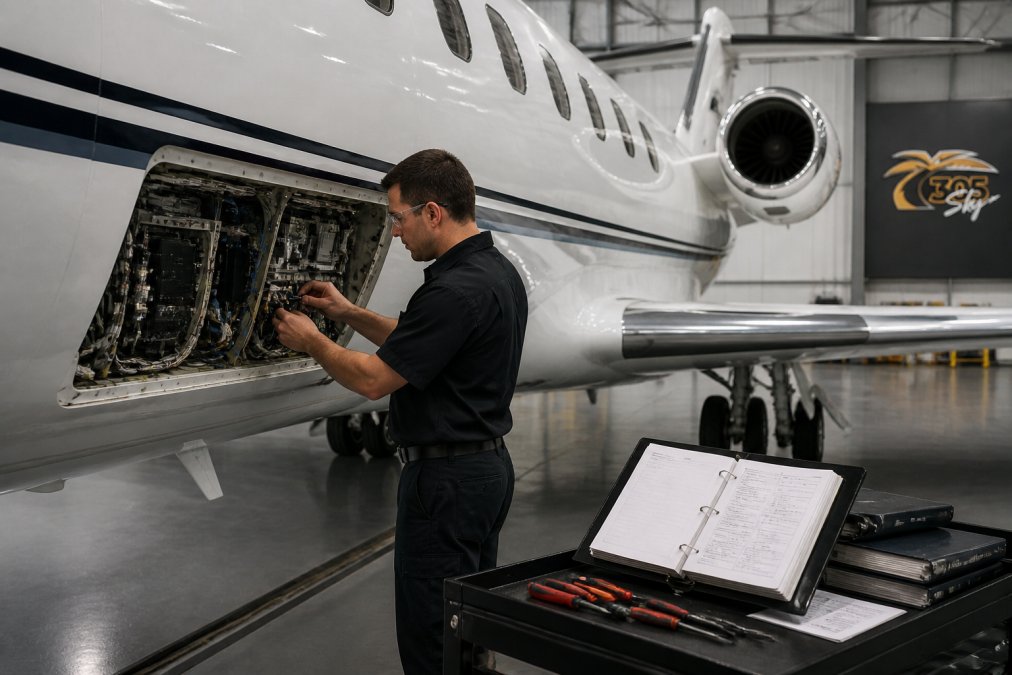
Good avionics installation follows the manufacturer's instructions exactly and documents every deviation. Sloppy work shows up months later as intermittent faults that are expensive to trace.
Insist on these practices:
- Pre-installation survey: the shop photographs existing wiring and documents equipment compatibility before touching anything.
- STC compliance: every modification references a valid STC or field approval.
- Bench testing: new units are tested before installation, not after.
- Post-installation flight test: a functional check flight confirms autopilot systems, transponder, and flight management system performance.
STC Coverage, NextGen Compliance, and ADS-B Out
NextGen compliance is not optional for aircraft operating in controlled US airspace. ADS-B Out requirements have been in force since 2020, and shops still encounter aircraft with non-compliant or poorly integrated installations.
| Verification Step | What to Check | Why It Matters |
|---|---|---|
| Part 145 certificate | Ratings match your work | Legal return-to-service authority |
| STC coverage | Airframe-specific approvals | Compliant installation |
| Technician certification | Current A&P and avionics credentials | Work quality and safety |
| Insurance and liability | Active coverage limits | Protects you if something fails |
Aircraft Downtime Estimation: What to Expect and How to Plan
- Scoping and engineering. The shop surveys your aircraft, confirms equipment compatibility, identifies the STC path, and produces a work scope. On a Challenger, Citation, King Air, Learjet, Falcon, Hawker, Gulfstream, Beechjet, or Pilatus, this phase is where the shop decides whether it can use an existing STC or needs a field approval. Field approvals add calendar time because they require FAA coordination.
- Parts procurement and lead time. Avionics units, harnesses, connectors, and STC documentation all have lead times. A shop that orders parts before your aircraft arrives compresses the schedule; a shop that orders after arrival extends it.
- Installation. This is the phase owners picture, but it is rarely the longest. Panel removal, wire routing, and rack installation are labor-intensive but predictable if the shop has done your airframe before.
- Bench testing and ground checks. New units should be tested before installation, not after. Ground checks confirm power, data bus communication, and interface behavior before the aircraft flies.
- Functional check flight and return to service. A functional check flight validates autopilot systems, transponder, flight management system, and any data link or weather radar work. Return-to-service paperwork follows.
Plan around these realities:
- Order parts before the aircraft arrives whenever the shop controls procurement.
- Confirm the turnaround time in writing, with the assumptions the shop is using.
- Ask how they handle a discovered fault mid-job, and whether that fault resets the schedule.
- Ask what happens if a part arrives late, and who absorbs the downtime.
- Ask whether the shop can stage work around your existing inspection calendar so you do not pay for two downtimes.
For South Florida owners, one scheduling reality is worth naming: the Miami to Port St. Lucie corridor is one of the busiest business aviation clusters in the country, and shop calendars fill accordingly. Booking a slot during peak maintenance season is a different exercise than booking in a slow month. If your aircraft is based at Fort Lauderdale, Boca Raton, West Palm Beach, or Vero Beach, ask the shop how they sequence local aircraft against transient ones, because that answer affects how quickly your job moves.
Questions to Ask Before Hiring Private Jet Avionics Installers
The right questions separate a capable shop from a confident one. Ask them before you commit.
- Which airframes have you completed avionics integration on in the last twelve months?
- Can you show me your Part 145 certificate and technician certification records?
- What STCs do you hold for my aircraft type?
- What is your documented turnaround time, and what causes delays?
- How do you handle warranty claims on installed equipment?
- Who provides post-installation support if a fault appears six months later?
- Are you insured for work-related liability, and at what limits?
Warranty, Post-Installation Support, and Regional Vetting in South Florida
Warranty terms and post-installation support are where many avionics projects quietly fail. The installation looks clean on delivery, then a navigation system fault appears three months later and the shop stops returning calls. The fix is to separate two things most owners treat as one: the manufacturer warranty on the equipment, and the installer's labor guarantee on the work.
Get both in writing before you sign. Ask specifically:
- What does the manufacturer warranty cover, and what does it exclude?
- Does the installer's labor guarantee cover removal and reinstallation, or only the original installation?
- Who pays for troubleshooting if the fault is intermittent and hard to reproduce?
- How long does each guarantee run, and what voids it?
- Who provides post-installation support if a fault appears six months later?
Vetting a South Florida Avionics Shop: A Local Checklist
- Verify the Part 145 certificate directly through the FAA repair station database, not from a photocopy. Confirm the ratings on the certificate match the work you need: avionics, instruments, radio, and accessories each carry separate ratings.
- Confirm airframe-specific experience. Ask which Challenger, Citation, King Air, Learjet, Falcon, Hawker, Gulfstream, Beechjet, or Pilatus projects the shop completed in the last twelve months. Platform familiarity determines how fast the job moves and how few surprises appear.
- Ask about STC access. An STC (Supplemental Type Certificate) is the FAA approval that allows a modification outside the original type design. A shop that holds or can access the right STC for your airframe avoids the field-approval detour.
- Check technician credentials. Ask to see current A&P and avionics certification records for the technicians assigned to your aircraft.
- Confirm insurance and liability limits. Ask for active coverage and the limits, and confirm it covers work-related liability on your aircraft.
- Test the AOG response. Ask how quickly the shop can reach your aircraft for warranty work or an AOG event. A shop inside the corridor can respond in hours; a distant shop adds days to every follow-up.
- Request platform-specific references. Ask for two references from owners of your exact aircraft type, not just any jet. Platform-specific feedback reveals how well the shop understands your avionics panel layout and equipment compatibility quirks.
305 Sky operates four South Florida facilities with 24/7 AOG emergency response, so an avionics fault does not strand your aircraft waiting on a distant shop. Our team handles avionics upgrades, routine maintenance, aircraft inspections, and pre-buy inspections under one roof.
Frequently Asked Questions
What certifications should a private jet avionics installer hold?
Look for an FAA Part 145 repair station certificate, which confirms the shop meets federal standards for maintenance and alterations. Individual technicians should hold an Airframe and Powerplant (A&P) certificate, and many avionics specialists earn additional factory training from manufacturers like Garmin, Collins, or Honeywell. A repair station rating that matches your aircraft category matters too. Ask to see the certificate and confirm the ratings cover the work you need, whether that is a full flight deck upgrade or a transponder swap.
How do I verify an avionics shop's experience with my specific aircraft model?
Ask for references from owners of the same make and model, whether that is a Challenger, Citation, King Air, or Gulfstream. Request copies of completed STC paperwork for your aircraft type. A shop that has done the same installation before will have the engineering data, wire routing plans, and panel layouts already worked out. That experience directly reduces aircraft downtime estimation risk and improves turnaround time. If they cannot show prior work on your platform, treat that as a warning sign.
What is the difference between a Part 145 repair station and a standard avionics shop?
A Part 145 repair station holds an FAA certificate that authorizes it to perform maintenance, preventive maintenance, and alterations on aircraft and components under specific ratings. A standard avionics shop may install equipment but cannot legally return certain aircraft to service without that certification. Part 145 stations also operate under an approved quality system and must maintain detailed aircraft maintenance logbooks. For any work affecting aircraft airworthiness, a Part 145 station is the safer choice.
What questions should I ask before hiring an avionics installers in South Florida?
Ask about their Part 145 certificate and ratings, turnaround time for your specific upgrade, STC availability, and how they handle warranty claims after installation. Confirm whether they provide loaner avionics or mobile AOG support if your aircraft is grounded. Request a written scope of work with a timeline. Also ask how they document the installation in your aircraft maintenance logbooks and whether they coordinate with your flight department or management company. Clear answers to these questions separate organized shops from ones that will leave you guessing.