Table of Contents
- Why Preparation Matters for Mobile Maintenance
- Your Pre-Arrival Mobile Aircraft Maintenance Checklist
- Preparing the Cabin and Workspace for Technicians
- Aircraft Maintenance Logbook Organization and Documentation
- Understanding AOG Emergency Response in South Florida
- Safety Protocols and Regulatory Compliance for On-Site Work
- Fort Lauderdale Weather and Environmental Considerations
- Conclusion: Ensuring a Successful Mobile Maintenance Visit
- Frequently Asked Questions
Last Updated: September 14, 2026
Why Preparation Matters for Mobile Maintenance
Knowing how to prepare your aircraft for mobile maintenance is the difference between a technician who starts work on arrival and one who spends the first hour hunting for a logbook. Mobile maintenance brings the shop to your ramp, but only delivers when the aircraft and its paperwork are ready.
At 305 Sky, we run mobile calls across Fort Lauderdale and the wider South Florida corridor, and the pattern is consistent: well-prepared aircraft return to service faster, while disorganized ones sit waiting on missing records. That downtime is the real cost, a Citation or King Air parked on a ramp earns nothing.
Preparation is not complicated, it is a short checklist executed before the van pulls up. Here is what owners, operators, and flight departments need to do, in order.
Your Pre-Arrival Mobile Aircraft Maintenance Checklist
A mobile aircraft maintenance checklist covers access, documentation, and workspace readiness before the technician arrives. Done properly, it removes the two biggest causes of delay: no access to the aircraft and no access to the records. Establishing these organizational habits creates a reliable framework for complex repairs, much like the systematic approach required by a vessel maintenance checklist for owners operating in coastal environments.
Start as soon as the visit is scheduled, not the morning of. Most items take minutes, but a missing logbook or a locked hangar can cost hours.
Checklist for Owners and Operators
Work through this list in the days before the appointment:
- Confirm the appointment window and the technician's expected arrival time
- Verify the aircraft is parked where the mobile van can reach it
- Arrange hangar or ramp access, including gate codes and after-hours permissions
- Pull the airframe and engine logbooks and confirm they are current
- Locate the work order or service request and confirm the scope
- Note any squawks or discrepancies reported by the crew
- Confirm which systems the technician will need powered
- Have a point of contact on site who can answer technical questions
Preparing the Cabin and Workspace for Technicians
Cabin and workspace preparation means clearing the interior and exterior so a technician can work without moving your belongings or hunting for power. At a Fort Lauderdale-area FBO during winter charter season, ramp space, gate access, and ground support equipment are not automatically yours just because you booked a mobile call.
Cabin and Interior Preparation
Empty the cabin of personal items, catering, loose equipment, and crew bags. Technicians working on avionics, environmental systems, or interior components must remove sidewalls, floor panels, and seats, and every item in the way gets handled twice.
For the aircraft types we work on most, Challenger, Citation, King Air, Learjet, Falcon, Hawker, Gulfstream, Beechjet, and Pilatus, plan on the following before the van arrives:
- Remove or secure anything that could shift during panel access (loose headsets, iPads, drinkware, galley items).
- Clear the aft baggage compartment if the work touches avionics or pressurization.
- Confirm the cabin is unlocked and the door can be opened from outside without a crew member present.
- Note any interior trim that is already loose or cracked so it is not attributed to the technician.
If the work touches the cabin, expect seats and sidewalls to come out. On a Citation or Learjet that is a short job; on a Gulfstream with a full interior it is not, and the technician needs space to stage removed components.
Ramp and Hangar Space Setup in Fort Lauderdale
The aircraft needs to sit where the van can park alongside it with room to open doors and run power cables. On a busy FBO ramp, Fort Lauderdale Executive (KFXE), Fort Lauderdale-Hollywood International (KFLL), and Pompano Beach Airpark (KPMP) all run tight during peak season, confirm that space with the FBO in advance.
Three Fort Lauderdale-specific logistics items that trip up owners:
- FBO access and badging. Most South Florida FBOs require the mobile technician to be on an approved vendor list or to be escorted. If your provider is not already badged at your field, allow extra lead time. This is a real delay on first visits.
- Ramp space reservation. Ask the FBO to block a tie-down or ramp position adjacent to your aircraft for the duration of the work. Do not assume the aircraft's current parking spot is workable, it may be a transient position that has to be vacated.
- After-hours and gate codes. If the work is scheduled outside normal FBO hours, confirm who issues gate codes and whether an escort is required. A technician standing at a locked gate is a technician not working.
Clear the area around the aircraft, remove chocks, tie-downs, and ground equipment that will interfere with access. If the work requires ground support equipment (tow bar, power cart, nitrogen or oxygen servicing cart, or a boom lift for tail work), confirm in advance what the technician brings and what you or the FBO supply.
A common mistake is assuming the technician carries everything. Mobile teams travel with a substantial kit, but specialized GSE is often better sourced locally through the FBO. Sorting that out before arrival is the difference between a same-day start and a next-day return trip.
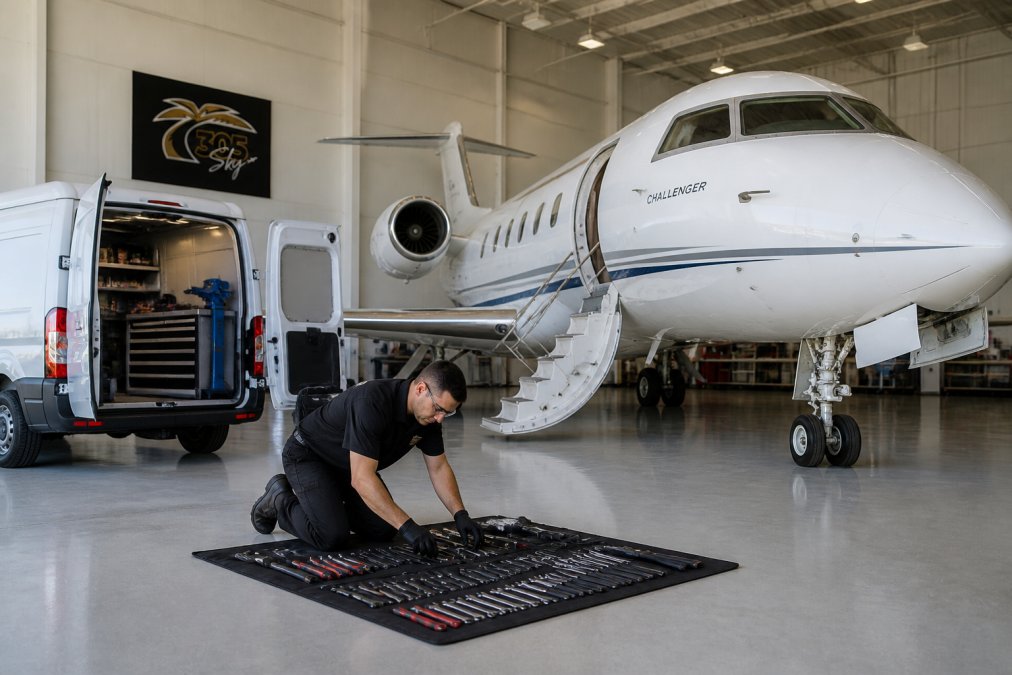
Aircraft Maintenance Logbook Organization and Documentation
Aircraft maintenance logbook organization means keeping airframe, engine, propeller, and avionics records complete, current, and immediately accessible so an on-site technician can verify compliance without delay. Poor records are the most common reason a mobile visit runs past its window, and the most common reason a technician cannot return an aircraft to service that day.
Before the technician arrives, confirm the following are on hand and legible:
- Airframe logbook with current entries
- Engine and propeller logbooks
- Avionics and modification records (including any STC paperwork)
- AD compliance list and service bulletin status
- Last inspection sign-off and return-to-service entry
- Any open squawks or deferred items
The Pre-Arrival Documentation Handover
What actually saves time is how you hand the records over. A technician who arrives to a stack of unmarked logbooks and three people who each know part of the story will burn an hour before touching the aircraft. Here is the process that works:
- Assemble one packet, not a pile. Pull the airframe, engine, and propeller logbooks, the AD compliance list, and the last return-to-service entry. Put them in one place, a single table, a single binder, or a single shared folder.
- Flag the relevant pages. Tab the last inspection entry, the current AD status, and any open discrepancy write-ups. The technician does not need to read 20 years of history; they need the last 12 months and the open items.
- Assign one point of contact. Name a single person, the director of maintenance, the management company contact, or the owner's representative, who can answer records questions and authorize work. A technician who has to chase down three different people loses time that shows up on your downtime, not theirs.
- Confirm the approval chain in writing. Before the visit, send the technician an email naming who can approve additional work and up to what scope. This is the item that most often stalls an AOG or scheduled call.
- Scan and share in advance. For anything beyond a minor task, send the relevant logbook pages and AD status electronically before the van rolls. The technician can then arrive knowing what they are walking into.
Digital records help enormously. Maintenance tracking platforms keep asset history and compliance status in one place, accessible to a remote technician before arrival. If you still run on paper, at minimum scan the relevant pages, a phone photo of a legible logbook page beats a promise to find it later.
Why the Handover Determines the Sign-Off
The handover is what allows the technician to legally return the aircraft to service at the end of the visit. Every task performed must generate a logbook entry signed by the person who did the work, and if the visit involves an inspection, the return-to-service entry is what allows the aircraft to fly again.
A technician who cannot verify the previous inspection sign-off may be unable to return the aircraft to service, and the aircraft stays grounded until the record surfaces (faa.gov). That is not a technician being difficult, it is the same FAA requirement that applies in a repair station, applied on your ramp.
Understanding AOG Emergency Response in South Florida
AOG emergency response in South Florida is a 24/7 mobile maintenance service dispatched when an aircraft is grounded away from its home base and cannot fly until repaired. The region's density of private aviation traffic, from Fort Lauderdale to West Palm Beach, means AOG calls here are frequent and urgent.
What does preparation look like when the call is an emergency rather than a scheduled visit? Less of it, but the same principles apply in compressed form.
When you call for AOG support, have the following ready: aircraft type and tail number, location on the field, the nature of the discrepancy, and who has authority to approve work. That last item trips up more calls than any technical issue. A technician who arrives and cannot get approval to proceed is a technician standing still.
For owners of Challenger, Citation, Learjet, Falcon, Hawker, Gulfstream, Beechjet, King Air, and Pilatus aircraft, the airframe type determines what the mobile team can carry and what it may need to source. Knowing your type and its common AOG failure points before you call speeds the whole process.
If you are searching for mobile aircraft maintenance near me in the Fort Lauderdale area, confirm the provider's actual response capability. Ask what the van carries, how many technicians respond, and what happens if the first visit cannot resolve the issue.
Safety Protocols and Regulatory Compliance for On-Site Work
On-site work is governed by the same FAA rules as work done in a repair station. The setting changes; the compliance standards do not. A technician performing maintenance on your aircraft must hold the appropriate certification, and the work must be documented to the same standard wherever it happens (Federal Register).
Three things to confirm before any on-site work begins:
- Technician certification. Verify the technician holds an A&P license, or that the work is performed under an approved repair station certificate with proper supervision.
- Liability insurance. Ask for a certificate of insurance covering on-site work at your location. This protects you if something is damaged during the visit.
- Safety protocols. Confirm the technician's procedures for fuel handling, lockout of aircraft systems, and fire safety on the ramp.
The documentation side is equally important. Every task performed must generate a logbook entry signed by the person who did the work (Federal Register). If the visit involves an inspection, the return-to-service entry is what legally allows the aircraft to fly again.
The owner has a role in compliance too. Providing accurate records, disclosing known discrepancies, and not pressuring a technician to skip a required step all keep the operation legal. An owner who asks a technician to "just sign it off" creates a liability that outlives the visit.
Fort Lauderdale Weather and Environmental Considerations
Fort Lauderdale's climate shapes how mobile maintenance is scheduled. Afternoon thunderstorms, high humidity, and salt-laden air near the coast affect both the work and the aircraft.
Plan outdoor work for the morning when possible. Afternoon storm cells roll through South Florida routinely in summer, and an open aircraft on a ramp during a downpour is a problem no one wants. If work must happen outside, confirm the technician's plan for weather delays.
Humidity and salt air matter for corrosion. Technicians working on aircraft based near the coast should inspect for corrosion as part of any visit, particularly on airframes that sit outside. This is a genuine regional concern, not a sales pitch.
Wind is the third factor. Panel work on an exposed ramp in gusty conditions is unsafe. If your aircraft is parked in an exposed position, a hangar space is worth arranging for anything beyond a minor task.
Conclusion: Ensuring a Successful Mobile Maintenance Visit
Most mobile maintenance visits that go wrong do so for reasons unrelated to the technician's skill. Missing records, blocked access, and unclear approval chains cause the delays.
305 Sky handles routine maintenance, AOG emergency response, and avionics upgrades across South Florida with over 55 years of combined aviation experience and four strategically located facilities. Our mobile van responds around the clock, and our team keeps the documentation and communication side as tight as the technical work.
Get a quote from 305 Sky and see what a prepared, transparent maintenance partner looks like.
Frequently Asked Questions
What documentation must be ready for mobile aircraft maintenance?
Have your aircraft maintenance logbooks, AD compliance records, and a list of known discrepancies ready. Ensure your mobile aircraft maintenance checklist is accessible. Technicians will need to review these to understand your aircraft's history and plan their work. Proper aircraft maintenance logbook organization saves time and ensures accurate logbook entries after service.
How do I prepare my ramp space for on-site repairs?
Clear the area of debris, FOD, and unrelated equipment. Ensure the aircraft is parked with enough clearance for a mobile repair team to work safely around it. Provide access to ground support equipment if needed. For AOG emergency response in South Florida, communicate any site-specific access restrictions to the dispatcher beforehand.
What is the difference between AOG support and routine mobile maintenance?
AOG (Aircraft on Ground) support is an emergency, on-demand service to return a grounded aircraft to service quickly. Routine mobile maintenance is scheduled preventative maintenance performed at your location. Both are on-site maintenance, but AOG requires immediate dispatch, while routine visits are planned in advance.
How can I ensure my aircraft is compliant during mobile service visits?
Verify the mobile repair team holds proper FAA certifications, such as an A&P license. Ensure they follow all safety protocols and regulatory compliance standards. After the work, confirm all logbook entries are completed correctly. This ensures your aircraft remains airworthy and compliant with FAA regulations.