Table of Contents
- What AOG Means and Why Every Hour Counts
- The Real Cost of a Grounded Aircraft: Revenue Loss and Flight Delays
- AOG Aircraft Maintenance Services: Mobile Response and On-Site Repair
- The Private Jet AOG Recovery Timeline: From Call to Airborne
- Sourcing Mission-Critical Parts and Expedited Shipping Logistics
- FAA Compliance During AOG Repairs: Documentation and Airworthiness
- How 24/7 AOG Emergency Response Prevents Downtime Before It Starts
- Frequently Asked Questions
Last Updated: September 13, 2026
What AOG Means and Why Every Hour Counts
AOG (Aircraft on Ground) means an aircraft is unfit to fly and cannot be dispatched until a repair is completed, the most urgent category in aircraft maintenance. In private aviation, an AOG event can strand a crew, cancel a charter, and disrupt an owner's schedule within hours. This guide from 305 Sky, a Fort Lauderdale-based maintenance provider with more than 55 years of combined aviation experience, explains why AOG emergency response is critical and how a fast, compliant recovery works.
An AOG declaration is not a routine squawk. A Citation with a failed pressurization controller, a King Air with a hydraulic leak, or a Gulfstream with a faulty avionics bus cannot legally or safely fly until the discrepancy is corrected and signed off. Every hour on the ramp accrues cost: lost charter revenue, repositioning fees, crew duty time, and hangar or ramp charges. For owners of Challenger, Falcon, Hawker, Learjet, Beechjet, and Pilatus aircraft, downtime is a direct financial hit.
The FAA treats airworthiness as a continuous obligation, not a periodic checkpoint. According to FAA Airworthiness Directives and continued airworthiness guidance, an aircraft must meet its type design and be in a condition for safe operation at all times. That standard does not pause because a component failed away from home base.
The Real Cost of a Grounded Aircraft: Revenue Loss and Flight Delays
A grounded aircraft costs far more than the repair itself. Lost flight hours, canceled charter legs, repositioning of replacement aircraft, and crew rebooking stack up faster than most operators expect. A single missed trip can trigger knock-on delays across an entire week's schedule.
The operational consequences fall into four buckets:
- Revenue loss from canceled or delayed charter flights
- Flight delays that push crews past duty limits and force replacements
- Repositioning costs to move a substitute aircraft into position
- Reputation damage when clients lose confidence in on-time performance
For a small operator running two or three aircraft, one AOG event can wipe out a month's margin, which is why prevention and rapid response matter more than shaving dollars off a routine inspection.
Where the Money Actually Goes
The repair invoice is usually the smallest line item. The larger costs are indirect and compound hourly:
- Lost charter revenue. A midsize jet like a Citation XLS or Learjet 60 that sits instead of flying a booked trip loses the full charter rate for that leg, plus any follow-on legs the same client had scheduled. A light jet like a Beechjet 400A or Pilatus PC-12 flies shorter legs at lower rates, but those are often the bread-and-butter trips that keep a small operator's utilization healthy.
- Repositioning and ferry costs. Bringing a substitute aircraft in from another base burns fuel, crew time, and possibly a ferry permit. If the substitute is a different type, the client may not accept it at all.
- Crew duty and rest. Under FAA flight and duty time rules, a crew that has already reported and waited can time out before the replacement arrives, forcing a fresh crew, a hotel night, and a delayed departure, costs that never appear on the maintenance invoice (faa.gov).
- Passenger-side costs. Ground transportation, hotel, and rebooking for passengers stranded at a remote field are frequently absorbed by the operator to protect the relationship, a direct hit to a management company's fee margin.
- Hangar and ramp fees. An aircraft stuck at an unfamiliar field accrues daily parking and possibly hangar charges until it is recovered.
Why the Cost Curve Is Not Linear
The first few hours of an AOG event are cheap. The aircraft is still where it was supposed to be, the crew is still legal, and the client has not yet missed anything. The cost curve steepens sharply once the aircraft misses its first scheduled departure. From that point, every additional hour multiplies across the schedule rather than adding to it.
That is why the difference between a four-hour recovery and a fourteen-hour recovery is rarely a ten-hour cost difference. It is often the difference between a trip that operates late and a trip that cancels, plus the follow-on trips that cancel with it.
The Aircraft Types Where This Bites Hardest
Owners of Challenger, Falcon, Hawker, Gulfstream, Learjet, Beechjet, King Air, Citation, and Pilatus aircraft all face the same math, but exposure differs. Large-cabin types like the Gulfstream G450 or Falcon 900 carry higher charter rates, so each grounded day costs more, but they tend to have more redundancy and better dispatch reliability. Light and midsize types fly more legs per week, so a single AOG event disrupts more trips: a King Air 350 or Pilatus PC-12 on a regional charter schedule may have six or eight legs booked in the days following a failure, and every one is at risk.
For a broker or management company overseeing a mixed fleet, the takeaway is the same: downtime cost is driven by schedule density and client expectations, not aircraft size.
AOG Aircraft Maintenance Services: Mobile Response and On-Site Repair
AOG aircraft maintenance services bring the shop to the aircraft. Instead of towing a grounded jet to a fixed facility, a mobile response team arrives with tooling, diagnostic equipment, and parts to complete the repair on the ramp, in a hangar, or at a remote field.
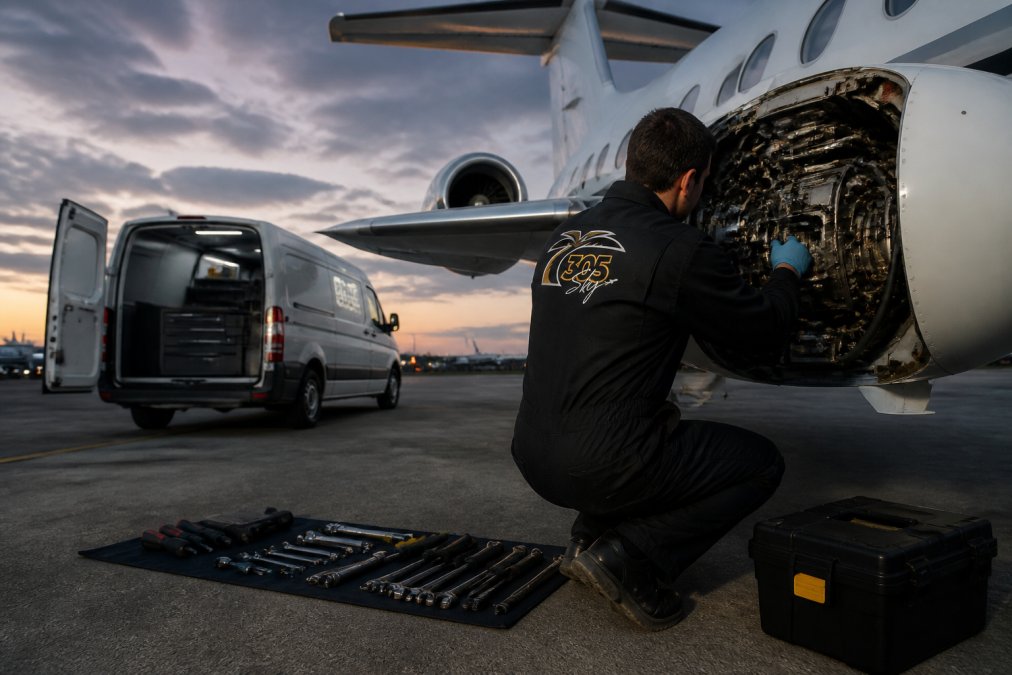
305 Sky operates a 24/7 AOG emergency response van staffed by technicians who handle mobile maintenance across Fort Lauderdale, Boca Raton, West Palm Beach, and Vero Beach. When a client calls at 2 AM on a Sunday, a technician is dispatched, the discrepancy is documented, and the repair path is set before sunrise.
The critical distinction is scope. Some shops handle avionics but farm out airframe work. Others do routine maintenance but lack AOG capability. An operator with a mixed fleet needs one provider who can cover inspections, avionics upgrades, and emergency repairs without handing the aircraft off mid-job.
The Private Jet AOG Recovery Timeline: From Call to Airborne
The private jet AOG recovery timeline follows a predictable sequence, and knowing it helps operators set realistic expectations. A well-run recovery moves through six stages, each with its own clock.
- Initial call and triage - Discrepancy described, aircraft type and location confirmed
- Dispatch decision - Mobile unit or remote support assigned based on fault type
- On-site diagnosis - Fault isolated using maintenance manual procedures and test equipment
- Parts sourcing - Component located, ordered, or pulled from local stock
- Repair and inspection - Work performed, then inspected per the applicable manual
- Return to service - Documentation completed, aircraft released for flight
The stages that most often stall are parts sourcing and documentation, not the wrench work itself. A technician can diagnose a failed fuel control unit quickly. Getting the replacement part to the ramp and the paperwork signed correctly is where hours disappear.
| Recovery Stage | Typical Duration | What Causes Delay |
|---|---|---|
| Initial call and triage | Minutes | Incomplete fault description |
| Dispatch decision | Under an hour | No on-call technician available |
| On-site diagnosis | 1-3 hours | Fault not matching initial report |
| Parts sourcing | 2-24 hours | Part not in local stock |
| Repair and inspection | 1-6 hours | Manual procedures and sign-off |
| Return to service | Under an hour | Incomplete documentation |
The Human Factor Nobody Talks About
Most AOG guides treat the event as a purely technical problem. In practice, the hardest part of a recovery is often managing the people around the aircraft.
Crew stress is real and it affects decisions. A captain ten hours into duty, watching a passenger deadline slip and fielding calls from a charter broker, is not in the best position to evaluate a discrepancy objectively. Fatigue and pressure push crews toward shortcuts, deferring an item that should not be deferred, or accepting a repair without reviewing the documentation. A good AOG provider takes that decision pressure off the crew by communicating directly with the operator's maintenance control and, when appropriate, the client.
Passenger communication is a separate job. Private aviation clients are not used to delays, and a vague "we're working on it" damages trust faster than a specific update. Operators who handle AOG events well assign one person to own passenger communication from the first hour: what failed, what is being done, and a realistic departure window. That person should not be the technician turning wrenches.
Management companies carry the relationship risk. When a management company operates an owner's aircraft, the owner expects a call before the client does. A recovery that is technically flawless but communicated poorly still costs the management company the account.
Why Location Changes the Timeline: The Fort Lauderdale Advantage
Recovery timelines are not the same everywhere. An aircraft that goes AOG in a remote part of the country may wait a full day just for a technician to arrive; one that goes AOG in South Florida is in one of the densest business aviation corridors in the United States.
Fort Lauderdale sits within a short drive of Fort Lauderdale Executive (KFXE), Fort Lauderdale-Hollywood International (KFLL), Boca Raton (KBCT), Palm Beach International (KPBI), and Miami-Opa Locka Executive (KOPF). For an operator based in or passing through this corridor, that density means:
- Faster technician dispatch. A mobile AOG unit staged in Fort Lauderdale can reach most of the corridor in under an hour in normal traffic, versus several hours or a next-day arrival in less dense markets.
- Deeper local parts inventory. South Florida supports a concentration of parts distributors, repair stations, and avionics shops serving Challenger, Citation, King Air, Learjet, Falcon, Hawker, Gulfstream, Beechjet, and Pilatus fleets. A part that would need to be flown in elsewhere is often already within driving distance.
- More qualified hands. The region has a large pool of A&P technicians with business jet experience, which matters when a repair requires a specific type rating or manual familiarity.
- Access to international shipping. Parts arriving from Europe or Canada clear through Miami and Fort Lauderdale customs gateways, which can shorten the tail end of a sourcing delay.
None of this eliminates an AOG event. It shortens the two stages that most often stall, parts sourcing and dispatch, which is where the hours are actually saved. An operator based outside the corridor should factor this into their provider choice: a shop with real South Florida logistics reach can often recover an aircraft faster than a shop that is technically closer but lacks the local supply chain.
Sourcing Mission-Critical Parts and Expedited Shipping Logistics
Parts procurement is the single biggest variable in AOG recovery time. When a component fails, the repair cannot proceed until a serviceable replacement is in hand, and that part must be traceable to an approved source.
Expedited shipping logistics matter because most AOG parts are not sitting on a shelf nearby. A failed starter-generator on a Learjet might come from a distributor several states away, and a Hawker avionics component might require a certified repair station's exchange unit. The faster the part moves, the faster the aircraft flies.
Three practices shorten parts delays:
- Local stock relationships with distributors who hold common components for Challenger, Citation, and King Air fleets
- Exchange programs that swap a failed unit for a serviceable one instead of waiting on a repair
- Direct courier arrangements that bypass standard freight timelines for critical components
A provider with established supply chain contacts can often source in hours what would take a less connected shop days, a difference measured in grounded aircraft time.
FAA Compliance During AOG Repairs: Documentation and Airworthiness
FAA compliance during AOG repairs is not optional, even under time pressure. Every repair must be performed per the manufacturer's maintenance manual, documented on an approved return-to-service record, and signed by properly certificated personnel. Speed never overrides airworthiness.
According to FAA maintenance and alteration recordkeeping requirements under 14 CFR Part 43, maintenance records must include a description of the work performed, the date, and the signature and certificate number of the person approving the aircraft for return to service. An AOG repair that skips this step leaves the aircraft legally unairworthy, no matter how well the wrench work was done.
Regulatory compliance during emergency repairs also means respecting the limits of what can be deferred. Some discrepancies can be handled under a minimum equipment list (MEL) and flown to a repair base. Others cannot. A technician who understands the difference protects the operator from an illegal dispatch.
How 24/7 AOG Emergency Response Prevents Downtime Before It Starts
The best AOG emergency response is the one you never need. Predictive maintenance and proactive planning reduce the odds of an unscheduled grounding by catching component wear before it becomes a failure. This is where fleet availability is actually protected.
Prevention looks like scheduled inspections performed on time rather than deferred, tracking component life cycles so a known wear item is replaced at a planned interval instead of failing at a remote field, and knowing your maintenance manual limits well enough to plan around them.
305 Sky supports this with routine maintenance, aircraft inspections, and pre-buy inspections for operators across South Florida. For a fleet manager in the Miami to Port St. Lucie corridor, one provider handling routine care and emergency response means fewer handoffs and better continuity.
Resource allocation is the other half of prevention. When a provider knows your fleet, they can pre-position common parts and anticipate the failures your aircraft types are prone to, shortening the next recovery whenever it comes.
An AOG event will test your operation at the worst possible time, and the difference between a same-day recovery and a multi-day grounding comes down to who answers the phone. 305 Sky provides 24/7 AOG emergency response with a mobile van, routine maintenance, aircraft inspections, and avionics work from four South Florida facilities, backed by more than 55 years of combined aviation experience and a transparent, family-oriented approach. Get a quote from 305 Sky and keep your fleet airworthy, compliant, and ready to fly.
Frequently Asked Questions
What does AOG mean in aviation maintenance?
AOG stands for Aircraft on Ground, meaning an aircraft is unfit to fly until a repair is completed. For private jet owners and charter operators, an AOG event halts revenue flights, disrupts schedules, and can strand passengers. Unlike routine unscheduled maintenance that can be deferred under a minimum equipment list, a true AOG condition requires immediate attention because the aircraft cannot legally or safely operate. That is why AOG emergency response teams prioritize these calls around the clock, dispatching mobile units and sourcing parts on an expedited basis to restore airworthiness as fast as possible.
How quickly should an AOG response team arrive at a South Florida airport?
Response time depends on the airport, the aircraft type, and the nature of the fault, but a well-run AOG aircraft maintenance services provider aims to have a technician on site within a few hours of the initial call. In the Miami to Port St. Lucie corridor, providers with multiple facilities and mobile vans can often reach Fort Lauderdale, Boca Raton, or West Palm Beach airports faster than shops dispatching from a single location. Ask any provider what their realistic arrival window is for your home base before you need them.
What documentation is required during an AOG emergency repair?
Every AOG repair must be documented to FAA standards, including the discrepancy description, the approved repair method, parts traceability records, and a return-to-service entry signed by an authorized mechanic. For Part 91 and Part 135 operators, these records feed into the aircraft logbooks and maintenance tracking program. Missing or incomplete documentation can complicate the next inspection, hurt resale value, and create airworthiness questions. Reputable shops keep digital records so owners and flight departments can access a complete history of the event.
What are the most common causes of AOG situations for business jets?
Common causes include component failures in avionics, hydraulics, or pressurization systems; engine sensor faults; landing gear issues; and battery or electrical problems. Bird strikes, lightning damage, and foreign object debris can also ground an aircraft. Many of these faults appear without warning during preflight or after a flight, which is why operators of Challenger, Citation, King Air, Learjet, Falcon, Hawker, Gulfstream, Beechjet, and Pilatus aircraft keep a 24/7 AOG contact on hand. Proactive maintenance and predictive maintenance programs reduce, but never eliminate, these events.