Table of Contents
- Mobile Aircraft Mechanic vs FBO Maintenance: How Quality Actually Compares
- What Each Model Does Well
- The Quality Question: Certification, Documentation, and Oversight
- AOG Emergency Aircraft Maintenance in Fort Lauderdale: When Mobile Wins
- FAA Part 145 Repair Station vs Independent A&P: What Changes for Your Aircraft
- Inspection Depth and Quality Assurance: Annuals, Avionics, and Logbook Entries
- Cost, Downtime, and Parts Sourcing: Mobile vs Shop Realities
- Aircraft Maintenance Management for Private Jet Owners: Building a Hybrid Program
- Conclusion
- Frequently Asked Questions
Last Updated: September 14, 2026
Mobile Aircraft Mechanic vs FBO Maintenance: How Quality Actually Compares
The mobile aircraft mechanic versus FBO maintenance quality debate is less about which model is "better" and more about which fits your operation. A mobile aircraft mechanic is an FAA-certificated technician who travels to your aircraft with tools and parts to perform maintenance on-site; a Fixed-Base Operator provides hangar space, shop equipment, and permanent staff at a single airport (faa.gov). At 305 Sky, we've worked both sides across South Florida, and the quality gap most owners worry about is narrower than the forums suggest.
What actually differs is documentation, oversight, and logistics. Below, we break down where each model delivers and how to build a program that uses both.
What Each Model Does Well
Mobile maintenance wins on downtime and convenience. A technician arrives at your hangar or ramp and handles the job without a ferry flight. For King Air, Citation, and Learjet operators juggling charter schedules, that saved repositioning time is often the deciding factor.
FBO shops win on infrastructure. They hold the tooling, test benches, and hangar space for heavier work: gear swings, avionics bench testing, pressurization checks. A mobile van simply cannot carry a full avionics rack.
The honest answer: most private jet owners need both. Mobile for routine and AOG, FBO for deep maintenance.
The Quality Question: Certification, Documentation, and Oversight
Maintenance quality is not determined by where the work happens, but by who signs it off and how it is recorded. An FAA-certificated A&P technician working from a van is held to the same standards as one in a hangar (faa.gov).
Three things govern quality in either setting:
- Certification, the technician holds a current A&P certificate, and an IA signs off on annual inspections
- Documentation, every task is recorded against the maintenance manual, with a logbook entry and approved return-to-service statement
- Oversight, work performed under a Part 145 repair station carries its own quality system; independent A&P work relies on the technician's own discipline
A sloppy logbook entry from a big shop is just as damaging as one from a mobile tech. The paper trail is the quality.
AOG Emergency Aircraft Maintenance in Fort Lauderdale: When Mobile Wins
When an aircraft goes AOG in Fort Lauderdale, mobile response is usually the only realistic option. A grounded jet at a ramp in Boca Raton or a private strip near Vero Beach cannot wait three days for a shop appointment.
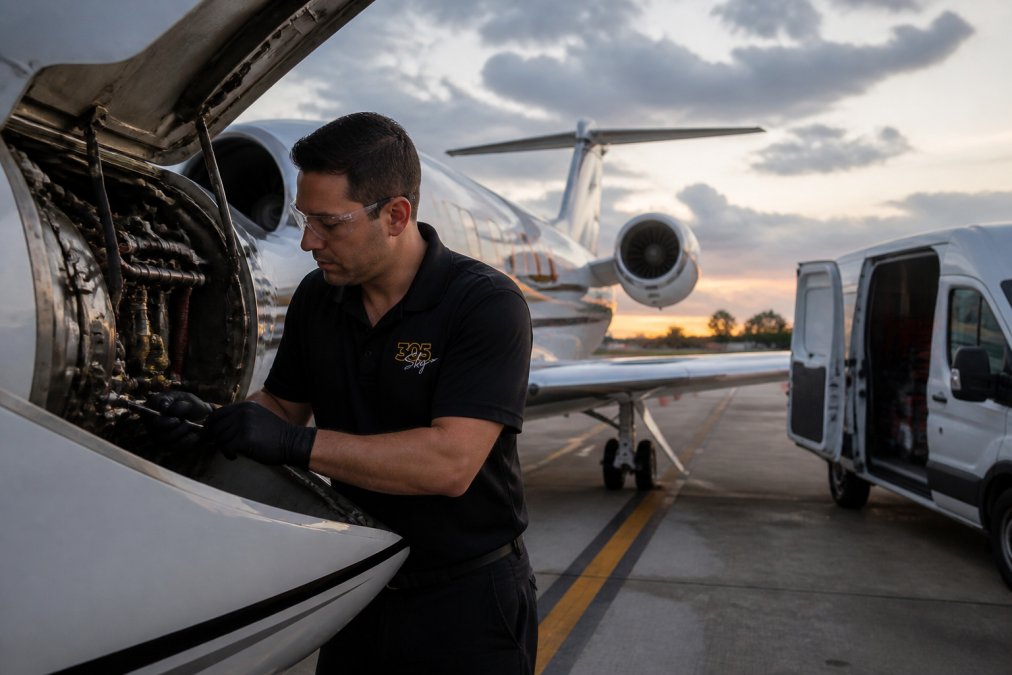
This is where 305 Sky's 24/7 mobile van operation earns its keep. A technician arrives with diagnostic equipment, troubleshoots on-site, and either returns the aircraft to service or coordinates a ferry if the repair exceeds field capability. For Challenger, Falcon, and Hawker operators on tight schedules, that first response often determines whether a trip departs on time.
The trade-off: mobile AOG work is limited by weather, lighting, and what the van can carry. If the fix needs a hangar, the mobile tech becomes the bridge, not the destination.
FAA Part 145 Repair Station vs Independent A&P: What Changes for Your Aircraft
A Part 145 repair station is an FAA-certificated facility with its own quality control system, trained personnel, and approved procedures (Federal Register). An independent A&P performs maintenance under their own certificate, without the repair station's formal quality manual.
What changes for you:
| Factor | Part 145 Repair Station | Independent A&P / Mobile |
|---|---|---|
| Quality system | Formal, audited | Technician-dependent |
| Scope of work | Broad, including heavy checks | Limited to field-capable tasks |
| Documentation | Standardized forms and records | Logbook entry plus work order |
| Flexibility | Scheduled, hangar-based | On-demand, on-site |
| Best for | Heavy maintenance, avionics, interiors | Routine, AOG, field repair |
Neither is inherently safer, the FAA holds both to airworthiness standards. What differs is the paper trail and the scope each can handle.
Inspection Depth and Quality Assurance: Annuals, Avionics, and Logbook Entries
Annual inspections require an Inspection Authorization holder to sign off, and that signature carries the same regulatory weight whether the inspection happens in a Part 145 hangar or on a Fort Lauderdale-area ramp. What differs is depth, a function of access and tooling, not the building.
A mobile setup handles most routine annuals on Citation, Beechjet, King Air, and Pilatus airframes well. It struggles with anything requiring a jig, press, calibrated avionics bench, or hangar-and-lift access. In those cases the aircraft goes to a shop, and the mobile technician shifts to prep, coordination, and return-to-service documentation.
The gap most owners run into is not the inspection itself but verifying the mobile technician is authorized and equipped to work on airport property. That verification is where quality assurance starts.
A practical verification checklist for mobile maintenance. Before you authorize a mobile technician to touch your aircraft, confirm the following:
- Airframe and Powerplant certificate. Ask for the certificate number and verify it against the FAA Airman Registry; it should be current and in the technician's possession.
- Inspection Authorization, if an annual or progressive inspection is involved. IA holders are separately certificated, and the IA number is verifiable through the same registry.
- Repair station relationship, if applicable. If work is performed under a Part 145 station's certificate rather than the technician's own A&P, ask which station and confirm its certificate and ratings, the quality system, work order format, and return-to-service authority flow from the station, not the individual.
- Insurance certificate. Ask for a certificate naming the aircraft owner or operator as an additional insured, and confirm the policy covers off-premises work. This is the most overlooked item in mobile maintenance, and the one that matters most if something goes wrong on your ramp.
- Airport access authorization. Many airports, including several in the Fort Lauderdale area, require vendors to hold a badge, permit, or sponsor letter before driving onto the ramp. Confirm current access, an unauthorized vendor can be turned away at the gate, and the aircraft stays grounded.
- Work order and manual revision. The work order should reference the specific maintenance manual chapter, revision date, and any applicable service bulletins or airworthiness directives. A work order that says only 'inspected per FAR' is a red flag.
- Logbook entry format. The entry should identify the work performed, the manual reference, the technician's certificate number, and the return-to-service statement. If the entry is vague, the record will be difficult to defend at pre-buy.
The most common mistake we see is an owner accepting a logbook entry that lists 'inspected per FAR' without referencing the specific maintenance manual chapter or service bulletin. That entry will fail a pre-buy inspection later, and the cost of reconstructing the record falls on you.
Quality assurance in mobile work comes down to three habits: verify the technician's certificate and insurance before the visit, confirm the work order references the correct manual revision, and check that every applicable airworthiness directive and service bulletin was addressed. Done consistently, those habits close most of the perceived quality gap, and give you a defensible record if you ever sell the aircraft.
Cost, Downtime, and Parts Sourcing: Mobile vs Shop Realities
The cost conversation around mobile aircraft mechanic versus FBO maintenance quality usually starts in the wrong place. Owners compare labor rates, but the number that moves the P&L is downtime, a grounded Challenger 350 or Citation X on a Fort Lauderdale ramp burns charter revenue, crew availability, and client goodwill every hour it is not flying. Mobile maintenance carries a higher effective hourly rate because you pay for travel, a stocked van, and transit time. What it buys back is the repositioning flight, the shop queue, and the scheduling friction of moving an aircraft to a fixed base. Efficiency in aviation operations relies on the same vetting rigor required when hiring mobile technicians to ensure that the convenience of on-site service does not compromise the integrity of your security protocols.
The parts question is where the two models genuinely diverge, and it is the piece most comparison articles skip.
How a mobile technician sources parts. A well-run mobile operation carries a defined consumables loadout, filters, O-rings, hardware kits, common Citation and King Air line-replaceable items, lubricants, and field-capable hand and torque tools. Anything beyond that is sourced via overnight shipment from a distributor, a same-day run to a local supplier, or a cannibalization or loan arrangement with another operator. In South Florida the overnight channel is genuinely fast, a part leaving a Dallas or Atlanta warehouse in the evening is often on the ramp at FXE or HWO the next morning. The same-day channel depends on what is physically on a local shelf, and that shelf is not infinite.
How an FBO shop sources parts. A Part 145 repair station with a stocked parts room has already absorbed the lead time: the part is on the shelf, the work order can start immediately, and the only variable is technician availability. That is a real advantage for scheduled maintenance and common unscheduled repairs. The trade-off is that you paid for that inventory indirectly, and the shop still orders anything outside its normal consumption pattern.
Where the mobile model wins on parts. For AOG events, the mobile technician's value is not carrying every part, it is diagnosing the failure on-site, identifying the exact part number against the maintenance manual, and either sourcing it directly or confirming the repair exceeds field capability. That diagnosis prevents the worst outcome: ferrying to a shop only to discover the shop also has to order the part.
Where the shop model wins on parts. Heavy checks, avionics bench work, and interior jobs almost always require parts and tooling that no van can carry. A press, a jig, a calibrated avionics test bench, and the inventory to support a multi-day inspection live in a hangar, not a truck.
| Scenario | Mobile parts reality | Shop parts reality |
|---|---|---|
| Common consumable failure | On the van, same visit | On the shelf, same visit |
| Less-common LRU failure | Overnight or same-day source | Often on shelf; otherwise same overnight channel |
| AOG away from base | Diagnose on-site, source to the ramp | Requires ferry first, then source |
| Heavy check or avionics | Not field-capable | Full inventory and bench access |
For owners and management companies, the practical rule is this: mobile wins the first response and the common repair, and the shop wins the deep work. The parts question is not which model has more inventory, it is which model can diagnose accurately enough to know what to order and where.
A hybrid program, a primary mobile provider for AOG and routine work, a Part 145 shop for heavy checks and avionics, captures the parts advantage of both. The coordination cost is real, but almost always smaller than a misdiagnosed ferry flight or a multi-day shop queue for a job the van could have finished on the ramp.
Aircraft Maintenance Management for Private Jet Owners: Building a Hybrid Program
Aircraft maintenance management for private jet owners works best when it treats mobile and FBO as complementary tools, not competing ones. The program that keeps a Gulfstream, Challenger, or Citation airworthy on schedule uses mobile response for routine and AOG events, and a Part 145 shop for heavy checks, avionics, and interiors.
A practical hybrid framework:
- Assign a primary mobile provider for AOG and routine work
- Identify a Part 145 shop for heavy maintenance and avionics
- Standardize logbook and work order formats across both
- Track AD and service bulletin compliance in one system
- Review the program quarterly against actual downtime
305 Sky runs this model across four South Florida locations, with mobile response backed by hangar capability when a job outgrows the van. For owners near Fort Lauderdale, that combination removes the false choice between convenience and depth.
Conclusion
The real challenge is not picking a side in the mobile versus FBO debate. It is building a maintenance program that keeps your aircraft airworthy, documented, and flying on schedule, whether that means a van on the ramp at 2 AM or a hangar slot next month. 305 Sky delivers 24/7 AOG response, routine maintenance, pre-buy inspections, and avionics upgrades across South Florida, backed by 55+ years of combined experience and transparent pricing. Get a quote from 305 Sky and put a maintenance program in place that fits how you actually operate.
Frequently Asked Questions
What are the primary quality differences between mobile A&P mechanics and FBO maintenance shops?
The biggest difference is infrastructure, not skill. Both use FAA-certified A&P technicians, but an FBO hangar offers overhead cranes, paint booths, and specialized tooling for heavy checks. A mobile aircraft mechanic brings calibrated tooling and diagnostic equipment to your ramp, which handles most unscheduled repairs, routine inspections, and troubleshooting. For major structural work or avionics bench repairs, the aircraft still needs a hangar. Quality depends on the technician's certification, documentation habits, and parts sourcing, not on whether the work happens indoors or outdoors.
Is mobile aircraft maintenance FAA-compliant for major inspections?
Yes, provided the technician holds the right ratings and signs the work correctly. An A&P mechanic with Inspection Authorization (IA) can perform and sign off annual inspections under FAA standards, whether the work happens in a hangar or on your ramp. The key is that the mobile provider follows the manufacturer's maintenance manual, completes service bulletins and airworthiness directives, and records every logbook entry properly. Ask for the technician's certificate number and confirm the IA before scheduling any annual inspection.
How does 24/7 AOG mobile support compare to scheduled FBO maintenance?
AOG support is built for urgency. If your Citation or King Air is grounded at a regional airport, a mobile unit can often reach you the same day with troubleshooting tools and common parts, cutting aircraft downtime from days to hours. Scheduled FBO maintenance is planned around hangar availability and works well for annuals, avionics upgrades, and interior work. Most South Florida operators use both: mobile for unscheduled repairs and AOG events, and a fixed facility for planned heavy maintenance and inspections that need hangar space.
What should private jet owners look for when vetting a mobile aircraft mechanic?
Verify four things: FAA certification (A&P with IA if inspections are involved), liability insurance that covers off-site work, parts sourcing practices that use traceable aviation parts, and documentation habits that include complete logbook entries and technical documentation. A transparent provider will share references from other operators and show you their certificate and insurance certificate before any work begins.