Table of Contents
- What Makes Reliable Jet Maintenance Essential
- FAA Aircraft Maintenance Regulations You Need to Know
- Private Jet AOG Support Services: 24/7 Emergency Response
- How to Evaluate Maintenance Providers by Aircraft Type
- Private Jet Maintenance Cost Factors to Consider
- Pre-Buy Inspections and Transparency in Service
- Red Flags and What to Avoid When Selecting a Provider
- Frequently Asked Questions
Last Updated: September 3, 2026
What Makes Reliable Jet Maintenance Essential
The difference between an aircraft that runs smoothly and one that becomes a liability often comes down to reliable jet maintenance. For private jet owners in Fort Lauderdale and across South Florida, this means protecting your investment, minimizing downtime, and ensuring regulatory compliance. A single missed inspection or delayed repair can ground your aircraft unexpectedly and expose you to FAA violations.
Reliable jet maintenance means having a provider who understands your specific aircraft type, responds immediately when emergencies strike, and communicates transparently about what needs to be done and why. Whether you own a Challenger, Gulfstream, Learjet, Citation, or King Air, your aircraft demands specialized expertise. The maintenance provider you choose will directly affect your aircraft's resale value, operational reliability, and your peace of mind.
At 305 Sky, we've built our reputation on the principle that reliable jet maintenance isn't something you compromise on. With over 55 years of combined aviation experience and a team of 3rd generation aviators, we understand what it takes to keep your aircraft in peak condition. Our 24/7 AOG emergency response, four strategically located facilities across South Florida, and transparent approach to service set us apart from larger, impersonal maintenance shops.
FAA Aircraft Maintenance Regulations You Need to Know
Understanding FAA aircraft maintenance regulations is non-negotiable if you own a private jet. The Federal Aviation Administration establishes strict standards that govern every aspect of aircraft upkeep, from routine inspections to major component overhauls.
The most critical regulation for private jet owners is FAA Part 145, which certifies repair stations. Any facility performing maintenance on your aircraft should hold this certification. According to FAA regulations on Part 145 certification, a certified repair station must demonstrate technical competency, maintain proper facilities and equipment, and employ trained personnel. This certification is your assurance that the facility has been audited and meets federal safety standards.
Beyond Part 145, your aircraft is subject to Airworthiness Directives (ADs). These are mandatory inspections or modifications issued by the FAA when a safety defect is discovered (faa.gov). Your maintenance provider must track and comply with every AD applicable to your aircraft model. Missing an AD compliance deadline can result in your aircraft being grounded until corrected.
Preventative maintenance schedules are also regulated. The FAA requires that aircraft undergo inspections at specific intervals, typically annual inspections for most business jets, with more frequent checks for high-use aircraft (faa.gov). A reliable maintenance provider maintains detailed logs of every service performed, every inspection completed, and every regulation met, giving you documentation that protects your aircraft's airworthiness and resale value.
Private Jet AOG Support Services: 24/7 Emergency Response
AOG, Aircraft on Ground, is every jet owner's nightmare scenario. Your aircraft breaks down unexpectedly, and you need it fixed immediately. This is where reliable jet maintenance providers separate themselves from the rest. A true 24/7 AOG support service means someone answers the phone at 2 AM on a Sunday, understands your emergency, and has the resources to respond.
Real AOG support goes beyond just answering calls. It means having mobile maintenance units ready to dispatch, technicians trained across multiple aircraft types, and the ability to source parts quickly. When your King Air or Learjet experiences an unexpected failure, you need immediate diagnosis and repair.
305 Sky operates mobile AOG response units across South Florida, including Fort Lauderdale and surrounding areas. Our team can reach most locations within hours, perform diagnostics on-site, and often complete repairs without moving your aircraft. For more complex issues, we have the facilities and expertise to bring your aircraft in for comprehensive troubleshooting. We'll tell you exactly what the problem is, what fixing it will require, and how long it will take upfront.
How to Evaluate Maintenance Providers by Aircraft Type
Choosing a maintenance provider requires understanding what capabilities matter for your specific aircraft and verifying that your provider actually has them.
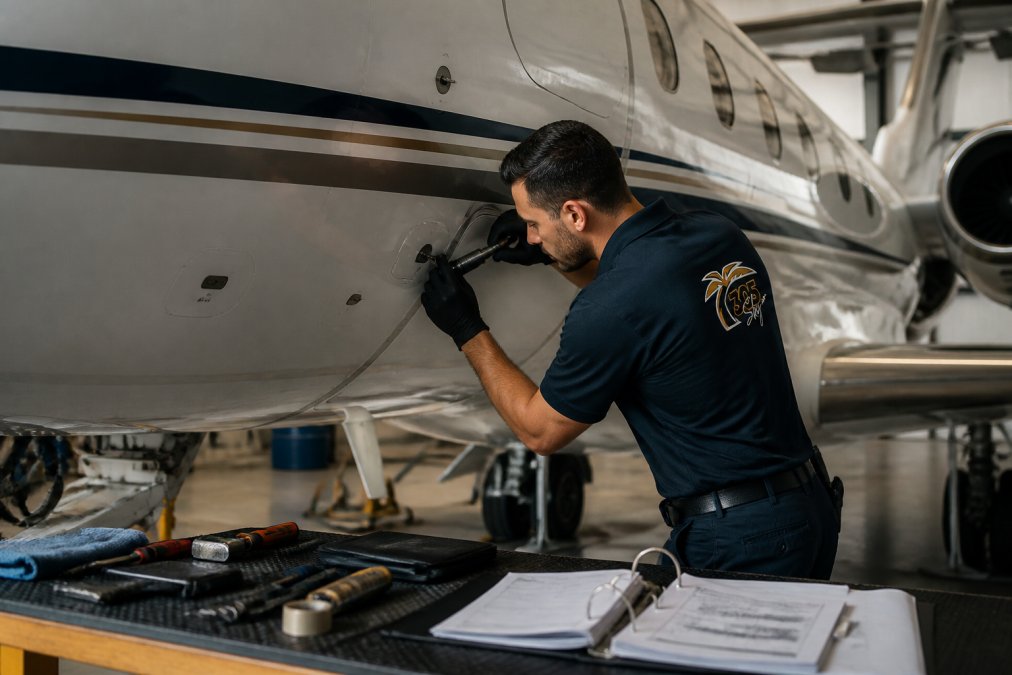
Learjet, Citation, and Hawker Specialists
Learjets demand specialized knowledge. These aircraft have specific avionics systems, unique engine configurations, and particular maintenance requirements that differ from larger jets. A provider claiming to work on "all business jets" may lack the deep expertise your Learjet deserves.
When evaluating providers for these aircraft types, ask: How many aircraft of your model have they serviced? Can they provide references from owners of your exact aircraft? Do they stock common replacement parts? The difference between a shop that knows your aircraft well and one that treats it as just another job will show in turnaround time and attention to detail.
Challenger, Gulfstream, and Falcon Expertise
Larger, more sophisticated business jets require different expertise. Challengers, Gulfstreams, and Falcons are complex aircraft with advanced avionics, pressurization systems, and cabin management technology. A provider working on these aircraft must understand not just the airframe, but the integrated systems that make them operate.
For Challenger aircraft, 305 Sky brings specialized experience across the Challenger family. Our team has worked on Challenger 300, 350, 604, and other variants, understanding the specific maintenance requirements and common issues that arise with each model. With four strategically located facilities across South Florida and 24/7 AOG support, we can provide the comprehensive care that Challenger owners expect.
When evaluating providers for these larger aircraft, look for evidence of their experience with your specific model. Ask about their hangar capacity and avionics capabilities. Inquire whether they handle major inspections in-house or outsource them. A provider that keeps major work in-house typically delivers better quality and faster turnaround.
Private Jet Maintenance Cost Factors to Consider
Understanding what drives maintenance costs helps you budget accurately and identify providers who are transparent about pricing.
Aircraft age and use are primary cost drivers. A newer Gulfstream with 500 flight hours per year will have different maintenance requirements than a 20-year-old Citation with 1,000 flight hours per year. Older aircraft typically require more frequent inspections and are more likely to need component replacement.
Inspection intervals create predictable cost variations. Annual inspections are relatively straightforward, while 100-hour inspections may be more involved. When an annual inspection uncovers deferred maintenance or component wear, costs can escalate. A transparent provider will give you a preliminary estimate before beginning work and notify you immediately if inspections reveal additional issues.
Component overhauls and replacements represent the largest cost variables. Engine overhauls, landing gear service, avionics upgrades, and cabin refurbishment can each represent significant expenses. A reliable provider will present options with clear pros and cons for each.
Parts availability affects both cost and turnaround time. Providers with established supplier relationships and inventory of common parts can often complete work faster.
Pre-Buy Inspections and Transparency in Service
If you're purchasing a private aircraft, a professional pre-buy inspection is non-negotiable. This inspection protects your investment by identifying maintenance issues, deferred work, and potential safety concerns before you commit to the purchase.
A thorough pre-buy inspection examines the entire aircraft: airframe, engines, avionics, interior, and all systems. The inspection should include a complete review of maintenance logs to verify that all required inspections and airworthiness directives have been completed. It should also identify any damage history, previous repairs, and any outstanding service bulletins.
The inspection report should be detailed and specific. You should receive clear documentation of the aircraft's condition, a list of any discrepancies found, and recommendations for addressing them. This report becomes your negotiating tool.
Transparency in the inspection process matters enormously. A reliable provider will explain their findings clearly, avoid technical jargon, and give you honest assessment. They should be willing to walk you through the aircraft and show you exactly what they found.
305 Sky provides comprehensive pre-buy inspections for aircraft across all major business jet types. Our inspection process is thorough, our reporting is clear, and our team is willing to discuss findings in detail. We understand that you're making a significant investment, and our job is to give you the information you need to make a confident decision.
Red Flags and What to Avoid When Selecting a Provider
Not all maintenance providers are created equal. Some cut corners, overcharge, or lack the expertise to properly service your aircraft.
A provider that can't or won't discuss their FAA Part 145 certification is a major red flag. This certification is fundamental. If they don't have it, they're not legally authorized to perform certain maintenance work.
Providers that quote work without inspecting the aircraft first are problematic. Reliable maintenance requires diagnosis before quoting. If someone quotes a price for an AOG repair without seeing the aircraft, they're guessing.
Lack of transparency about pricing is another warning sign. If a provider won't explain what work will be performed, how long it will take, or what it will cost, they're not being transparent.
Unwillingness to provide references is a red flag. Any reputable maintenance provider should be able to give you the names of aircraft owners they've serviced.
Providers that claim to work equally well on all aircraft types lack specialization. A shop claiming equal competence on Learjets, Gulfstreams, and King Airs is likely cutting corners on at least one of them.
Facilities that appear disorganized, lack proper equipment, or seem understaffed are concerning. Your aircraft deserves a professional environment where work is performed with attention to detail.
Long turnaround times without clear explanation suggest either understaffing or disorganization. Reliable providers manage their workload to complete maintenance on schedule.
Choosing reliable jet maintenance is one of the most important decisions you'll make as a private aircraft owner. Your aircraft is a significant investment that requires expert care, transparent communication, and immediate response when emergencies arise. The providers discussed here, 305 Sky, represent options available in Fort Lauderdale and across South Florida, each bringing specialized expertise in specific aircraft types.
The key is matching your aircraft's needs with a provider's capabilities. If you own a Learjet, work with a Learjet specialist. If you operate a Gulfstream or Falcon, choose a provider with deep experience in those platforms. Ensure your provider offers 24/7 AOG support, maintains FAA Part 145 certification, and communicates transparently about what your aircraft needs and what repairs will cost.
At 305 Sky, we're committed to providing the expert, transparent maintenance your aircraft deserves. Our 55+ years of combined aviation experience, four strategically located South Florida facilities, and dedicated 24/7 AOG response team ensure your aircraft remains airworthy, compliant, and in peak condition. Whether you need routine maintenance, emergency AOG support, avionics upgrades, or pre-buy inspections, we're here to help. Contact 305 Sky for a maintenance consultation and discover why private jet owners across South Florida trust us with their aircraft.
Frequently Asked Questions
Q: What are the FAA requirements for private jet maintenance?
A: The FAA requires all aircraft to undergo maintenance according to manufacturer-approved schedules and airworthiness directives. Private jets must maintain current airworthiness certificates and comply with 14 CFR Part 91 regulations. Maintenance records must be retained and made available for inspection. Your maintenance provider should hold FAA Part 145 certification as a repair station, ensuring they meet strict regulatory standards for parts, personnel, and procedures.
Q: How does private jet AOG support services differ from routine maintenance?
A: AOG (Aircraft on Ground) support is emergency response when your aircraft is grounded unexpectedly and cannot fly. Routine maintenance is scheduled preventative care performed at regular intervals. AOG providers maintain rapid-response teams and mobile vans ready 24/7 to diagnose and repair issues on-site or in the hangar. Routine maintenance prevents emergencies through inspections, component overhauls, and service bulletins performed during planned downtime.
Q: What private jet maintenance cost factors should I budget for?
A: Maintenance costs depend on aircraft type (Learjet, Citation, Gulfstream, etc.), flight hours, age of the aircraft, and complexity of required repairs. Routine inspections, component overhauls, avionics upgrades, and interior refurbishment all carry different expenses. AOG emergency response typically costs more than scheduled maintenance due to rapid mobilization. Request a detailed estimate from your provider based on your specific aircraft model and expected flight hours to understand true costs.
Q: How can I verify a jet maintenance provider's credentials and experience?
A: Confirm FAA Part 145 certification, which indicates the provider meets federal standards for repair stations. Ask for references from current clients with similar aircraft types. Review their experience with your specific model (Challenger, King Air, Hawker, etc.). Check how long they've been in business and verify their technicians hold appropriate airframe and powerplant (A&P) certifications. Request documentation of their safety record and maintenance logs from previous clients.
Q: What should I expect during a pre-buy inspection?
A: A comprehensive pre-buy inspection examines the airframe, engines, avionics, interior, and all systems for airworthiness and hidden damage. The inspector reviews maintenance records, compliance with airworthiness directives, and component time-since-overhaul. A detailed written report identifies any issues, required repairs, and estimated costs. Turnaround time typically ranges from a few days to a week, depending on aircraft complexity and the depth of inspection. Transparent providers will explain findings clearly and estimate repair costs upfront.
This article was written using GrandRanker