Table of Contents
- Why Aircraft Engine Overhauls Cost So Much
- Repair vs. Overhaul: A Cost-Benefit Analysis
- Aircraft Engine Life Extension Programs Explained
- Hot Section Inspection Benefits for Turbine Engines
- Engine Health Monitoring Systems: Catching Problems Early
- AOG Emergency Engine Support South Florida
- Engine Exchange Programs and Factory Options
- Preventative Maintenance to Avoid Major Overhauls
- Frequently Asked Questions
Last Updated: September 12, 2026
Why Aircraft Engine Overhauls Cost So Much
Alternatives to expensive aircraft engine overhauls start with understanding why the bill gets so large. An overhaul, teardown, inspection, repair, and reassembly to return an engine to serviceable condition, is the single largest scheduled expense most private aircraft owners face. The cost driver is not just parts, but labor hours, mandatory replacement components, machining, testing, and downtime.
For turbine engines on Challenger, Citation, Falcon, Gulfstream, Hawker, and Learjet airframes, the overhaul interval is driven by cycle and hour limits set by the manufacturer and tracked against an approved maintenance program. Piston engines on King Air, Beechjet, and Pilatus aircraft follow a time-between-overhaul figure published by the engine maker. Either way, the number is not negotiable.
What most owners miss is that the overhaul itself is rarely the whole story. Accessory components, exhaust systems, hydraulic components, and engine mounts often need attention at the same time, and those line items add up fast.
Repair vs. Overhaul: A Cost-Benefit Analysis
The decision between repair and overhaul comes down to three factors: the nature of the defect, the remaining life on the engine, and the aircraft's role in your operation. A repair addresses a specific failed component. An overhaul resets the clock on the whole engine. Choosing wrong in either direction wastes money.
When Repair Makes Sense
Repair makes sense when the problem is isolated and the engine has meaningful time remaining before its next scheduled overhaul. A cracked exhaust stack, leaking hydraulic component, or failed accessory drive does not require a full teardown. Targeted repair keeps the aircraft flying and preserves remaining overhaul credit.
This is where a mobile AOG response matters. A technician who can diagnose and repair on the ramp avoids the ferry flight and the shop queue.
When Overhaul Is Unavoidable
Overhaul becomes unavoidable when the engine reaches its published interval, when metal is found in the oil, or when a compressor or turbine section shows damage beyond repairable limits. Deferring the work is not a cost saving but a safety and airworthiness risk.
| Situation | Recommended Path | Why |
|---|---|---|
| Isolated accessory or exhaust failure | Component repair | Preserves remaining engine life |
| Engine at or past overhaul interval | Full overhaul or exchange | Required for continued airworthiness |
| Metal in oil, borescope damage | Teardown inspection | Determines repair vs. replacement |
| High-time engine on an aircraft you plan to sell | Exchange or overhaul | Protects resale value |
Aircraft Engine Life Extension Programs Explained
Aircraft engine life extension programs are structured maintenance plans that keep an engine within approved limits without a full teardown, combining oil analysis, borescope inspection, trend monitoring, and strict adherence to the manufacturer's maintenance manual. They do not eliminate the overhaul; they push it further out and give you time to plan.
Factory and OEM programs, such as those offered for Citation and Beechcraft airframes, bundle predictable hourly costs with access to a service network. Independent overhaul facilities offer a different trade-off: often lower cost, more customization, and variable turnaround.
FAA Regulations and Documentation Requirements
The FAA requires that maintenance be performed by properly certificated persons and recorded in the aircraft's maintenance records (faa.gov). For engines, every inspection, repair, and overhaul must be documented with the work performed, the date, and the signature and certificate number of the person approving the work (ecfr.gov).
Logbook documentation is the evidence chain that supports airworthiness and protects resale value; a missing entry or improperly signed return to service can ground an aircraft and kill a sale.
Hot Section Inspection Benefits for Turbine Engines
A hot section inspection is a borescope-based examination of the combustion chamber, turbine blades, and related components without removing the engine from the aircraft. For turbine-powered aircraft, it is the most cost-effective way to catch distress before it becomes a full overhaul.
You see the hot section's condition while the engine is still installed. If the blades and combustor are within limits, you return to service with documented evidence; if not, you have caught the problem before it cascades into turbine damage.
For operators of Challenger, Gulfstream, and Falcon aircraft, hot section inspections are typically scheduled at intervals defined by the engine manufacturer. Skipping them is a false economy: the cost of a hot section inspection is a fraction of the turbine damage it prevents.
Engine Health Monitoring Systems: Catching Problems Early
Engine health monitoring systems are onboard and ground-based tools that track engine parameters over time and flag trends indicating developing problems, turning engine maintenance from reactive to predictive.
Modern turbofan and turboprop platforms log exhaust gas temperature, fuel flow, vibration, and other parameters. When those values drift outside expected ranges, the system flags it, letting a technician investigate a trend instead of waiting for a failure.
How Monitoring Reduces Overhaul Frequency
Monitoring reduces overhaul frequency by catching small problems before they compound. A slightly high vibration reading might indicate a bearing issue that, left alone, damages the shaft. Caught early, it is a component repair; caught late, an overhaul.
The data does not fix anything, but it tells you where to look and gives you evidence to justify a targeted repair instead of a full teardown.
AOG Emergency Engine Support South Florida
AOG emergency engine support in South Florida means getting a qualified technician and the right parts to your aircraft fast enough to protect the next leg of its schedule. When an engine issue grounds an aircraft, the first decision is not which shop to call but whether the problem can be handled on the ramp or the engine has to come off.
That decision is the difference between a mobile repair and a shop-based repair, and it drives both your downtime and your invoice.
Mobile vs. Shop-Based Engine Repair: How to Choose
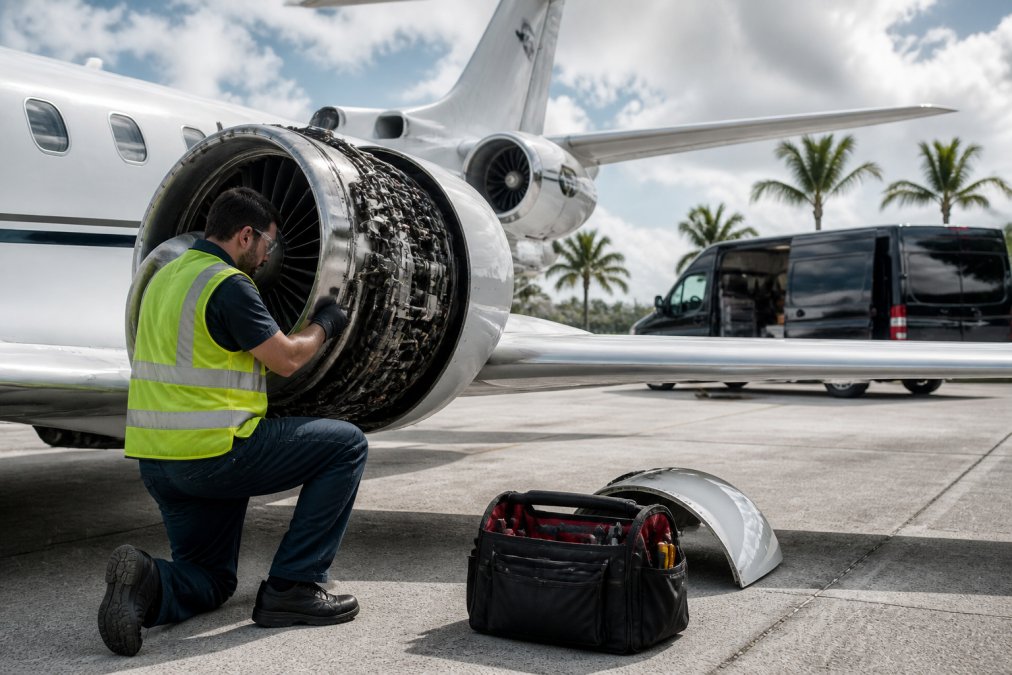
Mobile repair sends a technician and a mobile van to your aircraft. It works best for line-replaceable components, accessory drives, exhaust and hydraulic components, sensor and harness faults, borescope inspections, and other work that can be done with the engine installed. The aircraft stays where it is, the schedule is protected, and there is no ferry flight or shop queue.
Shop-based repair is required when the engine has to be removed, when the work involves internal rotating components, or when the diagnosis points to damage that cannot be corrected in place. Removing and reinstalling an engine is a major maintenance event requiring the right tooling, a controlled environment, and a documented work scope.
A common pattern is that an operator authorizes a mobile call for what turns out to be a shop-level problem. The mobile technician confirms the diagnosis, the aircraft is ferried or the engine is removed, and the operator pays for both the mobile visit and the shop work. Avoid that by insisting on a diagnostic step before anyone commits to a repair path.
What Mobile AOG Support Can and Cannot Do
Mobile AOG support is not a substitute for a repair station. It is a way to stabilize an aircraft, confirm a diagnosis, and complete work that does not require engine removal. A well-equipped mobile unit can perform borescope inspections, troubleshoot and replace accessories, repair exhaust and hydraulic components, and return an aircraft to service when the work falls within its capabilities.
What it cannot do is perform an internal engine repair on the ramp. If metal is found in the oil, if a borescope shows turbine or compressor damage, or if the engine is at or past its overhaul interval, the aircraft is going to a shop. Mobile support shortens the path to that decision. It does not replace it.
South Florida AOG Logistics
South Florida is a dense business aviation market, and that cuts both ways. There are more qualified technicians and parts sources within a short drive than in most regions, but also more competition for hangar space and shop slots. An aircraft that goes AOG in Fort Lauderdale, Boca Raton, West Palm Beach, or Vero Beach is usually within reach of mobile support the same day.
305 Sky provides 24/7 AOG emergency response with a mobile van across those areas. The team brings over 55 years of combined aviation experience to the ramp, and the mobile setup means many engine and component issues can be handled without a ferry flight.
If you are searching for AOG engine support near me in the Fort Lauderdale area, ask two questions before you authorize anything: can this be fixed on the ramp, and if not, who is paying for the ferry flight? The shop that answers both honestly is the one worth calling at 2 AM.
Documentation After an AOG Event
Every AOG repair must be documented the same way as scheduled maintenance. The work performed, the date, the parts used, and the signature and certificate number of the person approving the work all go into the aircraft's maintenance records. For an owner or broker, that record protects resale value; an AOG repair that is not properly logged becomes a question at the next pre-buy inspection.
Engine Exchange Programs and Factory Options
An engine exchange program swaps your run-out or damaged engine for a certified replacement, usually on a flat-fee-plus-core basis. You get a known engine with a defined warranty, faster than a custom overhaul. For an owner facing a sudden engine event, that speed is often the deciding factor.
The mechanics matter more than the marketing. When you exchange an engine, you buy a replacement and sell your old engine back as a core. The core credit offsets the replacement price and is almost always conditional: if your engine has damage beyond the program's limits, the credit is reduced or eliminated. That is why the exchange quote you get before teardown is rarely final.
How Core Credits and Warranties Work
A core credit is the value the program assigns to your old engine when you return it. The program inspects the core and adjusts the credit based on condition: a run-out engine with no damage typically earns the full credit, while one with a damaged case, failed module, or missing accessories earns less.
The warranty on the replacement engine is the other half of the equation. Factory exchange programs typically provide a defined warranty period tied to the program's terms, while independent overhaul shops offer their own warranties with widely varying terms. Before you sign, read what is covered, what voids coverage, and who pays for removal and reinstallation if the replacement has a problem.
Factory Exchange vs. Independent Overhaul
For piston aircraft, factory exchange programs from manufacturers like Lycoming offer standardized assembly, genuine parts, and warranty coverage. Independent overhaul shops often compete on price and offer custom balancing and blueprinting. For turbine operators, OEM programs for Citation and Beechcraft airframes bundle predictable hourly costs with network access.
The trade-off is consistent across both: factory options cost more upfront but protect pedigree and resale value, while independent options cost less but come with variable turnaround and shipping logistics. Neither is automatically right; the answer depends on how long you plan to keep the aircraft, how the engine will be used, and how much documentation you can produce at resale.
| Factor | Factory Exchange | Independent Overhaul |
|---|---|---|
| Upfront cost | Higher | Lower |
| Turnaround | Predictable, program-defined | Variable, shop-dependent |
| Warranty | Program terms, network-backed | Shop-specific, varies |
| Resale documentation | Standardized | Depends on shop records |
| Customization | Limited | Often available |
Documentation and Resale Value
An exchange or overhaul is only as valuable as the paperwork behind it. The FAA requires that maintenance be performed by properly certificated persons and recorded in the aircraft's maintenance records, including the work performed, the date, and the signature and certificate number of the person approving the work. A buyer's pre-buy inspector will read those records line by line.
A standardized factory exchange record is easy to verify. An independent overhaul record can be just as strong, but only if the shop documents the work to the same standard. For brokers and owners preparing an aircraft for sale, the engine logbook is often the single most scrutinized document in the deal. Missing entries, unsigned return-to-service statements, or gaps in the work history get priced into the offer.
FAA Advisory Circular on maintenance recordkeeping
Preventative Maintenance to Avoid Major Overhauls
Preventative maintenance is the cheapest alternative to an expensive overhaul, and the one most owners underuse. Regular oil analysis, borescope inspections, and adherence to the approved maintenance program catch problems while they are still small.
A common mistake is treating the maintenance manual as a suggestion. The intervals and inspections in that manual exist because the manufacturer knows where these engines fail. Deviating from them to save time does not save money. It moves the cost to a later, larger invoice.
For owners and charter operators in Fort Lauderdale and across South Florida, a transparent maintenance partner matters as much as the technical work. 305 Sky handles routine maintenance, pre-buy inspections, and engine-related service with clear pricing and secure digital record keeping, so your documentation is ready when a buyer or the FAA asks for it.
Engine problems do not wait for a convenient moment, and the cost of an overhaul only grows when maintenance is deferred. 305 Sky offers 24/7 AOG emergency response with a mobile van, four strategically located South Florida facilities, and a team with over 55 years of combined aviation experience. Whether you fly a Challenger, Citation, King Air, or Pilatus, we handle routine maintenance, pre-buy inspections, and AOG support with transparent pricing and secure digital records. Get a quote from 305 Sky and keep your aircraft airworthy, compliant, and flying.
Frequently Asked Questions
What is the difference between an engine overhaul and a hot section inspection?
An engine overhaul involves disassembling the entire engine to inspect, repair, or replace components and return it to zero-time or serviceable condition. A hot section inspection focuses only on the combustion and turbine sections, where the highest heat and stress occur. Hot section inspections cost significantly less and can be performed without removing the full engine in some cases. They help identify wear before it cascades into a full overhaul, making them a practical middle-ground option for turbine engines on Challenger, Citation, or Gulfstream aircraft.
Can engine health monitoring systems prevent premature overhauls?
Engine health monitoring systems track parameters like exhaust gas temperature, fuel flow, vibration, and oil pressure trends. When these systems flag anomalies early, maintenance teams can address small issues before they become major failures. This proactive approach often extends the time between overhauls and reduces unplanned engine removals. For operators of King Air, Learjet, or Falcon aircraft, investing in monitoring technology can delay the need for a full overhaul by hundreds of hours, saving significant capital.
What are the FAA regulations regarding engine life extension programs?
The FAA allows engine life extension through approved programs that follow manufacturer service bulletins and airworthiness directives. Operators must document all inspections, repairs, and parts replacements in the engine logbook. Programs like trend monitoring and oil analysis are accepted if they meet FAA-approved repair station standards. Compliance ensures the aircraft remains airworthy and retains its resale value. Always verify that any life extension work is performed by an FAA-approved facility and recorded properly.
How does proactive maintenance impact the resale value of a private jet?
Proactive maintenance, including regular inspections and timely component repairs, keeps engines in better condition and produces a well-documented maintenance history. Buyers and brokers view a complete logbook with consistent upkeep as a sign of reliability, which supports a higher resale value. Aircraft with deferred maintenance or gaps in records often sell at a discount. For owners of Hawker, Beechjet, or Pilatus aircraft, staying ahead of engine issues can preserve hundreds of thousands of dollars in asset value.
When is it more cost-effective to replace an engine versus overhauling it?
Replacement becomes more cost-effective when the engine has repeated failures, the airframe has high total time, or the aircraft's market value does not justify overhaul costs. In those cases, an engine exchange program or a used serviceable engine may offer a better financial path. For distressed aircraft, brokers often compare overhaul quotes against replacement options using valuation tools. The decision hinges on the specific engine model, remaining life, and the aircraft's role in your fleet.