
Table of Contents
- Understand the Scope of Your Aircraft Avionics Installation
- Get an Accurate Aircraft Avionics Installation Estimate
- Build an Avionics Upgrade Planning Checklist
- Compare Avionics Installation Quote Options
- Plan for Aircraft Avionics Upgrade Downtime
- Account for Installation Labor and System Integration
- Next Steps: Request Your Quote
- Frequently Asked Questions
Budgeting for aircraft avionics installation requires understanding your systems, labor costs, integration complexity, and downtime. Most owners underestimate labor and integration work. This guide walks you through accurate planning.
Understand the Scope of Your Aircraft Avionics Installation
Start by defining exactly what you're upgrading. Your budget depends on which systems you're adding and how they integrate with existing equipment.
List every system you want to install: GPS, autopilot, displays, radios, transponders. Each has its own labor footprint and compatibility requirements. A Citation XLS+ glass cockpit retrofit is a different project from adding backup GPS to a Learjet 45XR.
Verify compatibility. Not every avionics system works with every aircraft. Your King Air 350i might support one autopilot but not another. Your Challenger 350 might need wiring upgrades for a modern flight management system. Experienced technicians know which combinations work and which create problems.
GPS and navigation equipment upgrades
Modern GPS/WAAS systems improve accuracy and unlock better approach options. Older aircraft often lack WAAS capability or terrain awareness.
Standalone GPS units are simpler to install. Integrated systems feeding autopilot and flight management require more wiring and integration work. A plug-and-play GPS might take 8-16 hours; an integrated navigation system can take 40-80 hours or more, depending on aircraft type.
Consider backup systems. Many operators prefer redundancy, primary GPS plus standalone backup, for navigation capability if the primary fails.
Autopilot and flight control system options
Autopilot upgrades range from 20-30 hours for basic retrofits to 100+ hours for full flight control systems with coupled approach capability.
The Bombardier Challenger and Global Express support advanced autopilot systems with envelope protection and autoland. Cessna Citation systems may be simpler but still require panel redesign. Beechcraft King Air wiring architecture differs from Gulfstream.
Autopilot installation requires new control modules, wiring harnesses, servo integration, and coupled approach testing, each adding labor hours and compatibility challenges.
Panel upgrades and display systems
Glass cockpit retrofits replace analog gauges with integrated digital displays. A Falcon 2000LXS may have modern displays; a Hawker 800XP or Beechjet 400A might benefit from retrofit.
Panel redesign is labor-intensive: rerouting power and data lines, testing new systems against old, verifying no electromagnetic interference with communication or navigation systems.
A full panel upgrade involves removing and reinstalling the panel, rewiring power distribution, integrating new data buses (CAN, ARINC, Ethernet), and system testing. Plan for 80-150 hours depending on aircraft type.
Get an Accurate Aircraft Avionics Installation Estimate
A proper estimate requires detailed information about your aircraft, current systems, and upgrade goals. Detailed requests lead to accurate budgets.
What to include in your request
Provide your aircraft make, model, and year; current avionics; desired upgrades; regulatory requirements; integration preferences; and timeline. Detail enables accurate labor estimates and identifies wiring reuse and compatibility issues upfront.
FAA guidance on avionics installation and certification
Parts, labor, and integration costs
Avionics installation has three cost categories: parts (equipment), labor (installation and setup, 20-150 hours depending on complexity), and integration (making systems communicate). Integration work is often underestimated because it's invisible, debugging communication failures between systems takes significant time.
Build an Avionics Upgrade Planning Checklist
A structured approach prevents missed steps and hidden costs.
Prioritizing equipment upgrades by mission need
Prioritize upgrades by mission: IFR operations need navigation and autopilot; precision approaches need coupled capability; long-distance flying needs fuel management and weather radar. Rank by criticality: (1) required for operation, (2) safety improvement, (3) efficiency, (4) resale value. Install categories 1-2 now; defer 3-4 later.
Regulatory approvals and return-to-service documentation
Every avionics installation requires FAA regulatory approval before flight. Modifications require an STC (Supplemental Type Certificate) if available, a field approval for minor modifications, or an engineering evaluation for complex modifications.
FAA regulations on aircraft modifications (14 CFR Part 43)
The maintenance facility should handle this process, but you need to understand it. An STC approval takes time. A field approval takes time. An engineering evaluation takes significantly more time.
Budget for regulatory approval time as part of your project schedule. Some installations can be approved and returned to service in days. Others take weeks or months.
Return-to-service documentation includes:
- The maintenance log entry describing the work performed
- The FAA approval (STC, field approval, or engineering evaluation)
- Test flight results confirming the systems operate correctly
- Any required placards or operating limitations
This documentation is part of your aircraft's permanent record. It's required for resale. It's required for insurance. It's required for regulatory compliance.
Compare Avionics Installation Quote Options
Once you have detailed estimates, compare them carefully. Not all quotes are equivalent.
What to look for in each quote
A complete quote includes:
- Itemized parts list with part numbers and costs
- Itemized labor list with hours and hourly rates
- Integration and testing costs
- Regulatory approval costs
- Return-to-service flight test costs
- Timeline and scheduling information
- Warranty or guarantee terms
- Payment schedule
A vague quote ("avionics installation: $50,000") tells you nothing. A detailed quote tells you exactly what you're paying for and why.
Compare quotes on scope, not just price. A lower quote might exclude integration work or regulatory approval. A higher quote might include comprehensive testing and warranty coverage. You're not comparing identical services.
Ask each facility:
- What's included and what's not?
- What happens if additional work is discovered during installation?
- How are change orders handled?
- What warranty applies to the work?
- When can you schedule the work?
Hidden costs and contingency planning
Most avionics installations encounter surprises. Budget for contingencies.
Common surprises include:
- Wiring in the airframe is corroded or damaged and needs replacement
- New systems require power distribution upgrades
- Existing systems have undocumented modifications that complicate new installations
- Integration testing reveals compatibility issues that require engineering solutions
- Regulatory approval takes longer than expected
A typical contingency is [305 SKY TO ADD: a percentage] of the estimated labor cost. This isn't padding. It's realism.
Also budget for scheduling delays. If your aircraft is needed for operations, downtime costs money. A project that takes longer than expected can increase downtime cost, even if the labor cost stays the same.
Aircraft maintenance planning best practices
Plan for Aircraft Avionics Upgrade Downtime
Your aircraft is out of service during the installation. Plan accordingly.
Installation schedule and project phases
Most avionics installations follow phases:
- Removal phase (1-3 days): Remove old systems, disconnect wiring, test existing systems one last time
- Installation phase (3-10 days): Install new equipment, run new wiring, integrate systems
- Testing phase (2-5 days): Bench test, system integration test, functional test
- Regulatory approval phase (1-7 days): Obtain FAA approval, prepare documentation
- Return-to-service phase (1-2 days): Flight test, final inspection, logbook entry
The timeline depends on complexity. A simple GPS installation might take 5 days total. A full glass cockpit retrofit might take 4-6 weeks.
Owner-assisted installation and staged upgrades
Some owners reduce downtime by staging upgrades. Instead of installing all systems at once, you install them in phases over several months.
Phase 1: Install the GPS and navigation system. Return to service. Phase 2 (next month): Install the autopilot upgrade. Return to service. Phase 3 (next month): Install the panel upgrade. Return to service.
This approach spreads the downtime and the cost. It also allows you to test each system individually before moving to the next phase.
Another option is owner-assisted installation. Some facilities allow owners to participate in simpler tasks, removing panels, routing wiring under supervision, or performing preliminary testing. This reduces labor hours and downtime, though it requires your time and coordination.
Discuss these options with your maintenance facility. Not all facilities offer them, and not all installations are suitable for staging or owner participation.
Account for Installation Labor and System Integration
Labor is where most avionics installation costs concentrate. Understanding labor requirements helps you budget accurately.
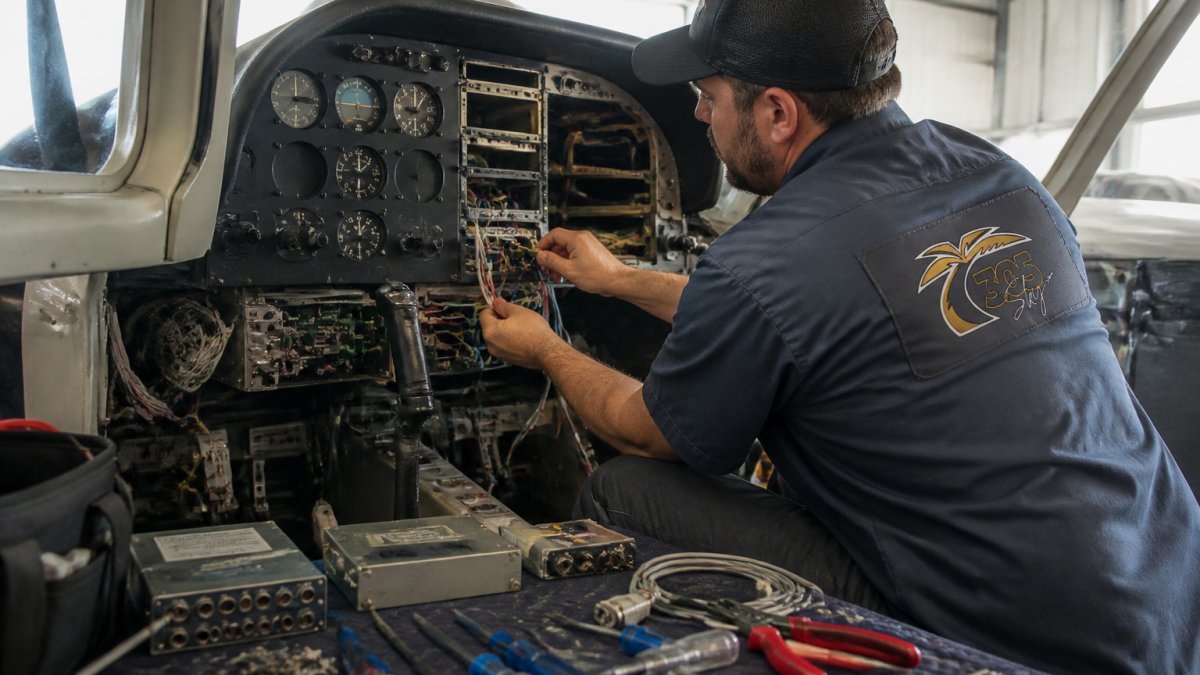
Labor costs depend on:
- Aircraft type: A Bombardier Challenger has different avionics architecture than a Pilatus PC-12 NGX. Different architectures require different installation approaches.
- System complexity: A standalone GPS is simpler than a fully integrated flight management system.
- Integration scope: How many systems need to communicate with each other? How much data routing and testing is required?
- Current panel condition: Is the existing wiring in good condition? Are there undocumented modifications?
- Technician experience: An experienced avionics technician works faster than a generalist.
System integration is the labor category most owners underestimate. Integration includes:
- Designing the wiring architecture for new systems
- Testing data flow between systems
- Troubleshooting communication failures
- Validating that new systems don't interfere with existing systems
- Documenting the final configuration
At 305 Sky, we have FAA-certificated A&P mechanics experienced in avionics installations across Bombardier Challenger, Cessna Citation, Beechcraft King Air, Learjet, Dassault Falcon, Hawker, Gulfstream, and Pilatus aircraft. We provide detailed estimates that separate parts, labor, and integration costs so you know exactly what you're paying for.
Next Steps: Request Your Quote
Budgeting for avionics installation requires detailed information about your aircraft, your current systems, and your upgrade goals. A vague request leads to a vague estimate. A detailed request leads to an accurate budget.
Gather your aircraft documents:
- Aircraft make, model, and year
- Current avionics inventory (list everything installed)
- Maintenance logs (to understand any previous modifications)
- Your upgrade goals (list every system you want to add or replace)
Contact 305 Sky for a detailed estimate. Call (305) 326-3498 or request a quote at our Fort Lauderdale, Boca Raton, or Vero Beach locations. We'll review your aircraft, discuss your mission requirements, and provide an itemized estimate that covers parts, labor, integration, and regulatory approval.
For more on aircraft maintenance planning and avionics systems, visit our /aircraft-management page or learn about /king-air-maintenance, /citation-maintenance, and /challenger-maintenance services.
Frequently Asked Questions
What factors affect the cost of an aircraft avionics installation?
Aircraft type, existing panel configuration, avionics equipment brand, wiring complexity, system integration requirements, and labor hours all drive costs. A Challenger 350 panel upgrade differs significantly from a Citation XLS+ installation. The scope of work, whether you're adding GPS and autopilot to aging systems or redesigning the entire panel, determines both parts and labor. Regulatory approvals and any structural modifications also factor in. Request an aircraft avionics installation estimate that breaks down each category so you understand what drives the total.
How much contingency should I plan for an avionics upgrade?
Set aside a contingency for your total budget. During installation, technicians may discover wiring issues, incompatibilities between new and legacy systems, or additional integration work not visible during the initial quote. This buffer protects you from project delays and cost surprises without padding the initial estimate artificially. Always ask your technician whether the quote includes a contingency allowance or if you should reserve funds separately.
Can I install avionics in stages to manage the budget?
Yes, staged installation is possible but requires careful planning. You might upgrade GPS and navigation first, then add autopilot and display systems later. However, each phase requires separate return-to-service documentation, testing, and potential downtime. Staged work can extend total project duration and may incur additional labor costs for separate system integration efforts. Discuss phasing options with your technician to understand cost trade-offs and ensure compatibility between stages.
How do I compare avionics installation quotes effectively?
Request detailed quotes from multiple shops that specify parts sourcing, labor hours, system integration scope, regulatory approvals, and return-to-service testing. Ensure each quote covers the same aircraft type and upgrade scope so comparisons are valid. Watch for quotes missing wiring work, panel redesign, or testing costs, these often appear later as change orders. Ask each shop about their timeline, warranty on labor, and who handles FAA documentation. An avionics installation quote comparison spreadsheet listing parts, labor, and total cost helps identify the best value.
Ready to upgrade your avionics? Call 305 Sky at (305) 326-3498 or request a detailed quote at our Fort Lauderdale (FLL), Boca Raton (BCT), or Vero Beach (VRB) locations. We'll walk you through the budgeting process and deliver a transparent, itemized estimate.