Table of Contents
- Why Bespoke Avionics Upgrades Matter for Your Aircraft
- Improved Flight Safety and Situational Awareness
- Enhanced Operational Efficiency and Fuel Savings
- Reducing Pilot Workload Through Modern Avionics
- NextGen Compliance and Regulatory Mandates
- Avionics Upgrade Cost Estimation and ROI
- Avionics Integration Timeline for Mid-Size Jets
- Aircraft Cockpit Modernization Benefits and Resale Value
- Frequently Asked Questions
Last Updated: September 3, 2026
Bespoke Avionics Upgrades: Benefits for Private Jet Owners
Private jet owners operating Challengers, Citations, King Airs, Learjets, Falcons, Hawks, Gulfstreams, Beechjets, and Pilatus aircraft face a critical decision: continue flying with aging glass cockpits and legacy navigation systems, or invest in bespoke avionics upgrades that transform operational capability. At 305 Sky, we've worked with aircraft owners across South Florida to modernize their flight decks, and the difference is immediate. Modern avionics don't just improve safety, they reshape how efficiently you operate, how quickly you respond to regulatory changes, and ultimately, what your aircraft is worth when you decide to sell. This guide covers the tangible benefits of bespoke avionics upgrades, the integration timeline you can expect, and why the decision to upgrade often pays for itself within a few years of ownership.
Why Bespoke Avionics Upgrades Matter for Your Aircraft
The gap between a 1990s-era steam gauge panel and a modern glass cockpit isn't incremental, it's fundamental. A bespoke avionics upgrade isn't a checkbox item on a maintenance spreadsheet. It's a structural improvement that changes how your aircraft performs, how your pilots work, and how your operation scales.
Legacy avionics require manual cross-checks, paper charts, and constant pilot workload just to maintain situational awareness. Modern systems integrate GPS navigation, terrain awareness and warning systems (TAWS), weather datalink, traffic advisory systems, and synthetic vision into a single coherent display. Your pilots see more, faster, with less cognitive load. That matters on a 2 AM emergency divert or a weather-challenged approach into a regional airport.
Regulators are tightening the screws too. The FAA's NextGen mandate requires ADS-B Out capability by specific deadlines for different aircraft classes. Many older aircraft also face pressure to upgrade to modern navigation standards that support Performance-Based Navigation (PBN). A bespoke upgrade handles these compliance requirements while simultaneously modernizing your flight deck for operational advantage.
The financial case is equally compelling. Aircraft with modern avionics suites command higher resale value, attract more qualified charter operators, and qualify for better insurance rates. A retrofit can add significant value to your aircraft's market value.
Improved Flight Safety and Situational Awareness
Modern glass cockpits deliver situational awareness that older aircraft simply cannot match. A bespoke avionics upgrade integrates multiple data streams, GPS position, terrain elevation, weather radar, traffic targets, wind data, into a unified display architecture that your pilots can trust.
Synthetic vision technology renders a three-dimensional representation of terrain and obstacles even in low-visibility conditions (faa.gov). Terrain awareness and warning systems (TAWS) alert your crew to terrain threats before they become emergencies. Traffic advisory systems show nearby aircraft with sufficient precision to support collision avoidance maneuvers. Weather datalink brings real-time radar and lightning data into the cockpit, replacing the guesswork of "what's that cell ahead?"
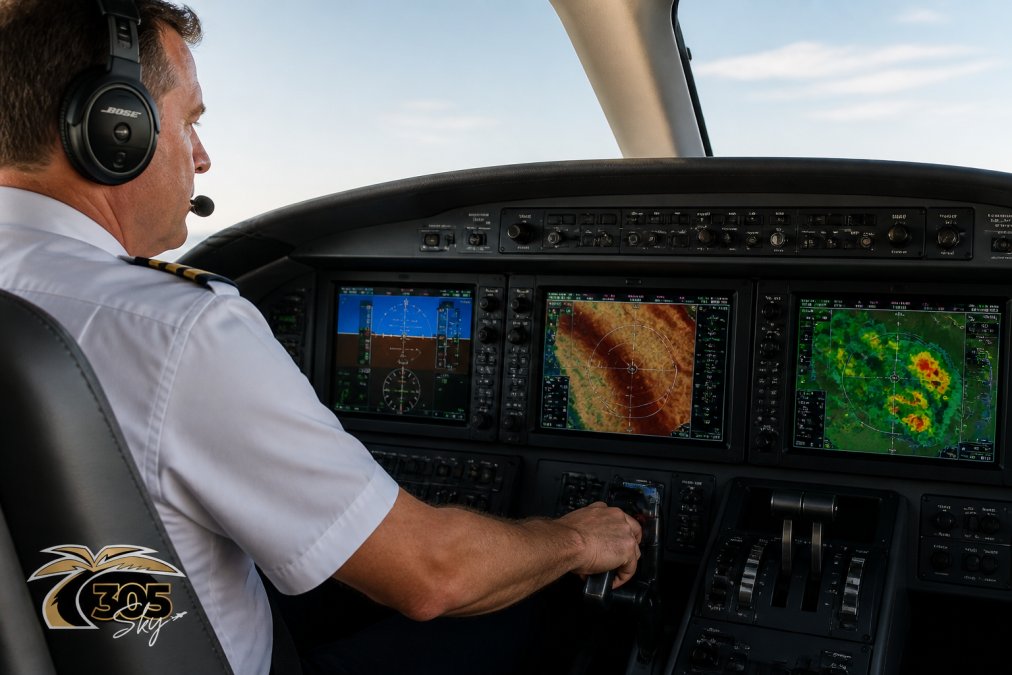
The practical effect is measurable: pilots make better decisions faster. A regional airport approach that would have required a go-around in a legacy aircraft becomes a stabilized descent in a modern cockpit. A weather cell that forces a 50-mile deviation on an old system becomes a 15-mile tactical maneuver on a glass cockpit. These aren't theoretical improvements, they're operational realities that show up in your dispatch reliability and your insurance loss history.
Bespoke upgrades also address the specific cockpit ergonomics of your aircraft. A Citation's avionics layout differs from a Challenger's; a King Air's panel geometry is entirely different from a Learjet's. Custom integration ensures that displays are positioned for optimal crew visibility, that controls are within natural reach, and that the flight deck logic matches your pilots' training and muscle memory. This attention to aircraft-specific detail separates a professional retrofit from a generic installation. As part of our comprehensive aircraft maintenance services, we ensure that every upgrade integrates seamlessly with your aircraft's existing systems and your operational workflow.
Enhanced Operational Efficiency and Fuel Savings
Modern avionics enable operational efficiency gains that compound over thousands of flight hours. GPS-based navigation allows your aircraft to fly more direct routes than older VOR-based systems. Performance-Based Navigation (PBN) procedures, supported by modern avionics, enable curved approaches and optimized descent profiles that reduce flight time and fuel burn.
Real-time wind data and weather routing tools help your flight planning teams identify optimal cruise altitudes and routing. A system that finds a 50-knot tailwind at FL350 instead at FL330 saves fuel on every leg. Autopilot integration with modern avionics reduces pilot workload on long flights, which improves crew fatigue management and reduces the likelihood of pilot error during critical phases.
Flight data logging, a standard feature in modern avionics suites, provides detailed records of every flight. This data supports fuel optimization analysis, maintenance interval planning, and crew performance evaluation. Over a year of operation, systematic analysis of flight data often reveals routing or altitude preferences that save meaningful fuel.
For charter operators and management companies, these efficiency gains translate directly to reduced operating costs and improved margins. A reduction in fuel burn across a fleet of aircraft compounds to significant annual savings. For private owners, the same efficiency translates to lower per-flight costs and longer useful range on each gallon of fuel.
Reducing Pilot Workload Through Modern Avionics
Pilot workload is a hidden killer in general aviation. Legacy steam gauge panels require constant cross-checks: is the heading indicator aligned with the compass? Is the altitude alert set? Are you tracking the correct VOR? Is the autopilot actually holding altitude? These vigilance tasks consume cognitive resources that should be allocated to navigation, weather evaluation, and threat management.
Modern glass cockpits eliminate most of these cross-check tasks (peer-reviewed research). A single integrated display shows your aircraft's position, altitude, heading, and track. Alerts are integrated and prioritized. The autopilot is transparent, you see what it's doing and why. Pilots transition from managing instruments to managing the flight.
This workload reduction matters most during high-stress phases: approaches in weather, emergency diversions, single-pilot operations, or long night flights. A bespoke avionics upgrade that reduces workload during these critical phases improves safety margins and crew fatigue management.
Training requirements do increase after an avionics upgrade. Your pilots need type-specific training on the new systems. However, modern avionics training is standardized and widely available. Most Citation, Challenger, and King Air pilots have already completed glass cockpit training on similar systems. The learning curve is shallow compared to the operational benefit.
NextGen Compliance and Regulatory Mandates
The FAA's NextGen mandate requires all aircraft operating in certain airspace to transmit ADS-B Out signals by specific compliance deadlines (faa.gov). Older aircraft without modern avionics cannot meet this requirement without a retrofit. For aircraft that operate in busy terminal areas or on cross-country flights, ADS-B compliance is no longer optional.
Beyond ADS-B, the FAA is gradually phasing out ground-based VOR navigation infrastructure. Aircraft that rely exclusively on VOR navigation will face increasing limitations on available routes and approaches. Modern GPS-based navigation, supported by bespoke avionics upgrades, future-proofs your aircraft against these regulatory transitions.
Performance-Based Navigation (PBN) procedures are becoming standard at major airports. These procedures, which require GPS navigation accuracy and integrity monitoring, enable more efficient routing and lower minimums on approaches. Aircraft equipped with modern avionics can fly these procedures; older aircraft cannot.
A bespoke avionics upgrade ensures that your aircraft remains compliant with current and foreseeable future regulations. The alternative, waiting until compliance deadlines force an emergency retrofit, creates scheduling pressure, higher costs, and potential operational disruptions. Our routine maintenance and aircraft inspections programs help identify regulatory compliance gaps early, so you can plan upgrades strategically rather than reactively.
Avionics Upgrade Cost Estimation and ROI
The cost of a bespoke avionics upgrade depends on your aircraft type, the current avionics configuration, and the scope of modernization you choose. A Challenger retrofit differs substantially from a King Air retrofit; a partial glass cockpit upgrade differs from a full panel replacement.
Rather than speculate on specific figures, the key insight is this: calculate your upgrade ROI based on three factors. First, the improvement in resale value. Modern avionics typically add to an aircraft's market value, depending on the aircraft type and the quality of the retrofit. Second, the reduction in operating costs through fuel efficiency and reduced maintenance intervals. Third, the improvement in charter revenue potential, if you operate the aircraft commercially.
For aircraft owners in South Florida operating Challengers, Citations, and King Airs on regular cross-country schedules, the ROI timeline is typically a few years when you factor in resale value appreciation and operational savings combined. For charter operators, the payback is often faster due to improved revenue potential and reduced operating costs.
A transparent approach to cost estimation is essential. At 305 Sky, we break down upgrade costs into components, avionics hardware, installation labor, testing and certification, training, so you understand where your investment is going. We also help you evaluate financing options and tax incentives that may apply to aircraft modernization.
Avionics Integration Timeline for Mid-Size Jets
The integration timeline for a bespoke avionics upgrade depends on the aircraft type, the complexity of the retrofit, and the availability of your aircraft for maintenance. A straightforward glass cockpit retrofit on a Citation or Challenger typically requires several weeks of shop time, depending on whether you're also upgrading the autopilot, the engine monitoring system, and the cabin management integration.
The timeline breaks down roughly like this: initial systems design and parts procurement takes a few weeks. Panel removal and wiring harness installation takes several weeks. System integration, testing, and software configuration takes another few weeks. FAA certification and final testing adds a few weeks. Throughout this process, your aircraft is out of service, so scheduling the upgrade during a planned maintenance interval or a slower operational period minimizes disruption.
For King Air and larger cabin-class aircraft, the timeline may stretch longer due to the complexity of the panel and the integration requirements for pressurization systems, engine management, and cabin pressurization integration.
The key variable is planning. Scheduling your upgrade well in advance, coordinating with your flight schedule, and working with an experienced shop that understands your aircraft type reduces surprises and keeps the timeline predictable. If you need your aircraft operational during the upgrade window, our AOG service can provide temporary solutions to keep your operation running.
Aircraft Cockpit Modernization Benefits and Resale Value
A modernized cockpit is one of the most visible improvements you can make to an aircraft. Potential buyers see it immediately. A glass cockpit signals that the aircraft has been well-maintained, that the owner invested in the aircraft's future, and that the aircraft is equipped for modern operations.
This visibility translates to resale value. Aircraft with modern avionics suites consistently command higher prices at resale than comparable aircraft with legacy systems. A Citation with a 20-year-old steam gauge panel and a Citation with a modern glass cockpit may have identical airframes, engines, and interiors, but the glass cockpit aircraft sells faster and for more money.
The resale value improvement typically ranges depending on the aircraft type, the quality of the retrofit, and the overall condition of the aircraft. For a Challenger, that's a significant difference at resale. For a King Air, it's also a substantial amount.
Beyond raw resale value, a modernized cockpit attracts charter operators and management companies as potential buyers. These operators prioritize aircraft equipped for modern operations, with integrated systems that reduce crew training requirements and operational risk. A bespoke avionics upgrade opens your aircraft to a broader buyer pool.
The resale value benefit also compounds with time. An aircraft with a modern avionics retrofit installed five years ago still has a modern cockpit today. An aircraft with legacy avionics from 2010 is falling further behind the market standard with each passing year. The longer you delay an upgrade, the more the resale value gap widens.
A bespoke avionics upgrade is one of the highest-return investments you can make in your aircraft. Modern glass cockpits improve safety, reduce pilot workload, enhance operational efficiency, and ensure regulatory compliance. For private jet owners operating Challengers, Citations, King Airs, and similar aircraft in South Florida, the decision to upgrade is increasingly a matter of when, not if.
305 Sky specializes in bespoke avionics retrofits tailored to your aircraft type and operational requirements. Our team has completed numerous glass cockpit upgrades on Challenger, Citation, and King Air platforms. We handle the full scope, systems design, installation, FAA certification, and crew training, so you can focus on operating your aircraft. Get a quote and let's discuss how a modern avionics suite can transform your flight deck.
=== FAQ ANSWERS (audit these too, same rules) ===
[1] Q: What is the difference between a standard avionics package and a bespoke upgrade? A: Standard packages offer pre-configured systems with limited customization, while bespoke avionics upgrades are tailored to your specific aircraft type, mission profile, and operational needs. Bespoke upgrades integrate seamlessly with your existing systems, optimize your glass cockpit layout, and include custom software configurations. This personalized approach ensures your avionics suite supports your exact flying requirements rather than forcing you into a one-size-fits-all solution.
[2] Q: How do bespoke avionics upgrades improve aircraft resale value? A: Modern avionics systems significantly increase buyer appeal and aircraft market value. A fully modernized glass cockpit with NextGen-compliant navigation, synthetic vision, and integrated weather datalink makes your aircraft more attractive to qualified buyers and justifies a premium asking price. Potential owners see reduced operating costs, enhanced safety features, and compliance certainty, all of which translate to stronger resale value and faster sale timelines.
[3] Q: Do bespoke avionics upgrades help with FAA NextGen compliance? A: Yes. NextGen mandates require ADS-B Out capability by 2025 and increasingly demand GPS-based navigation and advanced data logging. Bespoke upgrades integrate these regulatory requirements while future-proofing your aircraft against evolving mandates. A custom integration ensures your avionics suite meets current FAA requirements and is architected to accommodate future regulatory changes without costly rework.
[4] Q: How long does a custom avionics integration typically take for a mid-size jet? A: Integration timelines vary based on system complexity, aircraft type, and required certifications. A straightforward glass cockpit retrofit may take several weeks, while comprehensive integrations involving autopilot systems, terrain awareness, and traffic advisory systems typically require a longer duration. Planning ahead and working with experienced integrators minimizes downtime and ensures your aircraft returns to service without unnecessary delays.
Frequently Asked Questions
What is the difference between a standard avionics package and a bespoke upgrade?
Standard packages offer pre-configured systems with limited customization, while bespoke avionics upgrades are tailored to your specific aircraft type, mission profile, and operational needs. Bespoke upgrades integrate seamlessly with your existing systems, optimize your glass cockpit layout, and include custom software configurations. This personalized approach ensures your avionics suite supports your exact flying requirements rather than forcing you into a one-size-fits-all solution.
How do bespoke avionics upgrades improve aircraft resale value?
Modern avionics systems significantly increase buyer appeal and aircraft market value. A fully modernized glass cockpit with NextGen-compliant navigation, synthetic vision, and integrated weather datalink makes your aircraft more attractive to qualified buyers and justifies a premium asking price. Potential owners see reduced operating costs, enhanced safety features, and compliance certainty, all of which translate to stronger resale value and faster sale timelines.
Do bespoke avionics upgrades help with FAA NextGen compliance?
Yes. NextGen mandates require ADS-B Out capability by 2025 and increasingly demand GPS-based navigation and advanced data logging. Bespoke upgrades integrate these regulatory requirements while future-proofing your aircraft against evolving mandates. A custom integration ensures your avionics suite meets current FAA requirements and is architected to accommodate future regulatory changes without costly rework.
How long does a custom avionics integration typically take for a mid-size jet?
Integration timelines vary based on system complexity, aircraft type, and required certifications. A straightforward glass cockpit retrofit may take several weeks, while comprehensive integrations involving autopilot systems, terrain awareness, and traffic advisory systems typically require a longer duration. Planning ahead and working with experienced integrators minimizes downtime and ensures your aircraft returns to service without unnecessary delays.
This article was written using GrandRanker