Table of Contents
- Garmin G1000 NXi vs Aspen EFD1000 Pro: Quick Comparison Table
- Primary Flight Display Core Differences
- Retrofit Compatibility and Installation Complexity
- FAA Avionics Certification Standards for Both Systems
- Avionics Upgrade Downtime Expectations in South Florida
- Best Avionics Upgrades for Cessna 172 and Similar Aircraft
- Integration, Software Updates, and Long-Term Support
- Which Glass Cockpit Upgrade Should You Choose?
- Frequently Asked Questions
Last Updated: September 5, 2026
Choosing between the Garmin G1000 NXi and the Aspen EFD1000 Pro pits a complete, factory-integrated flight deck against a retrofit-friendly electronic flight instrument that slides into existing panel holes. At 305 Sky, we install both systems in South Florida, and the right choice depends on your airframe, your mission, and how much downtime you can absorb.
The G1000 NXi is a full avionics suite that replaces nearly everything on your panel, while the Aspen Evolution is a PFD upgrade that works alongside your existing radios and navigators. One is a ground-up rebuild; the other is a surgical enhancement. Both improve situational awareness over steam gauges, but they serve different aircraft and budgets.
Below, we break down the technical specifications, installation realities, and certification paths for each system so you can match the upgrade to your actual flying needs.
Garmin G1000 NXi vs Aspen EFD1000 Pro: Quick Comparison Table
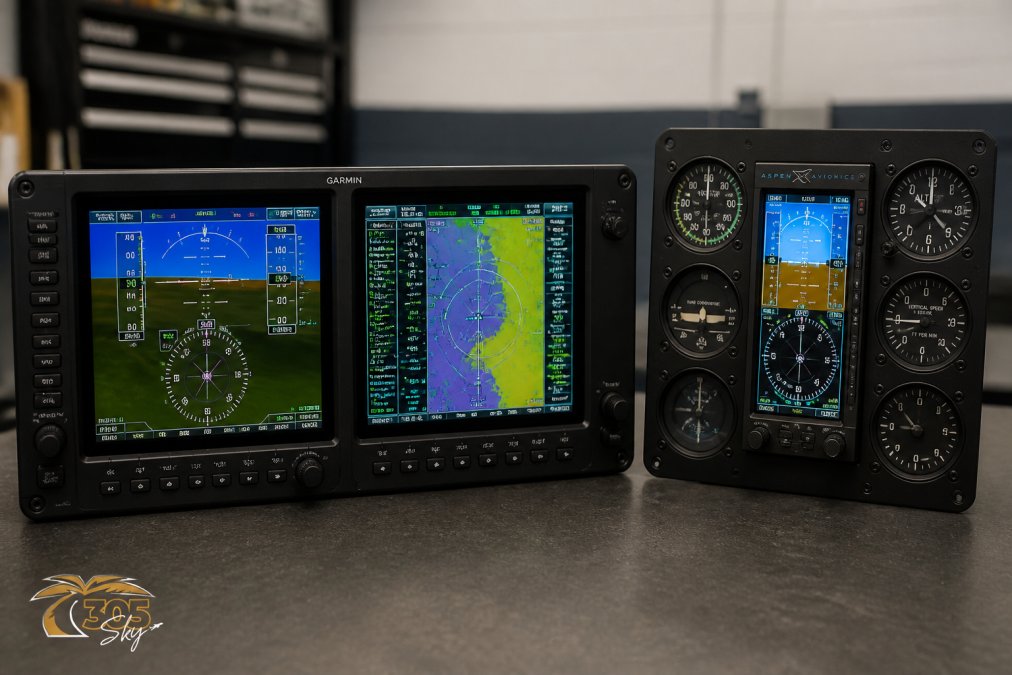
The most efficient way to frame this decision is to put the two systems side by side. The Garmin G1000 NXi is an integrated flight deck system designed for factory installation or complete panel retrofits, while the Aspen EFD1000 Pro is a standalone PFD engineered to replace a standard 3-1/8 inch attitude indicator.
| Specification | Garmin G1000 NXi | Aspen EFD1000 Pro MAX |
|---|---|---|
| System Type | Full integrated flight deck | Retrofit PFD |
| Display Size | Dual 10.6 inch displays | 3-1/8 inch standard case |
| Installation | Extensive panel rework | Fits existing instrument cutout |
| Backup Power | Standby battery system | Internal backup battery |
| Synthetic Vision | Included (optional) | Standard capability |
| Autopilot Integration | GFC 700 (integrated) | Works with existing autopilots |
| Best For | High-performance aircraft | Legacy GA aircraft |
Primary Flight Display Core Differences
The G1000 NXi wins on display real estate. Its dual 10.6 inch screens deliver weather, traffic, terrain, and engine monitoring simultaneously, which is impossible on a single Aspen display. The Aspen's 3-1/8 inch form factor gives you the critical flight instruments, not the full situational awareness picture.
Display Size, Resolution, and Readability
The G1000 NXi uses faster processors and LED-backlit displays that stay readable in direct sunlight, a meaningful advantage in Florida's glare-heavy cockpit (garmin.com). The Aspen EFD1000 Pro MAX also offers high-resolution displays, but presents a fraction of the information per glance. For a pilot transitioning from steam gauges, the Aspen's readability is a revelation; for a true glass cockpit experience, the G1000 NXi is the benchmark.
Synthetic Vision and Situational Awareness Tools
Both systems offer synthetic vision, but implement it differently. The Aspen Pro MAX renders terrain and obstacles on the PFD. The G1000 NXi goes further with an optional SVT package that integrates with the flight path vector, weather overlay, and traffic on a large-format display. The G1000 NXi also includes an integrated HSI and engine monitoring, which the Aspen requires a separate MFD1000 MAX to replicate.
Retrofit Compatibility and Installation Complexity
The Aspen EFD1000 Pro wins on installation complexity. It fits into the standard 3-1/8 inch instrument cutout where your old vacuum-driven attitude indicator sits, meaning minimal airframe modification and a faster path to certification. This appeals to owners who want glass instrumentation without a full panel tear-out.
The G1000 NXi demands a complete panel rework. It replaces the attitude indicator, airspeed indicator, altimeter, HSI, and often the audio panel and transponder, requiring new wiring, data buses, and structural modification. This is a project-based installation that can take weeks of skilled labor.
FAA Avionics Certification Standards for Both Systems
Both systems require FAA certification approval, but the path differs. The Aspen units typically install under an STC covering specific aircraft models, simplifying approval for common airframes (faa.gov). The G1000 NXi is often installed as original equipment or under a more complex STC requiring field approval or Form 337 for non-factory installations.
FAA guidance on major alterations and avionics certification requires that any change to your instruments be documented and approved before return to service. An avionics shop in Fort Lauderdale must hold the appropriate repair station certification and follow the approved data for your specific aircraft. This is where the experience of the installing shop matters as much as the equipment itself.
Avionics Upgrade Downtime Expectations in South Florida
Downtime expectations vary dramatically. An Aspen EFD1000 Pro installation can often be completed in a few days because the unit fits the existing instrument hole and interfaces with current navigation sources. The G1000 NXi installation typically requires the aircraft to be out of service for several weeks due to extensive panel modification and wiring.
In South Florida, where aircraft fly on tight schedules, this downtime difference is critical. Owners who rely on their aircraft for daily operations should weigh it carefully. A mobile maintenance team can reduce disruption, but the physical work on a G1000 NXi panel is unavoidable.
Best Avionics Upgrades for Cessna 172 and Similar Aircraft
For the Cessna 172 and similar legacy aircraft, the Aspen EFD1000 Pro is often the best upgrade. The aircraft's value rarely justifies a full G1000 NXi installation, which can exceed the airframe's resale value. The Aspen Evolution E5 offers an even more affordable path, replacing vacuum-driven gauges with dual-display capability and a built-in backup battery.
If you own a high-performance aircraft such as a Beechcraft Baron or Cessna 182 with a strong panel, a G1000 NXi retrofit can transform capability and resale value. The key is matching the upgrade to the airframe's ceiling. Installing a $150,000 avionics suite in a $80,000 airplane is poor economics.
Integration, Software Updates, and Long-Term Support
For owners of Challenger, Citation, King Air, Learjet, Falcon, Hawker, Gulfstream, Beechjet, and Pilatus aircraft, the decision hinges on how each system handles the maintenance lifecycle. The G1000 NXi is a closed, high-speed Ethernet-based ecosystem. Paired with Garmin's LRUs, it performs continuous self-tests and can flag a failing line-replaceable unit before it becomes a hard failure. This lets a flight department order the specific LRU and schedule the swap during a routine maintenance window rather than pulling the aircraft for an AOG event.
The Aspen EFD1000 Pro, by contrast, is an ARINC 429 and analog device at heart. It is designed to be the most reliable instrument in the panel, but does not broadcast internal health data to a central maintenance computer. Its strength is independence: because it does not rely on a proprietary data bus, it pairs with a legacy King or Collins autopilot and a third-party GPS navigator without requiring those units to be upgraded. This suits a Citation or King Air owner who wants to modernize the primary flight reference without a fleet-wide avionics harmonization project.
Software Update Cycles and Certification Pipelines
The software update cadence is where the systems diverge most sharply. The G1000 NXi operates on Garmin's certification pipeline: new software is bundled with a new part number and must be installed by an authorized facility that verifies the configuration against the aircraft's STC or type certificate data sheet. The update is fast, but requires coordination with a shop holding current Garmin dealer authorization. For a transient aircraft, this adds a layer of planning.
The Aspen EFD1000 Pro MAX uses a different model. Aspen releases updates that a pilot or technician loads via a USB drive in the cockpit, with the unit in a specific maintenance mode. The update is not wireless. More importantly, Aspen's upgrade path is hardware-centric: moving from the standard EFD1000 Pro to the Pro MAX often requires a physical exchange of the display unit or adding the MFD1000 MAX to unlock full synthetic vision and geo-referenced charts. The G1000 NXi's feature growth is primarily software-driven, while the Aspen's is primarily hardware-driven.
AOG and Repair Logistics in the Field
For AOG support, repairability is a deciding factor. The G1000 NXi's architecture means a display failure requires replacing a large, expensive LRU, and the aircraft is down until that part arrives. The Aspen EFD1000 Pro's 3-1/8 inch form factor is a logistical advantage: a replacement unit can be swapped in minutes if a spare is on the shelf. Most avionics shops supporting turbine aircraft stock an Aspen EFD1000 Pro or have one on loaner, because it covers so many airframes. The same cannot be said for a G1000 NXi display, which is airframe-specific in its bezel and mounting.
The Human Factors Gap: Transition Training
A rarely addressed topic is the pilot transition burden. The G1000 NXi is a full flight deck requiring formal difference training, especially for pilots coming from analog or early-generation glass panels. The menu logic, FMS integration, and reversionary modes require proficiency to be safe in IMC. The Aspen EFD1000 Pro, by design, mimics the scan pattern of a traditional six-pack, so a pilot can transition from steam gauges with minimal ground school. This is a major safety consideration for a flight department operating with contract pilots who may not fly the same aircraft daily. The G1000 NXi demands a higher baseline of systems knowledge; the Aspen demands almost none.
For a broker or management company upgrading a diverse fleet, this human factors difference affects the resale market. A Citation with a G1000 NXi appeals to a buyer wanting a modern, integrated flight deck. A King Air with an Aspen EFD1000 Pro appeals to a buyer wanting enhanced safety and reliability without the training burden of a full glass cockpit.
Which Glass Cockpit Upgrade Should You Choose?
The final decision often comes down to the operating environment. In South Florida, the aviation market is defined by three factors owners elsewhere rarely weigh as heavily: summer heat and humidity, dense airspace around Fort Lauderdale and Miami, and the proximity of the Atlantic hurricane zone.
The Florida Environment Factor
The G1000 NXi's LED-backlit displays are brighter and maintain contrast better in Florida's high-glare, high-humidity summer afternoons. The Aspen EFD1000 Pro MAX is readable, but its smaller screen means lower information density, which can reduce cognitive load in a busy terminal environment like Miami Bravo airspace. For a Pilatus or Citation owner flying in congested South Florida airspace, the G1000 NXi's larger situational awareness picture is a tangible safety benefit.
However, humidity cuts the other way for the G1000 NXi. A full panel rework in a high-humidity environment requires meticulous sealing and environmental conditioning of new wiring and connectors. A poorly executed installation can lead to intermittent connector corrosion that is difficult to diagnose. The Aspen EFD1000 Pro, fitting into the existing instrument hole with minimal new wiring, is less exposed to this risk. In a corrosive coastal environment, simpler is often more reliable.
The Downtime and Hurricane Season Calculus
Florida's hurricane season, June through November, creates a unique downtime calculus. If your aircraft is based in Fort Lauderdale or West Palm Beach, you need to move it out of a storm's path at short notice. A G1000 NXi installation taking weeks can leave your aircraft in pieces when a hurricane warning is issued. The Aspen installation, often completed in days, is far less likely to strand your aircraft. For a charter operator or management company with a fiduciary duty to protect the asset, this is not trivial.
The Verdict for South Florida Operators
Choose the Garmin G1000 NXi if you fly a high-performance turbine aircraft, operate primarily out of a climate-controlled hangar, and have a maintenance team comfortable managing a complex, integrated system. For a Challenger or Falcon operator, the investment is justified by the mission profile.
Choose the Aspen EFD1000 Pro if you fly a King Air, Beechjet, or legacy general aviation aircraft that sits on an open ramp or in a non-climate-controlled hangar. The simpler installation, lower corrosion exposure, and faster return-to-service are decisive in South Florida. The Aspen gives you the safety benefits of a glass PFD without turning your aircraft into a weeks-long project during hurricane season.
The G1000 NXi vs Aspen EFD1000 Pro decision is not about which system is better in the abstract, but which is better for your airframe, mission, and operating environment. An honest conversation with an avionics installer who works in the South Florida climate daily will help you avoid overcapitalizing an aircraft that will never recoup the investment, or under-equipping one that flies in the most demanding airspace on the East Coast.
Frequently Asked Questions
Is the Aspen EFD1000 Pro a suitable replacement for a legacy G1000 system?
No. The Aspen EFD1000 Pro is designed as a retrofit for legacy steam-gauge panels, fitting into standard 3-1/8 inch instrument cutouts. The G1000 NXi is a fully integrated flight deck that replaces the entire panel. You cannot swap a G1000 for an Aspen without removing the complete G1000 system and rewiring the aircraft, which is rarely cost-effective. The two systems target different starting points: Aspen upgrades older analog panels, while Garmin NXi upgrades existing G1000 installations or supports factory-installed integrated flight decks.
How much does it cost to upgrade from the G1000 to the G1000 NXi?
Upgrade costs vary significantly based on your existing G1000 configuration, the number of displays, and the required wiring changes. The G1000 NXi upgrade replaces the display units and some line-replaceable units, but installation labor and any additional hardware determine the final price. For an accurate estimate, an avionics shop must review your specific aircraft serial number and current equipment list. Contact 305 Sky with your aircraft details for a project-based quote tailored to your panel.
Can a G1000 NXi connect to ForeFlight?
Yes. The G1000 NXi supports wireless connectivity through Garmin's Flight Stream 510, which pairs with ForeFlight on iPads. This allows flight plan transfer, database updates, and traffic overlay on your tablet. The original G1000 requires a wired Flight Stream 210 or 510 installation and may need software updates to support full connectivity. The NXi's faster processor and built-in wireless capabilities make tablet integration simpler and more reliable than legacy G1000 systems.
Which system offers better integration with modern flight planning apps like ForeFlight?
The Garmin G1000 NXi offers superior integration with ForeFlight when paired with a Flight Stream 510 module. It enables two-way flight plan transfer, wireless database updates, and real-time weather and traffic display on your iPad. The Aspen EFD1000 Pro has more limited connectivity options and typically requires third-party interfaces for basic flight plan transfer. If tablet-based workflow and seamless app integration are priorities, the G1000 NXi is the stronger choice.
This article was written using GrandRanker